Izbat Al Bayyarah in Markaz Kom Ombo, Aswan Governorate, Egypt — مصر (Northeast Africa)
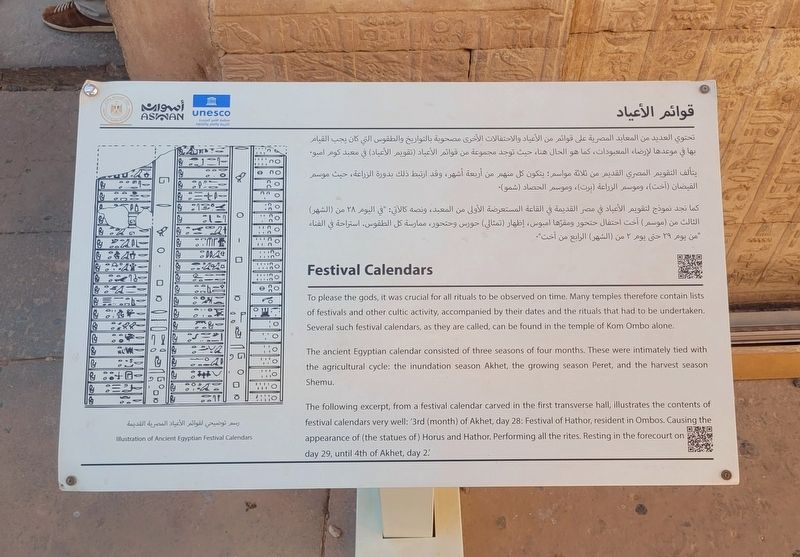
Festival Calendars
Photographed by James Hulse, October 12, 2024
1. Festival Calendars Marker
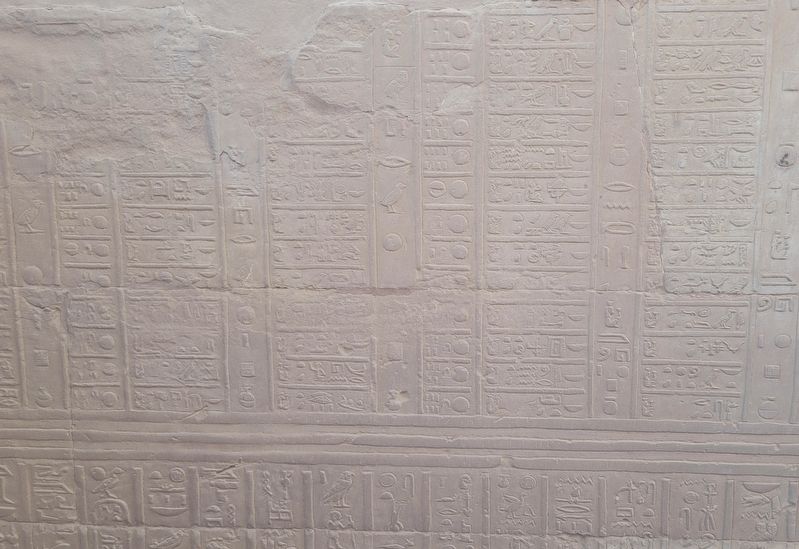
 To please the gods, it was crucial for all rituals to be observed on time. Many temples therefore contain lists of festivals and other cultic activity, accompanied by their dates and the rituals that had to be undertaken. Several such festival calendars, as they are called, can be found in the temple of Kom Ombo alone.
The ancient Egyptian calendar consisted of three seasons of four months. These were intimately tied with the agricultural cycle: the inundation season Akhet, the growing season Peret, and the harvest season Shemu.
The following excerpt, from a festival calendar carved in the first transverse hall, illustrates the contents of festival calendars very well: '3rd (month) of Akhet, day 28: Festival of Hathor, resident in Ombos. Causing the appearance of (the statues of) Horus and Hathor. Performing all the rites. Resting in the forecourt on day 29, until 4th of Akhet, day 2’.
Captions
(Photo #1) Illustration of Ancient Egyptian Festival Calendars
قوائم الأعياد
تحتوي العديد من المعابد المصرية على قوائم من الأعياد والاحتفالات الأخرى مصحوبة بالتواريخ والطقوس التي كان يجب القيام بها في موعدها لإرضاء المعبودات، كما هو الحال هنا، حيث توجد مجموعة من قوائم الأعياد (تقويم الأعياد في معبد كوم امبو.
يتألف التقويم المصري القديم من ثلاثة مواسم ؛ يتكون كل منهم من أربعة أشهر، وقد ارتبط ذلك بدورة الزراعة، حيث موسم الفيضان (آخت)، وموسم الزراعة (برت) ، وموسم الحصاد (شمو).
كما نجد نموذج لتقويم الأعياد في مصر القديمة في القاعة المستعرضة الأولى من المعبد، ونصه كالآتي: "في اليوم ۲۸ من (الشهر) الثالث من موسم ) آخت احتفال حتحور ومقرها امبوس، إظهار (تمثالي) حورس وحتحور ، ممارسة كل الطقوس. استراحة في الفناء من يوم ۲۹ حتى يوم ۲ من ( الشهر الرابع من اخت".
(1) رسم توضيحي لقوائم الأعياد المصرية القديمة
Erected by Ministry of Tourism & Antiquity, Aswan and unesco.
Topics. This historical marker is listed in these topic lists: Agriculture • Anthropology & Archaeology • Religion & Religious Structures.
Location. 24° 27.133′ N, 32° 55.711′ E. Marker is in Izbat Al Bayyarah, Aswan Governorate, in Markaz Kom Ombo. It is on Tariaq Bedon Esm. The marker is located on the grounds of the Kom Ombo Temple. Touch for map. Marker is in this post office area: Izbat Al Bayyarah, Aswan Governorate 12813-01, Egypt. Touch for directions.

Regionally, it is in Africa, specifically in North Africa, in the Middle East, on the Red Sea, and in a coastal Mediterranean country. Historically, it finds itself in what was once the Byzantine Empire, the Ottoman Empire, a British colony, and the Roman Empire.
Other nearby markers. At least 8 other markers are within walking distance of this marker: Inner Halls and Twin Sanctuaries (here, next to this marker); The Surgical Instruments Scene (a few steps from this marker); Inner Hypostyle Hall (a few steps from this marker); Chapel of the Hearing Ear (within shouting distance of this marker); a different marker also named The Surgical Instruments Scene (within shouting distance of this marker); Outer Hypostyle Hall (within shouting distance of this marker); The Temple of Ombos / Le temple d’Ombos (within shouting distance of this marker); The Open-Air Courtyard (within shouting distance of this marker). Touch for a list and map of all markers in Izbat Al Bayyarah.
Also see . . . Temple of Kom Ombo. Wikipedia
The building is unique because its 'double' design meant that there were courts, halls, sanctuaries and rooms duplicated for two sets of gods. The southern half of the temple was dedicated to the crocodile god Sobek, god of fertility and creator of the world with Hathor and Khonsu. Meanwhile, the northern part of the temple was dedicated to the falcon god Haroeris ("Horus the Elder"), along "with Tasenetnofret (the Good Sister, a special form of Hathor or Tefnut) and Panebtawy (Lord of the Two Lands)". The temple is atypical because everything is perfectly symmetrical along the main axis.(Submitted on November 24, 2025, by James Hulse of Medina, Texas.)
this page online
Photographed by James Hulse, October 12, 2024
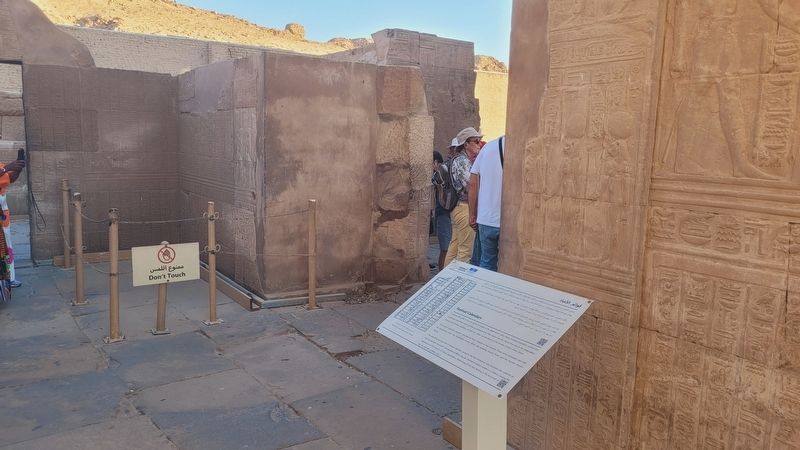
2. Festival Calendars Marker
Photographed by James Hulse, October 12, 2024
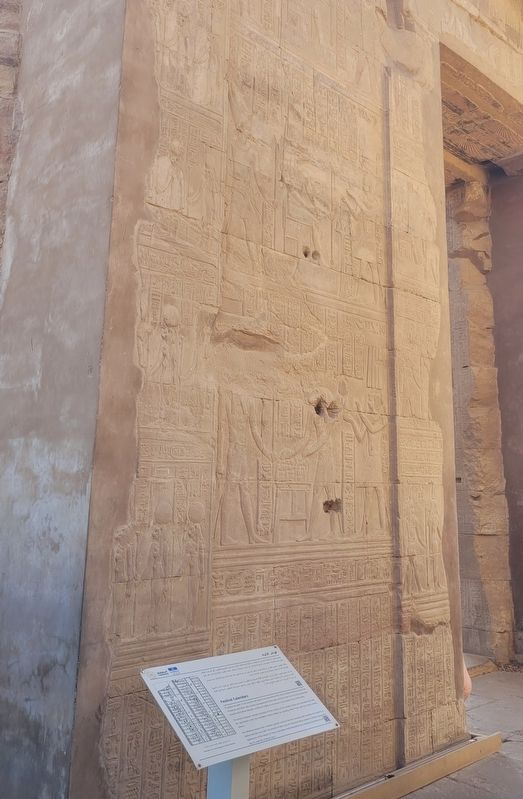
3. Festival Calendars Marker
Photographed by James Hulse, October 12, 2024
4. Relief of Festival Calendars
Credits. This page was last revised on November 29, 2025. It was originally submitted on November 21, 2025, by James Hulse of Medina, Texas. This page has been viewed 87 times since then and 51 times this year. Photos: 1, 2, 3, 4. submitted on November 29, 2025, by James Hulse of Medina, Texas.
