West Spokane in Spokane County, Washington — The American West (Northwest)
Whist-Alks Way

Photographed by Shirley A Stirling, August 30, 2025
1. Whist-Alks Way Marker
“Woman who walks in a dress”
Daughter of Chief Polotkin
Wife of Qualchan
A warrior woman in history
Strength
Leadership
Devotion
Erected 2022 by Esther Reed Chapter NSDAR.
Topics and series. This memorial is listed in these topic lists: Indigenous Peoples and Communities • Women. In addition, it is included in the Daughters of the American Revolution (DAR) series list. A significant historical year for this entry is 1925.
Location. 47° 40.518′ N, 117° 27.66′ W. Memorial is in Spokane, Washington, in Spokane County. It is in West Spokane. It is on West Whistalks Way east of Mitchell Drive, on the right when traveling east. The marker is located on the south end of the Spokane Falls Community College campus near The Lodge, a historic building that currently houses administrative offices. Touch for map. Memorial is at or near this postal address: 3305 W Whistalks Wy, Spokane WA 99224, United States of America. Touch for directions.

Regionally, this memorial is in the American Mountain West and in the Lewis & Clark Corridor. Globally, it is in North America, on the Pacific
this page online
Other nearby markers. At least 8 other markers are within one mile of this marker, measured as the crow flies: American Legion Cenotaph (approx. 0.9 miles away); a different marker also named American Legion Cenotaph (approx. 0.9 miles away); Llewellyn Marks "Louis" Davenport (approx. one mile away); Robert Edmund Strahorn Early Railroad Entrepreneur 1852-1944 (approx. one mile away); Amos Bradley (approx. one mile away); William Horatio Lewis (approx. 1.1 miles away); Walter Lawson (approx. 1.1 miles away); Home of Lt. Colonel Jack D. Holsclaw (approx. 1.1 miles away). Touch for a list and map of all markers in Spokane.
Another marker is no longer nearby. Col. George Wright (was a few steps from this marker but has been permanently removed).
More about this memorial. The marker replaces the 1925 marker about Col. George Wright who led U.S. troops in the Battle of Spokane Plains on September 5, 1858.
Regarding Whist-Alks Way. The following information was provided by the Esther Reed DAR Chapter:
Esther Reed Chapter dedicated an existing
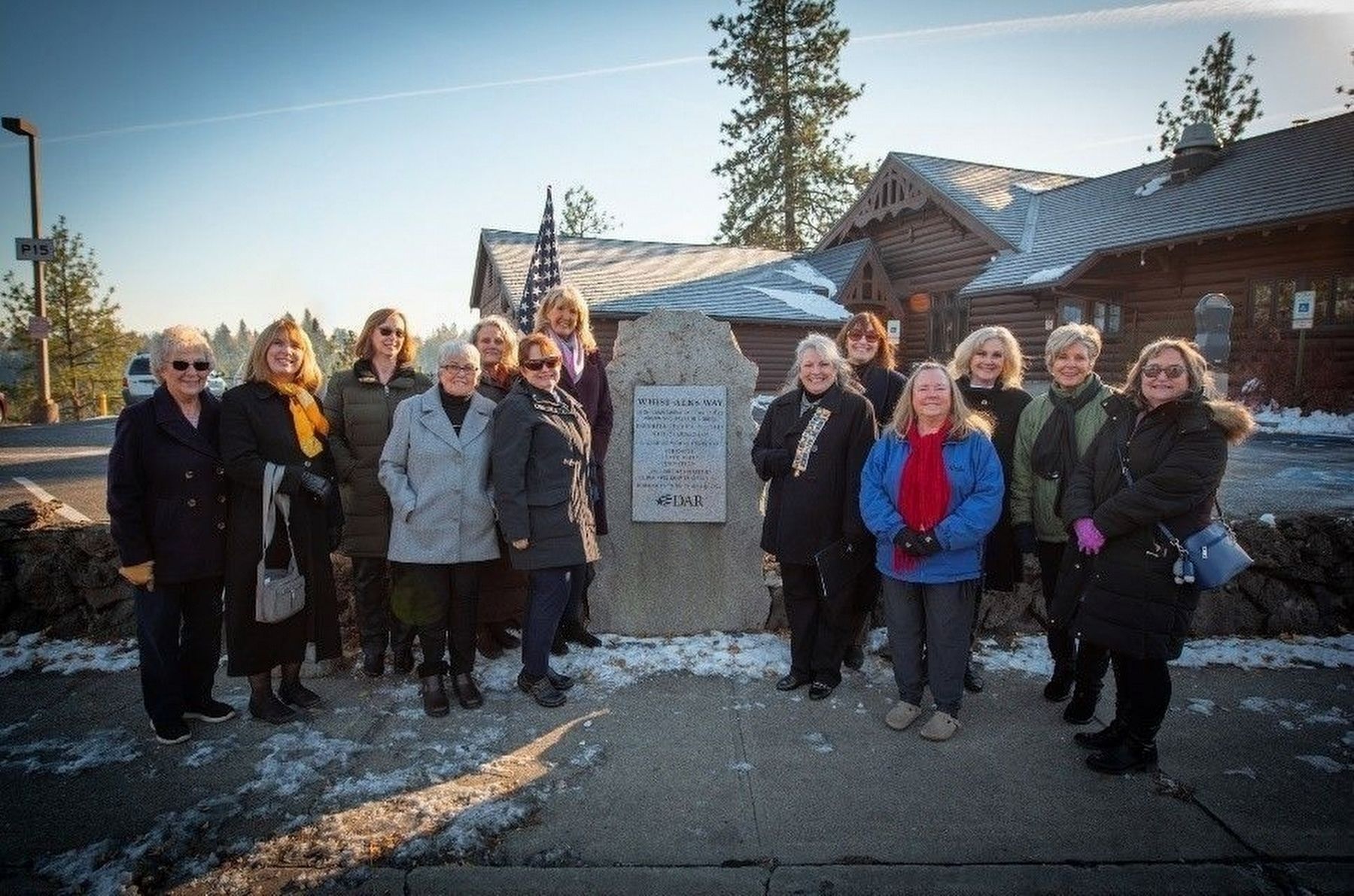
2. Whist-Alks Way marker dedication by the Esther Reed Chapter DAR dedication, Nov. 19, 2022.
woman, a member of the Spokane tribe and a warrior. The dedication ceremony was held on November 19th, 2022. It is located on Whistalks Way, formerly George Wright Drive, and is located along the Spokane Falls Community College campus. It was the decision of the Chapter membership to honor Whist-alks during November, the Native American Heritage month.
Background: In 1925, the chapter erected the monument at the site on which Col. George Wright commanding the 9th Infantry U.S. Army, pitched camp after winning the battle of the Spokane Plains. This would be the last fight with the Native Americans in this part of the Inland Empire. It was placed on what would become the grounds of Spokane Falls Community College, toward the back north cliff facing the Spokane river. Due to campus expansion, and with Esther Reed chapter consent, it was, in 1968, moved further from the original camp site and toward the southern edge of campus, approximately 2,000 feet, facing Fort George Wright Drive.
The inscription on the original bronze plaque read:
NEAR THIS SITE
SEPTEMBER 5, 1858
COL. GEORGE WRIGHT
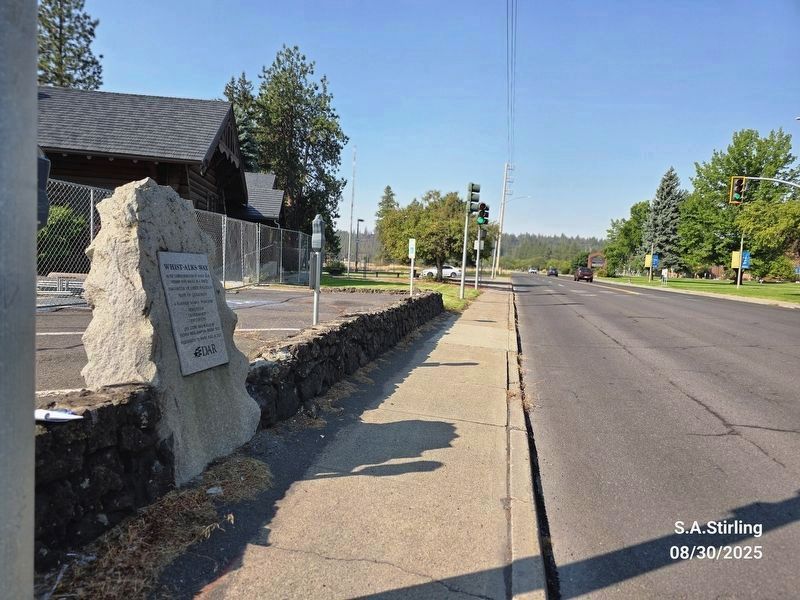
Photographed by Shirley A Stirling, August 30, 2025
3. Whist-Alks Way Marker at the sidewalk on the edge of SFCC campus, The Lodge.
BATTLE OF SPOKANE PLAINS, THE LAST FIGHT WITH INDIANS IN THIS PART OF THE INLAND EMPIRE
TABLET ERECTED BY ESTHER REED CHAPTER
DAUGHTERS OF THE AMERICAN REVOLUTION 1925
In 1998, due to the widening of the Fort George Wright drive to four lanes, it was then relocated across the street, approximately 60 feet to what is now the sidewalk in front of Building #9, the Lodge, formerly the Officers Club during WWI. The monument, its purpose, placement, and its inscription were no longer applicable to the original camp site.
Starting in the early 2000’s, there were articles written, publicity in newspapers, TV and radio with many opinions voiced, in addition to meetings held at the Spokane City council chambers; these all supported the need to remove the name George Wright from all signage and to rename the street in front of the Spokane Falls Community College campus. Wright’s aggressive and punitive campaign against the Spokane, Coeur d’Alene, Palouse, and other Northwest tribes during the 1850s, prompted the Spokane Tribal council to lead the effort to determine a new name

Photographed by Shirley A Stirling, August 30, 2025
4. Whist-Alks Way Marker.
The bronze plaque attached to the original granite monument was removed by the city in the Spring of 2020, without the chapter’s consent. This was due in part, to protest marches planned on Fort George Wright Drive led by local Native American activists. The plan by City officials was to detract attention from the historic lodge, known as Building #9 which is on the Spokane Register of Historic Places as part of Fort George Wright built in 1897 and 1906, respectively. The Spokane City Council approved the name change in December of 2020. The name chosen is in honor of Whist-alks, a member of the Spokane Tribe. And this honor is for all indigenous Native American women. Thus, the initial intent for the monument had been changed by moving it two times from the original campsite, and the street name was removed, and signage replaced. There was little that the Esther Reed chapter members could do, but go on a dramatic journey, that encouraged us to tell the rest of the story regarding the Battle of the Plains and honoring Spokane’s indigenous women, past and
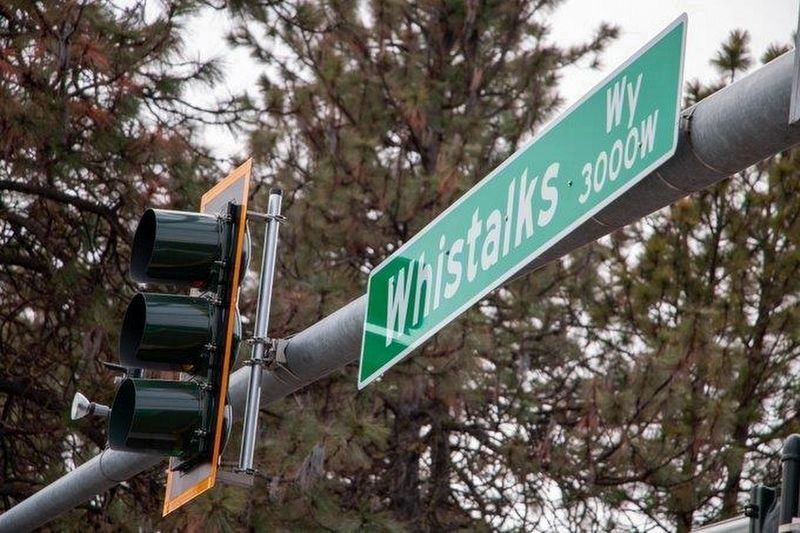
August 30, 2025
5. Whistalks Way street sign
Whist-alks was a woman and a warrior. What exactly does that imply? When researching articles on the indigenous female population in the Pacific Northwest, we found accounts of brave deeds, and stories told that were handed down through many generations by tribal leaders. Woman warriors were active participants preparing for battle alongside the men. They managed the medicine tents, gathered food, herbs and bandages, as well as stockpiling weapons ready for battle. They went into battle often to retrieve the wounded, returning them to their camps.
Whist-alks, which means “Woman Walks in a Dress,” was one such brave female warrior. Her name has rarely been brought to the forefront in books written in the 20th century, but because of the name change from George Wright Dr. to Whist-alks Way in June of 2021, her name and contributions to Northwest history have re-surfaced and have been the focus of many articles of late. She was a figure of defiance as shown in one of many frontier battle paintings by Dr. Nona Hengen. ( 2010 NSDAR Women in History Award, historical author, educator, and artist.
Whist-alks was the daughter of Chief Polotkin of the Yakama tribe and wife of Qualchan, a Yakima chieftan. It was Qualchan's tradition to have Whist-alks at his side with a medicine staff during battle. According to Col. Wright’s diary, Wright, and his cavalry summoned Qualchan to their encampment on September 24, 1858. With the pretense of talking peace, Qualchan was overrun, tied, and hung within 15 minutes.
In summary, Whist-alks proved her bravery by making her appearance in Col. Wright’s camp, holding a long lance covered with solid beadwork. “She was mounted on a fine horse and rode up in front of the Col’s tent and stuck the lance in the ground and rode off.” (Dandy Jim, “Warriors of the Mist” p. 329). Whist-alks later relocated to Flathead country, joining buffalo hunts east of the Rockies, where battles with the Blackfoot tribe were common. She lived her final years at the mouth of the Spokane river. And is considered a member of the Spokanes.
Esther Reed chapter planned for a new plaque in the spring of 2021 with the help of Tresko Monument Co. in Spokane, Washington. The original bronze plaque was requisitioned by the MAC (Museum of Arts and Culture) to find a place among the immense collection of Native American artifacts from the Northwest. A new granite slab was created honoring Whist-alks, who without question, exemplifies the dauntless courage that should be commemorated and known to all. As part of Esther Reed chapters plan, and due to the work of DAR Honorary State Regent Julie Pittmann, her name is now among the Women in American History and honored with the National Society's DAR award.
Also see . . . Spokane City Council renames Fort George Wright Drive as Whistalks Way on December 14, 2020. (Submitted on August 31, 2025.)
Additional keywords. WSSDAR
Credits. This page was last revised on November 24, 2025. It was originally submitted on August 31, 2025, by Shirley A Stirling of Lacey, Washington. This page has been viewed 158 times since then and 53 times this year. Last updated on November 24, 2025, by Shirley A Stirling of Lacey, Washington. Photos: 1. submitted on August 31, 2025, by Shirley A Stirling of Lacey, Washington. 2. submitted on October 5, 2025, by Shirley A Stirling of Lacey, Washington. 3, 4. submitted on August 31, 2025, by Shirley A Stirling of Lacey, Washington. 5. submitted on October 5, 2025, by Shirley A Stirling of Lacey, Washington. • Devry Becker Jones was the editor who published this page.
