
Sant Pere in Barcelona, Catalonia, Spain — Southwestern Europe (Iberian Peninsula)
Alborotos de Pan
⎯⎯⎯
Remboris de pa
⎯⎯⎯
Bread Riots
| — | Programes de Memòria | — |
Photographed by Andrew Ruppenstein, April 21, 2022
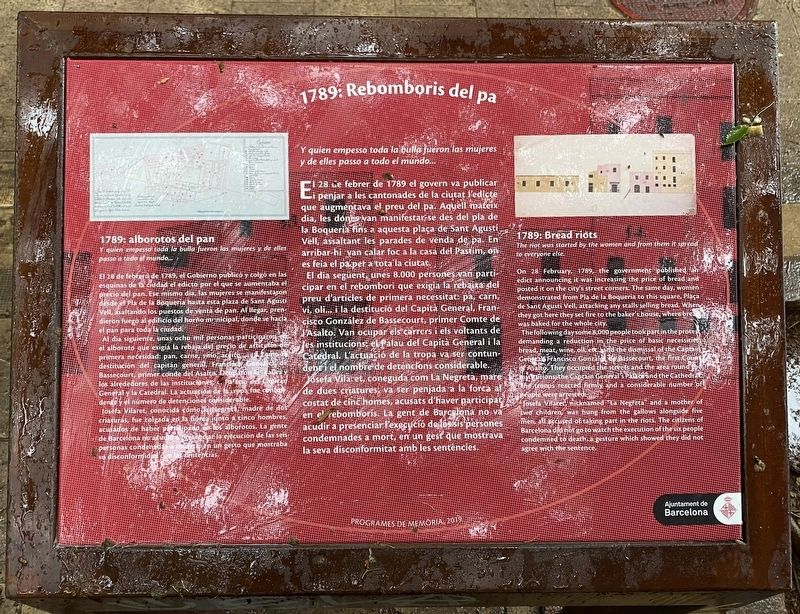
1. Alborotos de Pan / Remboris de pa / Bread Riots Marker

Y quien empresso todo la bulla fueron las mujeres y de elles passo a todo el mundo...
El 28 de febrero de 1789, el Gobierno publicó y colgó en las esquinas de la ciudad el edicto por el que se aumentaba el precio del pan. Ese mismo día, las mujeres se manifestaron desde el Pla de la Boqueria hasta esta plaza de Sant Agustí Vell, asaltando los puestos de venta de pan. Al llegar, prendieron fuego al edificio del horno municipal, donde se hacía el pan para toda la ciudad.
Al día siguiente, unas ocho mil personas participaron el alboroto que exigía la rebaja del precio de artículos de primera necesidad: pan, carne, vino, aceite...asi como la destitución del capitán general, Francisco Gonzalez des Bassecourt, primer conde del Asalto. Ocuparon las calles y los alrededores de las instituciones, Palacio del Capitan General y la Catedral. La actuación de la tropa fue contundente y el número de detenciones considerable.
Josefa Vilaret, conocida como la Negreta, madre de dos criaturas, fue colgada en la horca junto a cinco hombres, acusados de haber participado en los alborotos. La gente de Barcelona no acudió presenciar la ejecución de las seis personas condenadas a muerte en un gesto que mostraba su disconformidad con las sentencias.
Y quien empesso toda la bulla fueron las mujeres y de elles passo a todo el mundo...
El 28 de febrer de 1789 el govern va publicar penjar a les cantonades de la ciutat l'edicte que augmentava el preu del pa. Aquell mateix dia, les dones van manifestar-se des del pla de la Boqueria fins a aquesta plaça de Sant Agustí Vell, assaltant les parades de venda de pa. En arribar-hi van calar foc a la casa del Pastim, on es feia el paper a tota la ciutat.
El dia següent, unes 8.000 persones van participar en el rebombori que exigia la rebaixa del preu d'articles de primera necessitat: pa, carn, vi, oli... i la destitució del Capità General, Francisco González de Bassecourt, primer Comte de Asalto. Van ocupar els carrers i els voltants de les institucions: el Palau del Capità General i la Catedral. L'actuació de la tropa va ser contundenti el nombre de detencions considerable.
Josefa Vilaret, coneguda com La Negreta, mare de dues criatures, va ser penjada a la forca al costat de cinc homes, acusats d'haver participat en el rebomboris. La gent de Barcelona no va acudir a presenciar l'execució de les sis persones condemnades a mort, en un gest que mostrava la seva disconformitat amb les sentències.
The riot was started by the women and from them it spread to everyone else.
On 28 February, 1789, the government published an edict announcing it was increasing the price of bread and posted it on the city's street corners. The same day, women demonstrated from Pla de la Boqueria to this square, Placa de Sant Agustí Vell, attacking any stalls selling bread. When they got here they set fire to the baker's house, where bread was baked for the whole city.
The following day some 8,000 people took part in the protest demanding a reduction in the price of basic necessities bread, meat, wine, oil, etc., and the dismissal of the Captain General Francisco Gonzalez Bassecourt, the first Count of Asalto. They occupied the streets and the area around the institutions: the Captain General's Palace and the Cathedral. The troops reacted firmly and a considerable number of people were arrested.
Josefa Vilaret, nicknamed "La Negreta” and a mother of two children, was hung from the gallows alongside five men, all accused of taking part in the riots. The citizens of Barcelona did not go to watch the execution of the six people condemned to death, a gesture which showed they did not agree with the sentence.
Erected 2019
this page online
Topics and series. This historical marker is listed in these topic lists: Industry & Commerce • Notable Events • Women. In addition, it is included in the Barcelona Programes de Memòria series list. A significant historical date for this entry is February 28, 1789.
Location. 41° 23.269′ N, 2° 10.839′ E. Marker is in Barcelona, Cataluña (Catalonia). It is in Sant Pere. It is on Plaça de Sant Agustí Vell, on the right when traveling north. Touch for map. Marker is at or near this postal address: Plaça de Sant Agustí Vell 15, Barcelona, Cataluña 08003, Spain. Touch for directions.

Regionally, it is in the North Atlantic Region, in Europe, in the European Union, in Atlantic Europe, on the Iberian Peninsula, in the Schengen Area, in a coastal Mediterranean country, and in the Western World. Historically, it finds itself in what was once the Roman Empire.
Other nearby markers. At least 8 other markers are within walking distance of this marker: “The Great Gypsy Roundup” / Baró Istardipé (within shouting distance of this marker); Madrona Clarina y Colomer (within shouting distance of this marker); Monestir de Sant Pere de les Puelles
Photographed by Andrew Ruppenstein, April 21, 2022
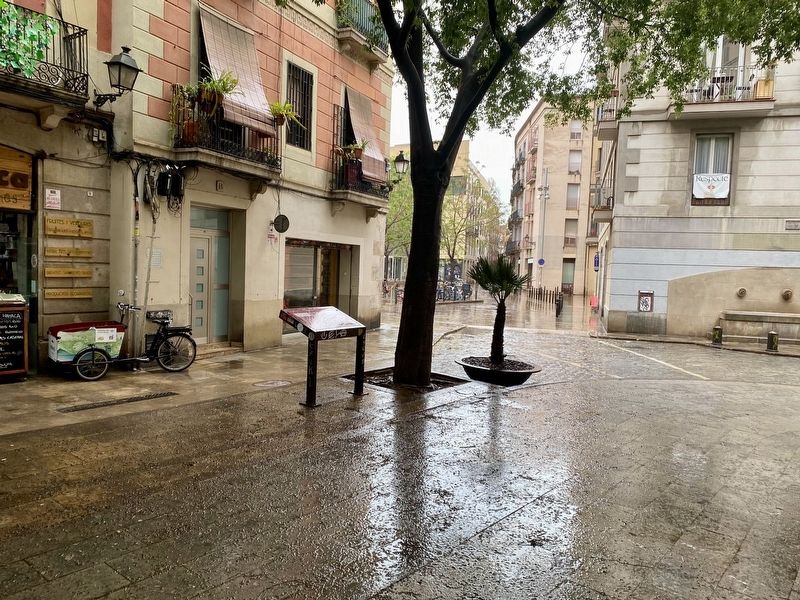
2. Alborotos de Pan / Remboris de pa / Bread Riots Marker - wide view
Also see . . . Josepa Vilaret (Wikipedia, in Catalan). Background on the riots (in translation):
Between August 1788 and February 1789, the price of bread in Barcelona rose by around 50%. This was due to various factors: poor harvests, the privatization of the municipal Pastim (the city's central bakery) and speculation by producers. The prices of other basic consumer goods, such as meat, wine and oil, also soared. At the time, popular protests were frequent - such as the riots in the quintas of 1773 or the French Revolution of 1789 - and these often arose spontaneously. The lower classes were the most affected by these increases and women were the ones who experienced it firsthand, since they were responsible for buying food for the family. Thus, the residents of Barcelona were responsible for lighting the wick, inciting the people to rebellion.(Submitted on November 25, 2025.)
On the first day, Saturday 28 February, 6 people were arrested, including Vilaret. On Sunday 1 March, the citizens increased the pressure on the city government and demanded the release of the prisoners. The bells of the Cathedral even rang out to the tune of sometent. On Monday 2 March, the captain-general, the Count of the Assault, accepted the price reduction and the uproar ended. Days later, Madrid deposed the captain-general and his replacement, the Count of Lacy, undid all the agreements and began a period of repression. As an exemplary measure, Lacy ordered the execution of the 6 rebels. A scaffold was set up near where Plaça de Catalunya is now located, and the public execution of the rioters was decreed on May 28. However, the public refused to attend, in protest.
Credits. This page was last revised on November 25, 2025. It was originally submitted on November 24, 2025, by Andrew Ruppenstein of Lamorinda, California. This page has been viewed 46 times since then and 23 times this year. Photos: 1, 2. submitted on November 24, 2025, by Andrew Ruppenstein of Lamorinda, California.
