Yorktown in York County, Virginia — The American South (Mid-Atlantic)
Converging on Yorktown
Photographed by Brandon D Cross
1. Converging on Yorktown Marker
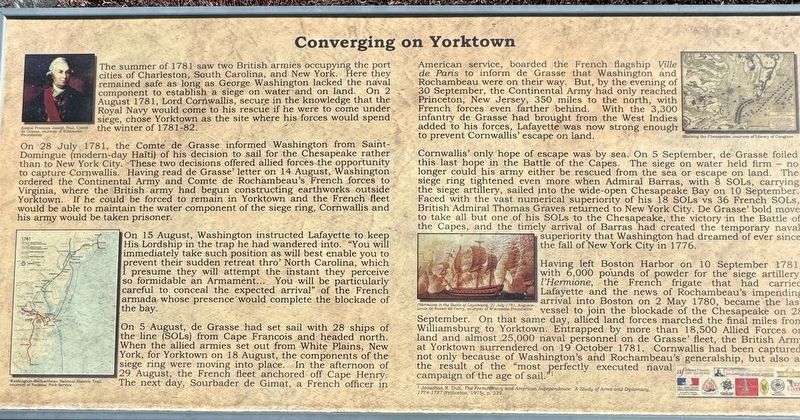
The summer of 1781 saw two British armies occupying the port cities of Charleston, South Carolina, and New York. Here they remained safe as long as George Washington lacked the naval component to establish a siege on water and on land. On 2 August 1781, Lord Cornwallis, secure in the knowledge that the Royal Navy would come to his rescue if he were to come under siege, chose Yorktown as the site where his forces would spend the winter of 1781-82.
On 28 July 1781, the Comte de Grasse informed Washington from Saint-Domingue (modern-day Haiti) of his decision to sail for the Chesapeake rather than to New York City. These two decisions offered allied forces the opportunity to capture Cornwallis. Having read de Grasse' letter on 14 August, Washington ordered the Continental Army and Comte de Rochambeau's French forces to Virginia, where the British army had begun constructing earthworks outside Yorktown. If he could be forced to remain in Yorktown and the French fleet would be able to maintain the water component of the siege ring, Cornwallis and his army would be taken prisoner.
On 15 August, Washington instructed
this page online
On 5 August, de Grasse had set sail with 28 ships of the line (SOLs) from Cape Francois and headed north. When the allied armies set out from White Plains, New York, for Yorktown on 18 August, the components of the siege ring were moving into place. In the afternoon of 29 August, the French fleet anchored off Cape Henry. The next day, Sourbader de Gimat, a French officer in American service, boarded the French flagship Ville de Paris to inform de Grasse that Washington and Rochambeau were on their way. But, by the evening of 30 September, the Continental Army had only reached Princeton, New Jersey, 350 miles to the north, with French forces even farther behind. With the 3,300 infantry de Grasse had brought from the West
Photographed by Brandon D Cross
2. Converging on Yorktown Marker
Cornwallis' only hope of escape was by sea. On 5 September, de Grasse foiled this last hope in the Battle of the Capes. The siege on water held firm - no longer could his army either be rescued from the sea or escape on land. The siege ring tightened even more when Admiral Barras, with 8 SOLs, carrying the siege artillery, sailed into the wide-open Chesapeake Bay on 10 September. Faced with the vast numerical superiority of his 18 SOLs vs 36 French SOLs, British Admiral Thomas Graves returned to New York City. De Grasse' bold move to take all but one of his SOLs to the Chesapeake, the victory in the Battle of the Capes, and the timely arrival of Barras had created the temporary naval superiority that Washington had dreamed of ever since the fall of New York City in 1776.
Having left Boston Harbor on 10 September 1781, with 6,000 pounds of powder for the siege artillery, L'Hermione, the French frigate that had carried Lafayette and the news of Rochambeau's impending arrival into Boston on 2 May 1780, became the last vessel to join the blockade of the Chesapeake on 28 September. On that same day, allied land forces marched the final miles from Williamsburg to Yorktown. Entrapped by more than 18,500 Allied Forces on land and almost 25,000 naval personnel on de Grasse’s fleet, the British Army at Yorktown surrendered on October 19, 1781. Cornawallis had been captured not only because of Washington's and Rochambeau's generalship, but also as the result of the "most perfectly executed naval campaign of the age of sail.” ”
(captions)
Admiral Francois Joseph Paul, Comte de Grasse, courtesy of Wikimedia Foundation
Washington-Rochambeau National Historic Trail, courtesy of National Park Service
Blocking the Chesapeake, courtesy of Library of Congress
I’Hermione in the Battle of Louisbourg, 21 July 1781, Augusta Louis de Rossellini de Cercy, courtesy of Wikimedia Foundation
Erected by York County.
Topics. This historical marker is listed in these topic lists: War, US Revolutionary • Waterways & Vessels. A significant historical date for this entry is October 19, 1781.
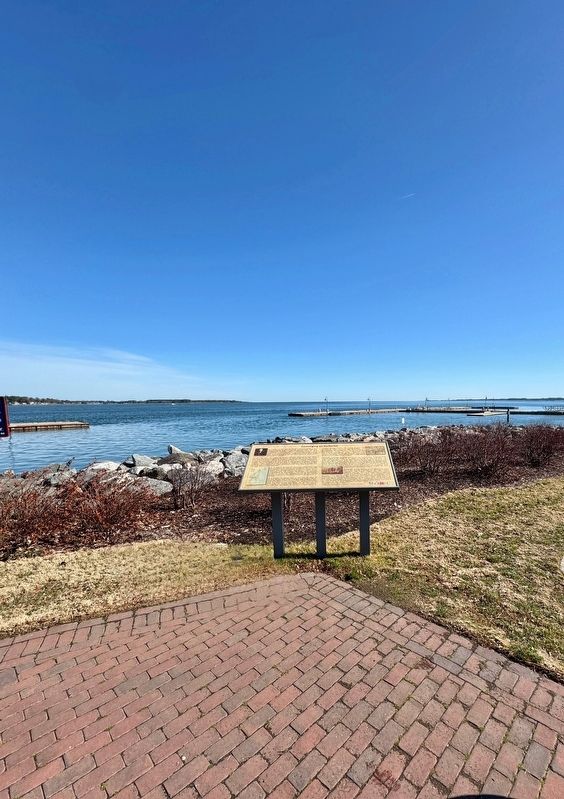
Location. 37° 14.333′ N, 76° 30.49′ W. Marker is in Yorktown, Virginia, in York County. It can be reached from Water Street west of Buckner Street, on the right when traveling west. The marker is located along Yorktown’s Riverwalk. Touch for map. Marker is at or near this postal address: 323 Water Street, Yorktown VA 23690, United States of America. Touch for directions.

Regionally, this marker is on Virginia’s Peninsula, in Coastal Virginia, and in the Hampton Roads Metropolitan Area. It is also in the American South, specifically in the Upper South, in the Tidewater, and on the Eastern Seaboard. Globally, it is in the North Atlantic Region, North America, the Western Hemisphere, the Western World, and the Anglosphere. Historically, it finds itself in what was once the territory of the Mississippian Culture, one of the original Thirteen Colonies, one of the Confederate States of America, and the Antebellum South.
Other nearby markers. At least 8 other markers are within walking distance of this marker: Heavy Artillery at Yorktown (here, next to this marker); Wars & Yorktown (here, next to this marker); Lafayette’s Tour (here, next to this marker); Replica Cannon (a few steps from this marker); Admiral de Grasse, the French Navy and American Independence (a few steps from this marker); The Olympic Flame (within shouting distance of this marker); The Historic Freight Shed (within shouting distance of this marker); N.S. Savannah (within shouting distance of this marker). Touch for a list and map of all markers in Yorktown.
Also see . . . Comte de Grasse. (Submitted on February 7, 2025, by Brandon D Cross of Flagler Beach, Florida.)
Credits. This page was last revised on December 11, 2025. It was originally submitted on February 7, 2025, by Brandon D Cross of Flagler Beach, Florida. This page has been viewed 188 times since then and 42 times this year. Last updated on November 29, 2025, by Thierry Chaunu of New York, New York. Photos: 1, 2. submitted on February 7, 2025, by Brandon D Cross of Flagler Beach, Florida. • Devry Becker Jones was the editor who published this page.
