Arvada in Jefferson County, Colorado — The American Mountains (Southwest)
Ralston's Gold Discovery

Photographed by Cosmos Mariner, August 14, 2022
1. Ralston's Gold Discovery Marker
Lewis Ralston made the first documented gold find in Colorado here on June 22, 1850. Although he stayed only a day and recovered little in the way of gold dust, his discovery paved the way for one of the largest migrations in the history of the American West.
No photographs of Lewis Ralston or his party of explorers is known to exist. But they might have looked similar to these goldseekers as they panned local creekbeds and built “long toms”, or sluiceboxes, to separate gold particles from the sand and gravel.
Lewis Ralston
Lewis Ralston was no stranger to gold mining when he arrived here in 1850. He had moved from South Carolina to Georgia and married Elizabeth Kell, the granddaughter of Cherokee Chief Benge. Gold was discovered near his land in 1828, and a boom town was born there. It was named Auraria — a Cherokee word meaning “gold mine.”
Ralston, a Scotsman, had rights not given the Cherokees. He successfully defended a government challenge to his land ownership, and his family was not part of the 1838 exodus known as the “Trail of Tears.” Hearing of the 1848 gold strike at Sutter's Mill in California, he joined
this page online
On April 20, 1850, leaving from Salina, in the new Cherokee Nation, the wagon train started west. It included 20 wagons, 105 men, 15 slaves and 12 women. The party followed the north bank of the Arkansas River into Kansas Territory, which extended into what would become Colorado. They turned north at tiny Ft. Pueblo, followed Fountain Creek north to Cherry Creek near its confluence with the South Platte River, which was flooding at the time. Crossing here was impossible so they detoured east and, with difficulty, forded the Platte at the mouth of Clear Creek. After this arduous crossing, they rolled west along Clear Creek, finally resting where it was joined by an unnamed mountain stream. Here, on June 22, 1850, Lewis Ralston found gold. John Lowery Brown, a member of the party, kept a daily journal of the expedition, and recorded the events: “We called this Ralstons Creek because a man of that name found Gold here.”
After panning for gold

Photographed by Cosmos Mariner, August 14, 2022
2. Ralston's Gold Discovery Marker
The marker is on the north side of this interpretive kiosk in Gold Strike Park.
Green Russell
The men and women of the 1850 expedition did not attain fame or fortune. Most, including Lewis Ralston, returned home within the year. The route of their wagon train was used by other gold seekers and became known as the Cherokee Trail.
Early in 1858, a group of 19 Georgians decided to try again. They were led by William Greeneberry “Green” Russell, and Lewis Ralston was their guide. Again they stopped in the Cherokee Nation to recruit members, bringing the total number to 104 men. On June 25 of that year, they reached Ralston's Creek. They explored a wide area, but by July 4 most of the discouraged men turned toward home. Only 13 men, including Russell, continued their quest for gold. A few days later, they found a large pocket of gold in a tributary of the South Platte River called Little Dry Creek (in present-day Englewood).
While Green Russell headed home to recruit new members, the remaining men moved to the confluence of Cherry Creek and the South Platte River, where they built a big double cabin. There, the party assembled
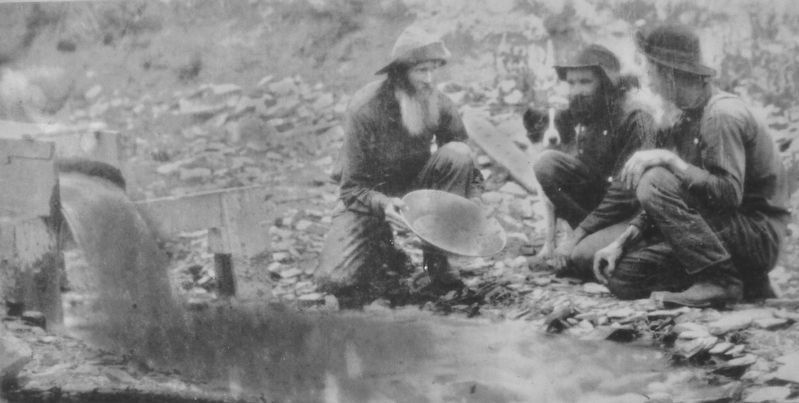
Denver Public Library Western History Department
3. Marker detail: Gold Panning
Throngs of eager gold prospectors rushed to the banks of Ralston and Clear Creeks, but the large strikes were in the mountains, at Idaho Springs, Central City and Black Hawk. Some of the prospectors on Ralston Creek stayed to develop farms and ranches. On December 1, 1870, twenty years after Ralston scooped his first pan of gold-bearing gravel from this site, Benjamin Franklin Wadsworth founded the town of Arvada.
This project was made possible by the City of Arvada Parks, Golf & Hospitality Services Department. Credits: FIRST GOLD, Lois C. Lindstrom, Arvada Heritage Printers; The Brawn Diary, John Lowery Brown, Gilcrease Museum, Tulsa, Oklahoma.
Topics. This historical marker is listed in these topic lists: Exploration • Indigenous Peoples and Communities • Settlements & Settlers • Waterways & Vessels. A significant historical date for this entry is June 22, 1850.
Location. 39° 47.881′ N, 105° 3.392′ W.
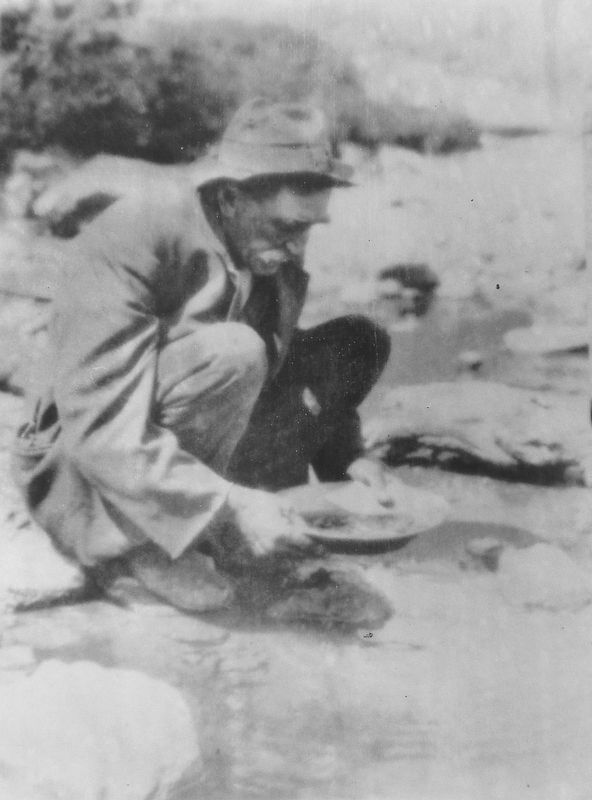
Denver Public Library Western History Department
4. Marker detail: Gold Panning

Regionally, this marker is in the Front Range. It is also in the American Mountain West. Globally, it is in North America, the Rocky Mountains, the Western Hemisphere, the Western World, and the Anglosphere. Historically, it finds itself in what was once the Louisiana Purchase.
Other nearby markers. At least 8 other markers are within 2 miles of this marker, measured as the crow flies: Gold Fever (here, next to this marker); The Cherokee Trail (here, next to this marker); Placer Mining (here, next to this marker); Gold Was Discovered (approx. ¾ mile away); McIlvoy House (approx. 1.2 miles away); Arvada's Trolleys (approx. 1.2 miles away); Arvada's First Park (approx. 1.2 miles away); Roads and Trains (approx. 1.2 miles away). Touch for a list and map
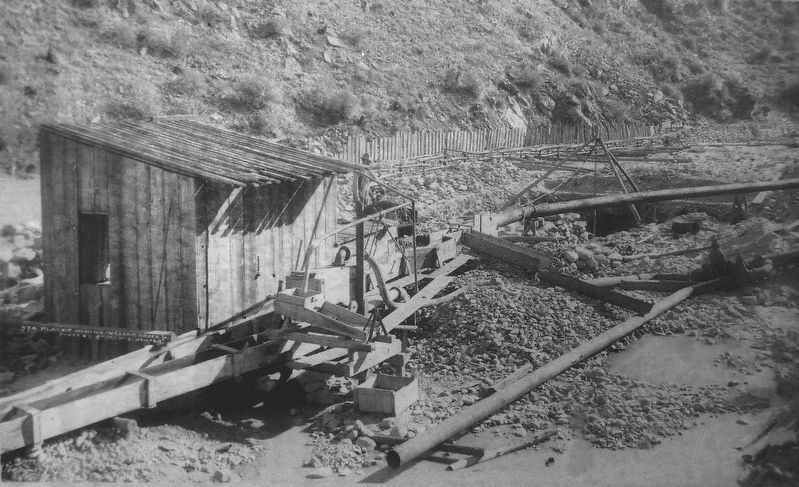
Denver Public Library Western History Department
5. Marker detail: Placer Mining Equipment
Related markers. Click here for a list of markers that are related to this marker.
Also see . . .
1. Lewis Ralston (Wikipedia).
Excerpt: In the spring of 1850, Ralston joined a wagon train of predominately Cherokee gold prospectors led by John Beck headed to the California gold fields. The party followed the Trail of Tears west, and on June 22, 1850, they crossed the South Platte River (a few miles north of what is today Denver) and camped near the confluence of two streams. Ralston panned for gold near the mouth of the smaller stream (in what is today Arvada.) He found about ¼ troy ounce of gold, then worth about five dollars (about $550 USD today.) While Ralston was elated, the rest of the party was unimpressed and continued on to California the next morning. Ralston continued panning for gold but gave up after a few days and caught up with his party. Ralston had little success in California and soon returned to his family in Georgia where he settled near Dahlonega.(Submitted on November 29, 2025, by Cosmos Mariner of Cape Canaveral, Florida.)
In 1858, John Beck and William Greeneberry “Green” Russell persuaded Ralston and some others from the original 1850Cherokee California party to journey back to the site of Ralston's discovery of placer gold in the Pikes Peak Country. On June 24, the party arrived at the site of Ralston’s 1850 discovery, then a part of the Kansas Territory. After five days of futile prospecting, Beck, Ralston, and 45 other men returned to Georgia leaving Green Russell and about a dozen men along the South Platte River.Denver Public Library Western History Department6. Marker detail: “Green” Russell
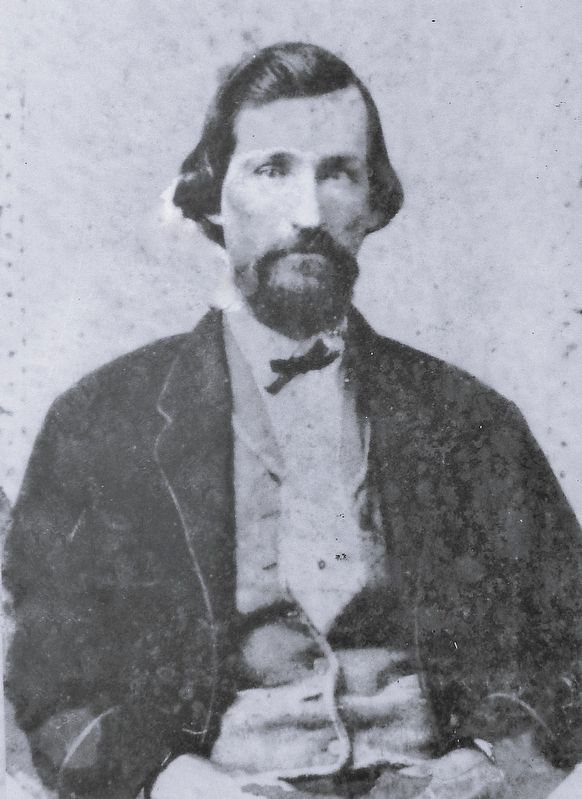
2. William Greeneberry "Green" Russell (Wikipedia).
Excerpt: Through his Cherokee connections Russell heard about an 1849 discovery of gold along the South Platte River at the foot of the Rocky Mountains. He organized a party to prospect along the South Platte River, setting off with his two brothers and six companions in February 1858. They rendezvoused with Cherokee tribe members along the Arkansas River in present-day Oklahoma and continued westward along the Santa Fe Trail. Others joined the party along the way until their number reached 107.(Submitted on November 29, 2025, by Cosmos Mariner of Cape Canaveral, Florida.)
Upon reaching Bent's Fort, they turned to the northwest, reaching the confluence of Cherry Creek and the South Platte on June 23. The site of their initial explorations is in present-day Confluence Park in Denver. They began prospecting in the river beds, exploring Cherry Creek and nearby Ralston Creek but without success. After twenty days, several decided to return home, leaving the Russell brothers and ten other men behind. In the first week of July 1858, Green Russell and Sam Bates found a small placer deposit near the mouth of Little Dry Creek that yielded about 20 troy ounces (620 g) of gold, then worth about 380 dollars (about $44,000 USD today), the first significant gold discovery in the Rocky Mountain region.
In early 1859, Russell was drawn to the mountains by the discovery of gold in nearby Gregory Gulch. He discovered placer gold deposits in June 1859 in the valley that was soon named Russell Gulch in his honor. By the end of September, 891 men were mining gold in the gulch, and the eponymous town was built near the head of the gulch to serve the miners.
Credits. This page was last revised on November 29, 2025. It was originally submitted on November 29, 2025, by Cosmos Mariner of Cape Canaveral, Florida. This page has been viewed 156 times since then and 112 times this year. Photos: 1, 2, 3, 4, 5, 6. submitted on November 29, 2025, by Cosmos Mariner of Cape Canaveral, Florida.
