Bellefontaine Neighbors in St. Louis County, Missouri — The American Midwest (Upper Plains)
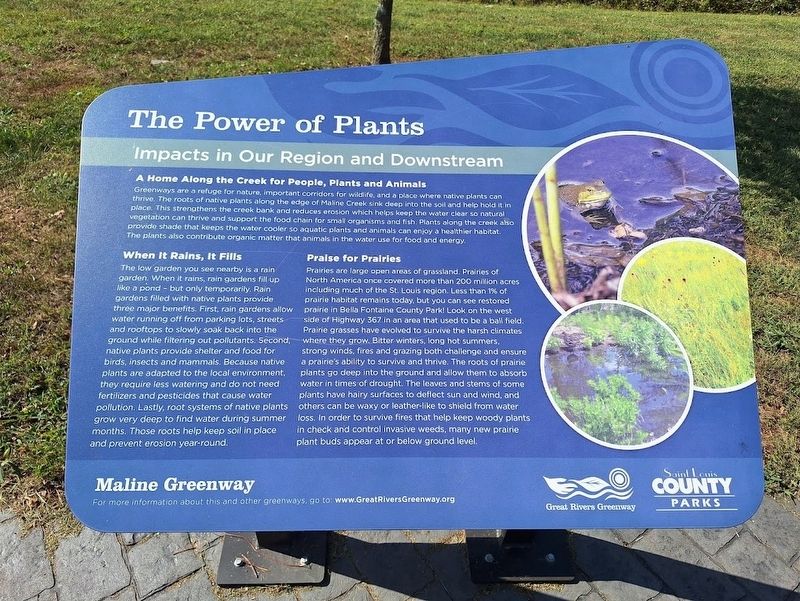
The Power of Plants
Impacts in Our Region and Downstream
| — | Maline Greenway | — |
Photographed by Jason Voigt, October 2, 2025
1. The Power of Plants Marker
A Home Along the Creek for People, Plants and Animals
Greenways are a refuge for nature, important corridors for wildlife, and a place where native plants can thrive. The roots of native plants along the edge of Maline Creek sink deep into the soil and help hold it in place. This strengthens the creek bank and reduces erosion which helps keep the water clear so natural vegetation can thrive and support the food chain for small organisms and fish. Plants along the creek also provide shade that keeps the water cooler so aquatic plants and animals can enjoy a healthier habitat. The plants also contribute organic matter that animals in the water use for food and energy.
When It Rains, It Fills
The low garden you see nearby is a rain garden. When it rains, rain gardens fill up like a pond - but only temporarily. Rain gardens filled with native plants provide three major benefits. First, rain gardens allow water running off from parking lots, streets and rooftops to slowly soak back into the ground while filtering out pollutants. Second, native plants provide shelter and food for birds, insects and mammals. Because native
this page online
Praise for Prairies
Prairies are large open areas of grassland. Prairies of North America once covered more than 200 million acres including much of the St. Louis region. Less than 1% of prairie habitat remains today, but you can see restored prairie in Bella Fontaine County Park! Look on the west side of Highway 367 in an area that used to be a ball field. Prairie grasses have evolved to survive the harsh climates where they grow. Bitter winters, long hot summers, strong winds, fires and grazing both challenge and ensure a prairie's ability to survive and thrive. The roots of prairie plants go deep into the ground and allow them to absorb water in times of drought. The leaves and stems of some plants have hairy surfaces to deflect sun and wind, and others can be waxy or leather-like to shield from water loss. In order to survive fires
Photographed by Jason Voigt, October 2, 2025
2. The Power of Plants Marker
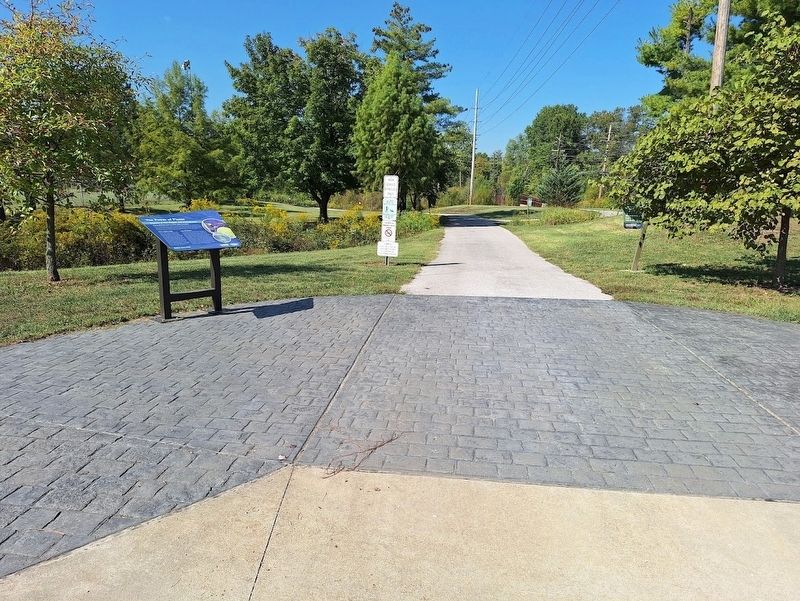
Located off Cardinal Trail at Bella Fontaine Park.
Erected by Great Rivers Greenway and St. Louis County Parks.
Topics. This historical marker is listed in these topic lists: Environment • Parks & Recreational Areas.
Location. 38° 44.429′ N, 90° 13.798′ W. Marker is in Bellefontaine Neighbors, Missouri, in St. Louis County. It is on Cardinal Trail west of Landwehr Drive, on the left when traveling west. Marker is located at Bella Fontaine Park. Touch for map. Marker is at or near this postal address: 1013 Cardinal Trail, Saint Louis MO 63137, United States of America. Touch for directions.

Regionally, this marker is in Greater St. Louis. It is also in the American Midwest, in the Lewis & Clark Corridor, in the Corn Belt, and in the Great River Road Region. Globally, it is in North America, the Western Hemisphere, the Western World, and the Anglosphere. Historically, it finds itself in what was once the Viceroyalty of New France, the territory of the Mississippian Culture, the Louisiana Purchase, and the Antebellum South.
Other nearby markers. At least 8 other markers are within 3 miles of this marker, measured as the crow flies: American Hornbeam / Cottonwood (approx. 0.6 miles away); North Riverfront Park (approx. 1.1 miles away); Nimíipuu (Nez Perce) (approx. 2.4 miles away); Founders of Saint Louis, Missouri (approx. 2.4 miles away); Rev. James J. Toomey (approx. 2.6 miles away); Rev. A. [Aloys] V. Garthoeffner (approx. 2.6 miles away); Rev. John C. Granville (approx. 2.6 miles away); Father Thomas Ambrose Butler (approx. 2.6 miles away).
Another marker is no longer nearby. North Riverfront Park (was approx. 1.1 miles away but has been replaced with another marker now near it).
Also see . . . Maline Greenway (Great Rivers Greenway). As of late 2025, the trail is partially complete and is still a work in progress as it will go through much of North County in St. Louis County. (Submitted on December 3, 2025, by Jason Voigt of Glen Carbon, Illinois.)
Credits. This page was last revised on December 3, 2025. It was originally submitted on December 3, 2025, by Jason Voigt of Glen Carbon, Illinois. This page has been viewed 53 times since then and 18 times this year. Photos: 1, 2. submitted on December 3, 2025, by Jason Voigt of Glen Carbon, Illinois.
