St. Augustine in St. Johns County, Florida — The American South (South Atlantic)
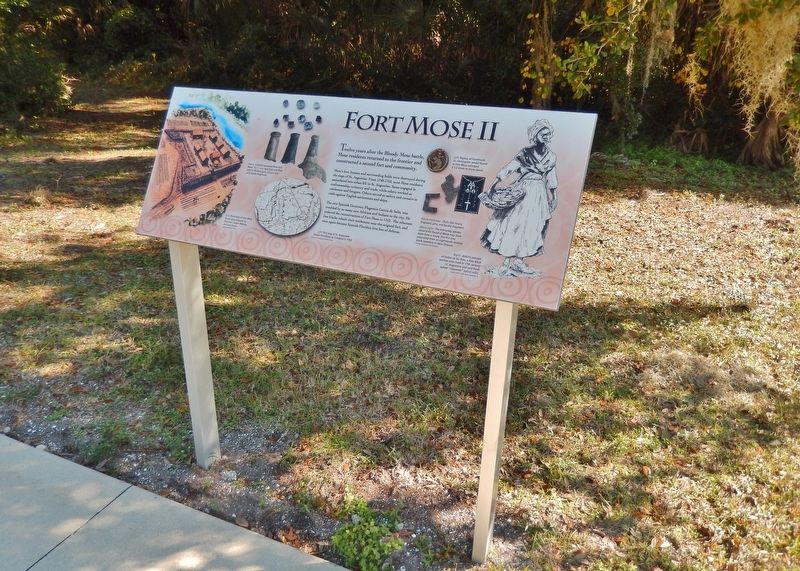
Fort Mose II
| — | Fort Mose Historic State Park | — |
Photographed by Cosmos Mariner, December 10, 2014
1. Fort Mose II Marker
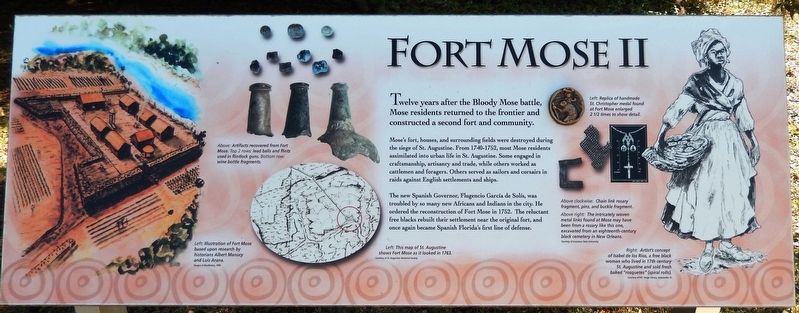
Mose's fort, houses, and surrounding fields were destroyed during the siege of St. Augustine. From 1740-1752, most Mose residents assimilated into urban life in St. Augustine. Some engaged in craftsmanship, artisanry and trade, while others worked as cattlemen and foragers. Others served as sailors and corsairs in raids against English settlements and ships.
The new Spanish Governor, Flugencio Garcia de Solís, was troubled by so many new Africans and Indians in the city. He ordered the reconstruction of Fort Mose in 1752. The reluctant free blacks rebuilt their settlement near the original fort, and once again became Spanish Florida's first line of defense.
Erected by Fort Mose Historic State Park.
Topics. This historical marker is listed in these topic lists: African Americans • Colonial Era • Forts and Castles • Indigenous Peoples and Communities. A significant historical year for this entry is 1752.
Location. Marker has been reported permanently removed. It was located near 29° 55.738′ N,
this page online
We have been informed that this marker is no longer there and will not be replaced. This page is an archival view of what was.
Regionally, this marker was in First Coast and in Greater Jacksonville. It was also in the American South and on the Eastern Seaboard. Globally, it was in the North Atlantic Region, North America, a Gulf of Mexico state, the Western Hemisphere, the Western World, and the Anglosphere. Historically, it found itself in what was once New Spain, the territory of the Mississippian Culture, one of the Confederate States of America, and the Antebellum South.

Other nearby markers. At least 8 other markers are within walking distance of this location:
Photographed by Cosmos Mariner
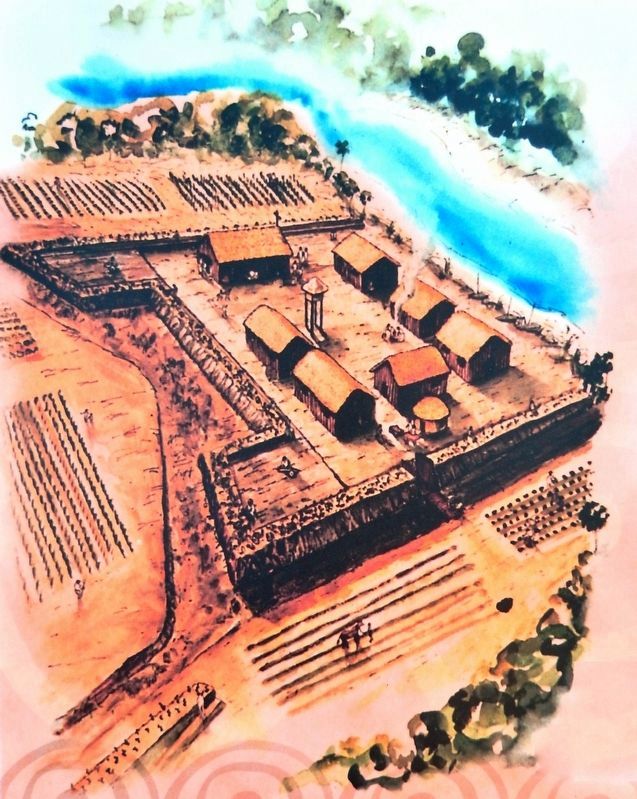
2. Marker detail: Fort Mose illustration based on research by historians Albert Manucy & Luis Arana
Other markers no longer nearby. Evacuation (was a few steps from this marker but has been permanently removed); Fort Mose I (was a few steps from this marker but has been permanently removed); British Enslavement (was within shouting distance of this marker but has been permanently removed); Middle Passage (was within shouting distance of this marker but has been permanently removed); African Origins (was within shouting distance of this marker but has been permanently removed).
More about this marker. This marker has been permanently removed.
The Fort Mose Historical State Park recently went
Photographed by Cosmos Mariner
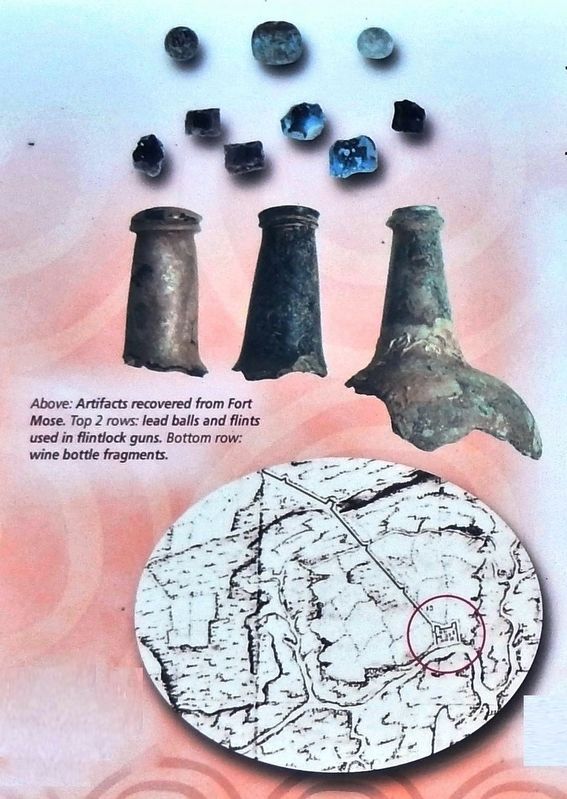
3. Marker detail: This map of St. Augustine shows Fort More as it looked in 1763
Above: Artifacts recovered from Fort Mose.
Top 2 rows: lead balls and flints used in flintlock guns. Bottom row: wine bottle fragments.
Top 2 rows: lead balls and flints used in flintlock guns. Bottom row: wine bottle fragments.
Related markers. Click here for a list of markers that are related to this marker. Fort Mose Historic State Park
Also see . . .
1. The journey of Africans to St. Augustine: Fort Mose. Rebuilt in 1752, the new Fort housed mostly African-American soldiers and their families until abandoned for the last time when Florida became an English colony in 1763. Fort Mose’s inhabitants were mainly runaway black Gullah slaves from the British colonies of South Carolina and Georgia, who escaped to freedom to Spanish, Florida in small groups at least as early as 1687. (Submitted on December 2, 2018, by Cosmos Mariner of Cape Canaveral, Florida.)
2. Fort Mose Historic State Park. Florida Department of Environmental Protection (Submitted on December 3, 2018.)
Courtesy of P.K. Yonge Library, Gainesville, Florida
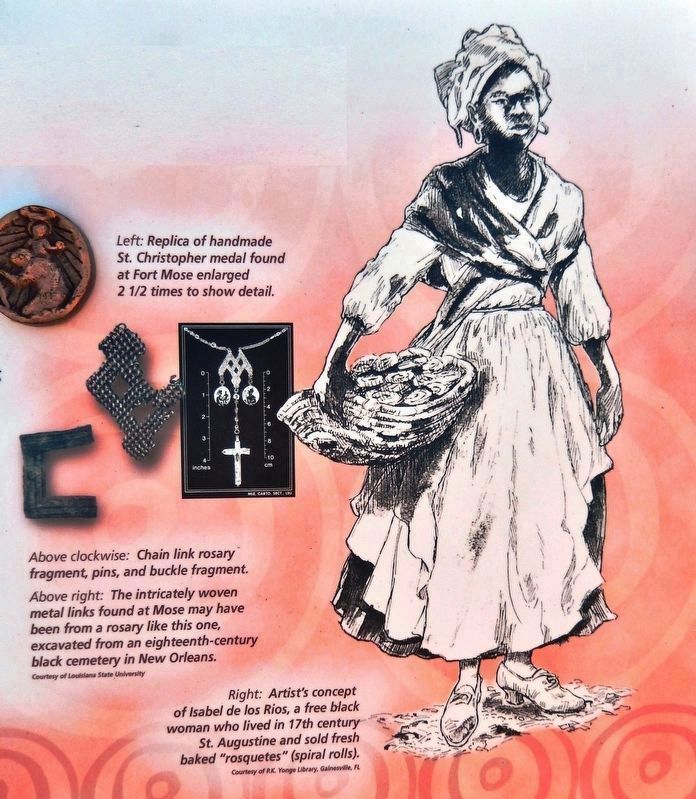
4. Marker detail: Artist's concept of Isabel de los Rios
Isabel de los Rios was a free black woman who lived in 17th century St. Augustine and sold fresh baked "rosquetes, (spiral rolls).
Top: Replica of handmade St. Christopher medal found at Fort Mose enlarged 2 1/2 times to show detail.
Middle: Chain link rosary fragment pins, and buckle fragment. The intricately woven metal links found at Mose may have been from a rosary like this one, excavated from an eighteenth-century black cemetery in New Orleans. [Courtesy of Louisiana State University]
Top: Replica of handmade St. Christopher medal found at Fort Mose enlarged 2 1/2 times to show detail.
Middle: Chain link rosary fragment pins, and buckle fragment. The intricately woven metal links found at Mose may have been from a rosary like this one, excavated from an eighteenth-century black cemetery in New Orleans. [Courtesy of Louisiana State University]
Photographed by Cosmos Mariner, December 10, 2014
5. Fort Mose II Marker (wide view)
Credits. This page was last revised on December 7, 2025. It was originally submitted on December 1, 2018, by Cosmos Mariner of Cape Canaveral, Florida. This page has been viewed 1,150 times since then and 132 times this year. Last updated on December 6, 2025, by Brandon D Cross of Flagler Beach, Florida. Photos: 1. submitted on December 1, 2018, by Cosmos Mariner of Cape Canaveral, Florida. 2, 3, 4, 5. submitted on December 2, 2018, by Cosmos Mariner of Cape Canaveral, Florida. • Bernard Fisher was the editor who published this page.
