Riverton in Barkhamsted in Northwest Hills Region, Connecticut — The American Northeast (New England)
Matthies Grove-Peoples Forest
Farmington River Wild & Scenic
⎯⎯⎯
Wild & Scenic Farmington River
Photographed by Conrad Ward, March 11, 2025
1. Matthies Grove-Peoples Forest Marker
Farmington River Wild & Scenic
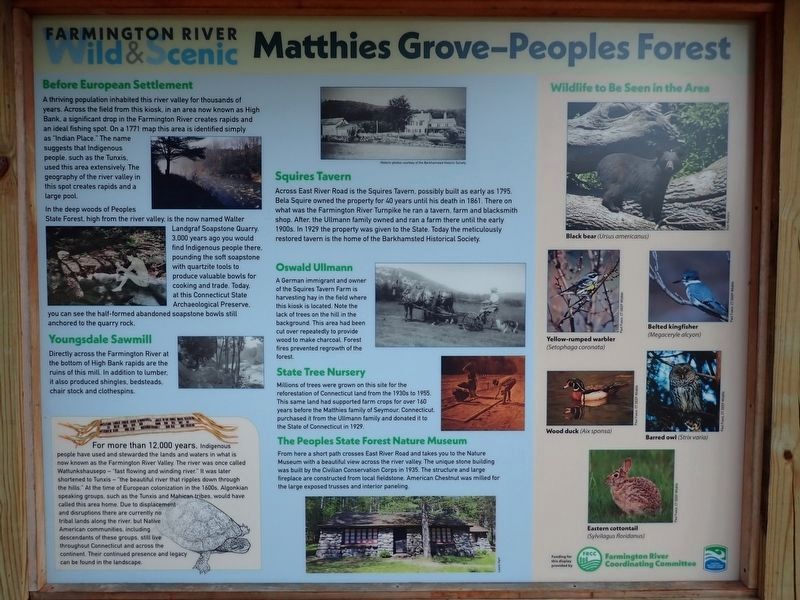
Before European Settlement
A thriving population inhabited this river valley for thousands of years. Across the field from this kiosk, in an area now known as High Bank, a significant drop in the Farmington River creates rapids and an ideal fishing spot. On a 1771 map this area is identified simply as "Indian Place." The name suggests that Indigenous people, such as the Tunxis, used this area extensively. The geography of the river valley in this spot creates rapids and a large pool.
In the deep woods of Peoples State Forest, high from the river valley is the now named Walter Landgraf Soapstone Quarry. 3,000 years ago you would find Indigenous people there, pounding the soft soapstone with quartzite tools to produce valuable bowls for cooking and trade. Today at this Connecticut State Archaeological Preserve, you can see the half-formed abandoned soapstone bowls still anchored to the quarry rock.
Youngsdale Sawmill
Directly across the Farmington River at the bottom of High Bank rapids are the ruins of this mill. In addition
this page online
Squires Tavern
Across East River Road is the Squires Tavern, possibly built as early as 1795. Bela Squire owned the property for 40 years until his death in 1861. There on what was the Farmington River Turnpike he ran a tavern, farm and blacksmith shop. After, the Ullmann family owned and ran a farm there until the early 1900s. In 1929 the property was given to the State. Today the meticulously restored tavern is the home of the Barkhamsted Historical Society. Oswald Ullmann
A German immigrant and owner of the Squires Tavern Farm is harvesting hay in the field where this kiosk is located. Note the lack of trees on the hill in the background. This area had been cut over repeatedly to provide wood to make charcoal. Forest fires prevented regrowth of the forest.
State Tree Nursery
Millions of trees were grown on this site for the reforestation of Connecticut land from the 1930s to 1955. This same land had supported farm crops for over 160 years before the Matthies family of Seymour, Connecticut purchased it from the Ullmann
Photographed by Conrad Ward, March 11, 2025
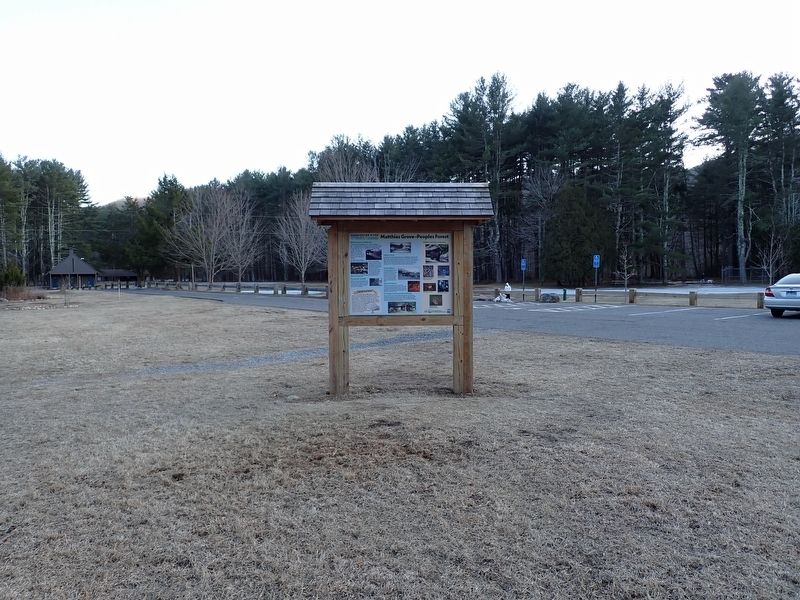
2. Matthies Grove-Peoples Forest Marker
The Peoples State Forest Nature Museum
From here a short path crosses East River Road and takes you to the Nature Museum with a beautiful view across the river valley. The unique stone building was built by the Civilian Conservation Corps in 1935. The structure and large fireplace are constructed from local fieldstone American Chestnut was milled for the large exposed trusses and interior paneling
[Inset:]
For more than 12,000 years, Indigenous people have used and stewarded the lands and waters in what is now known as the Farmington River Valley. The river was once called Wattunkshauspo - "fast flowing and winding river." It was later shortened to Tunxis - "the beautiful river that ripples down through the hills." At the time of European colonization in the 1600s, Algonkian speaking groups, such as the Tunxis and Mahican tribes, would have called this area home. Due to displacement and disruptions there are currently no tribal lands along the river, but Native American communities, including descendants of these groups still live throughout Connecticut and across the continent. Their continued presence and legacy can be found in the landscape.
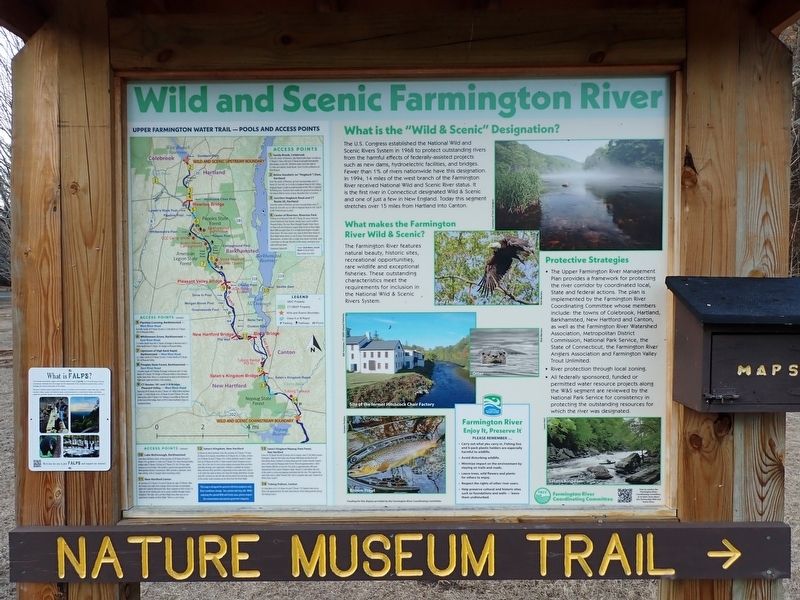
What is the "Wild & Scenic" Designation?
The
Photographed by Conrad Ward, March 11, 2025
3. Additional panel on opposite side
What makes the Farmington River Wild & Scenic?
The Farmington River features natural beauty, historic sites, recreational opportunities, rare wildlife and exceptional fisheries. These outstanding characteristics meet the requirements for inclusion in the National Wild & Scenic Rivers System.
Protective Strategies
• The Upper Farmington River Management Plan provides a framework for protecting the river corridor by coordinated local, State and federal actions. The plan is implemented by the Farmington River Coordinating Committee whose members include: the towns of Colebrook,
Photographed by Conrad Ward, March 11, 2025
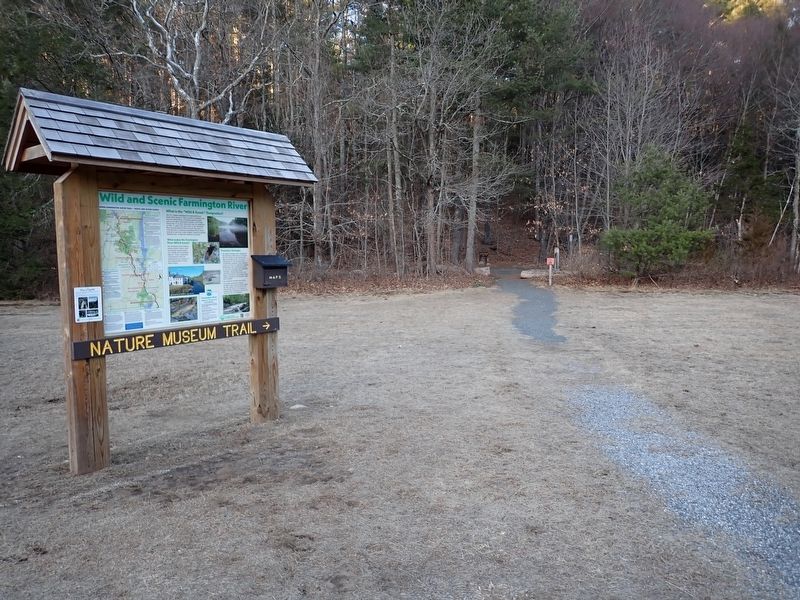
4. Wild & Scenic Farmington River Marker
• River protection through local zoning.
• All federally sponsored, funded or permitted water resource projects along the W&S segment are reviewed by the National Park Service for consistency in protecting the outstanding resources for which the river was designated.
Erected by Farmington River Coordinating Committee & National Wild & Scenic Rivers System.
Topics. This historical marker is listed in these topic lists: Indigenous Peoples and Communities • Industry & Commerce • Parks & Recreational Areas • Settlements & Settlers. A significant historical year for this entry is 1771.
Location. 41° 55.537′ N, 72° 59.961′ W. Marker is in Barkhamsted in Northwest Hills Region, Connecticut. It is in Riverton. It is on East River Road north of Greenwoods Road, on the right when traveling south. Touch for map. Marker is at or near this postal address: 106 E River Rd, Riverton CT 06065, United States of America. Touch for directions.

Regionally, this marker is in the Berkshire Foothills and in the Litchfield Hills. It is also in the American Northeast and in New England. Globally, it is in North America, the Western Hemisphere, the Western World, and the Anglosphere. Historically, it finds itself in what was once Litchfield County and also one of the original Thirteen Colonies.
Other nearby markers. At least 8 other markers are within 2 miles of this marker, measured as the crow flies: Demonstration Charcoal Mound (about 600 feet away, measured in a direct line); The Charcoal Industry (about 600 feet away); Squire's Tavern (approx. 0.2 miles away); The Bronson Legacy with Connecticut's Parks and Forests (approx. ¼ mile away); Austin Hawes Memorial Campground (approx. 0.7 miles away); Camp White (approx. 1.1 miles away); Church Pool (approx. 1.1 miles away); Barkhamsted Lighthouse Village Cellar Holes (approx. 1.2 miles away). Touch for a list and map of all markers in Barkhamsted.
Credits. This page was last revised on May 19, 2026. It was originally submitted on December 9, 2025, by Conrad Ward of Guilford, Connecticut. This page has been viewed 88 times since then and 42 times this year. Photos: 1, 2, 3. submitted on December 9, 2025, by Conrad Ward of Guilford, Connecticut. 4. submitted on December 14, 2025, by Conrad Ward of Guilford, Connecticut. • Devry Becker Jones was the editor who published this page.
