Uptown in Chicago in Cook County, Illinois — The American Midwest (Great Lakes)
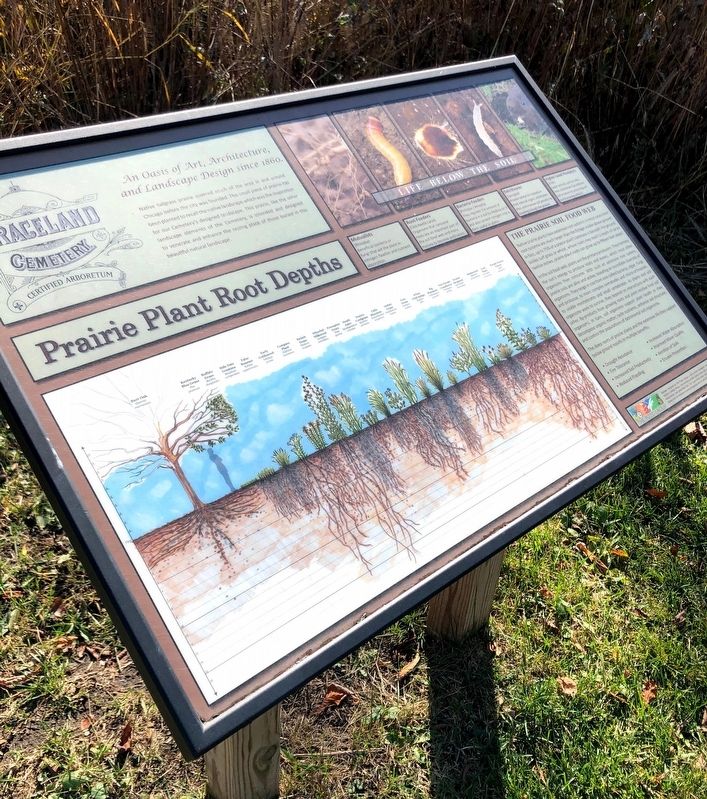
Prairie Plant Root Depths
Photographed by Sean P. Flynn, October 24, 2020
1. Prairie Plant Root Depths Marker
An Oasis of Art, Architecture, and Landscape Design since 1860.
Native tallgrass prairie covered much of the area in and around Chicago before the city was founded. This small piece of prairie has been planted to recall the native landscape which was the inspiration for our Cemetery's designed landscape. This prairie, like the other landscape elements of the Cemetery, is intended and designed to venerate and enhance the resting place of those buried in this beautiful natural landscape.
The Prairie Soil Food Web
Native prairie plants have extensive root systems. In most cases their root systems are much larger than the foliage visible above ground. In fact, up to 75% of a prairie plant's biomass is beneath the ground. Unlike turf grass or wheat, whose roots may reach a depth of six to twelve inches, prairie plant roots can grow up to fifteen feet deep!
in the soil food web, plants are the primary producers. They harness the sun's energy to produce roots and leaves, which most other organisms then consume. With such an extensive root system, prairie soils are alive and active, boasting an incredible diversity of organisms.
this page online
The deep roots of prairie plants and the extensive life they support below ground results in multiple benefits:
• Drought Resistance
• Fire Tolerance
• Increased Soil Productivity
• Reduced Flooding
• Increased Water Absorption
• Improved Water Quality
• Aeration of Soils
• Erosion Prevention
Erected by Graceland Cemetery.
Topics. This historical marker is listed in these topic lists: Cemeteries & Burial Sites • Environment. A significant historical year for this entry is 1860.
Location. 41° 57.276′ N, 87° 39.407′ W. Marker is in Chicago, Illinois, in Cook County. It is in Uptown. It is on North Kenmore Avenue. The marker is in the southeast corner of Graceland Cemetery. Touch for map. Marker is at or near this postal address: 4001 North Clark Street, Chicago IL 60613, United States of America. Touch for directions.

Regionally, this marker is on Chicago’s North Side. It is also in the American Midwest. Globally, it is in North America, on the Great Lakes, in the Western Hemisphere, in the Western World, and in the Anglosphere. Historically, it finds itself in what was once the Viceroyalty of New France, the territory of the Mississippian Culture, and the Northwest Territory.
Other nearby markers. At least 8 other markers are within walking distance of this marker: Pollinators of the Prairie (a few steps from this marker); Birds of the Prairie (about 400 feet away, measured in a direct line); Alta Vista Terrace (about 700 feet away); Graves Family Monument (approx. 0.2 miles away); Colonel Marcus M. Spiegel (approx. 0.2 miles away); Joseph R. Scott (approx. 0.2 miles away); John A. "Jack" Johnson (approx. 0.2 miles away); a different marker also named Alta Vista Terrace (approx. ¼ mile away). Touch for a list and map of all markers in Chicago.
Credits. This page was last revised on December 11, 2025. It was originally submitted on December 10, 2025, by Sean P. Flynn of Oak Park, Illinois. This page has been viewed 66 times since then and 31 times this year. Photo 1. submitted on December 10, 2025, by Sean P. Flynn of Oak Park, Illinois.
Editor’s want-list for this marker. a photo of the sign in its context • Can you help?
