Uptown in Chicago in Cook County, Illinois — The American Midwest (Great Lakes)
Pollinators of the Prairie
Graceland Cemetery
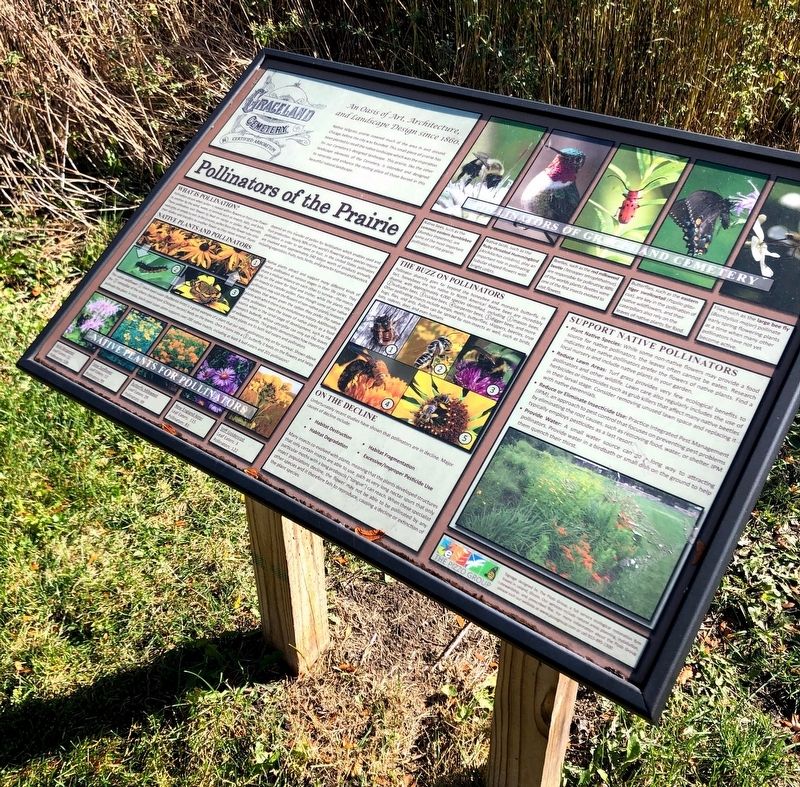
Photographed by Sean P. Flynn, October 24, 2020
1. Pollinators of the Prairie Marker
An Oasis of Art, Architecture, and Landscape Design since 1860.
Native tallgrass prairie covered much of the area in and around Chicago before the city was founded. This small piece of prairie has been planted to recall the native landscape which was the inspiration for our Cemetery's designed landscape. This prairie, like the other landscape elements of the Cemetery, is intended and designed to venerate and enhance the resting place of those buried in this beautiful natural landscape.
What Is Pollination?
Pollination occurs when pollen is moved within flowers or from one flower to another by the wind, water, or animals such as insects, bats, and birds. These pollinators visit flowers to feed on nectar or pollen, find warmth, seek prey, or simply to rest. In the process, pollen from the flower rubs onto their bodies and transfers to another flower as they move around. Plants depend on this transfer of pollen for fertilization which enables seed and fruit production. Nearly 90% of the world's flowering plant species require pollinators in order to set seed or fruit. In the United States pollinators are involved with
this page online
Native Plants and Pollinators
Native plants attract and support many different kinds of native pollinators at various stages in their life cycles. They share a mutual reliance on each other to survive the insects rely on the plant for food and shelter, while the plants rely on insects to transfer pollen. Even though some of our native pollinators may visit the flowers of non-native plants, research indicates that when given the option they prefer the native plants with which there is an evolutionary history. Additionally, many pollinators need the leaves of native plants as a food source when in the larval stage of development, such as the monarch butterfly, whose caterpillar can only eat the leaves of milkweed plants. This graphic demonstrates how important native plants are to both leaf eaters and pollinators.
The native wildflower 1) black-eyed susan (Rudbeckia hirta) is a great example of a plant that our native pollinators rely on for survival. Shown above the 2) caterpillar of the silvery checkerspot (Chlosyme nycteis) feeds on the leaves. Once it turns into a 3) butterfly it feeds on the flowers and helps pollinate the plant. In total, black-eyed susan alone supports over 200 native insects, including at least 8 leaf-eaters and 201 pollinators!
The Buzz on Pollinators
Pollinator diversity goes far beyond the honeybee and monarch butterfly. In fact, honeybees are not native to North America! Native bees are incredibly diverse, with approximately 4,000 species identified, including 1) mason bees; 2) leafcutter bees, 3) cuckoo bees, 4) carpenter bees, 5) digger bees, and more. Other pollinating insects include wasps, moths, butterflies, skippers, beetles, true bugs, flies, and ants. Pollen can be spread by non-insects as well, such as birds, bats, rodents, deer and even humans.
On the Decline
Unfortunately recent studies have shown that pollinators are in decline. Major causes of decline include:
• Habitat Destruction
• Habitat Fragmentation
• Habitat Degradation
• Excessive/Improper Pesticide Use
Many insects co-evolved with plants, meaning that the plants developed structures that only certain insects are able to use, such as very long nectar spurs that only particular moths with a long proboscis ("tongue") can reach. When these specialist insect populations decline, the flower may not be able to be pollinated by any other species and it therefore fails to reproduce, causing a decline or extinction of the plant species.
Support Native Pollinators
• Plant Native Species: While some non-native flowers may provide a food source for native pollinators, the leaves often cannot be eaten. Research indicates that native pollinators prefer the flowers of native plants. Find a local nursery and include native plants in your garden.
• Reduce Lawn Areas: Turf grass provides very few ecological benefits to pollinators and other wildlife. Lawn care also regularly includes the use of herbicides or insecticides such as grub killers that affect many native beetles in their larval stage. Consider removing unused lawn space and replacing it with native perennials.
• Reduce or Eliminate Insecticide Use: Practice Integrated Pest Management (IPM), an approach to pest control that focuses on preventing pest problems by eliminating the root causes, such as removing food, water, or shelter. IPM typically employs pesticides as a last resort.
• Provide Water: A small water source can 20 long way to attracting pollinators. Provide water in a birdbath or small dish on the ground to help them quench their thirst.
Erected by Graceland Cemetery.
Topics. This historical marker is listed in these topic lists: Animals • Cemeteries & Burial Sites • Environment. A significant historical year for this entry is 1860.
Location. 41° 57.286′ N, 87° 39.404′ W. Marker is in Chicago, Illinois, in Cook County. It is in Uptown. It is on West Irving Park Road (Illinois Route 19) near North Clark Street, on the right when traveling west. The marker is in the southeast corner of Graceland Cemetery. Touch for map. Marker is at or near this postal address: 4001 North Clark Street, Chicago IL 60613, United States of America. Touch for directions.

Regionally, this marker is on Chicago’s North Side. It is also in the American Midwest. Globally, it is in North America, on the Great Lakes, in the Western Hemisphere, in the Western World, and in the Anglosphere. Historically, it finds itself in what was once the Viceroyalty of New France, the territory of the Mississippian Culture, and the Northwest Territory.
Other nearby markers. At least 8 other markers are within walking distance of this marker: Prairie Plant Root Depths (a few steps from this marker); Birds of the Prairie (about 300 feet away, measured in a direct line); Alta Vista Terrace (approx. 0.2 miles away); Graves Family Monument (approx. 0.2 miles away); John A. "Jack" Johnson (approx. 0.2 miles away); Joseph R. Scott (approx. 0.2 miles away); Colonel Marcus M. Spiegel (approx. 0.2 miles away); a different marker also named Alta Vista Terrace (approx. ¼ mile away). Touch for a list and map of all markers in Chicago.
Credits. This page was last revised on December 11, 2025. It was originally submitted on December 10, 2025, by Sean P. Flynn of Oak Park, Illinois. This page has been viewed 58 times since then and 25 times this year. Photo 1. submitted on December 10, 2025, by Sean P. Flynn of Oak Park, Illinois.
Editor’s want-list for this marker. a photo of the marker in its context • Can you help?
