Uptown in Chicago in Cook County, Illinois — The American Midwest (Great Lakes)
Birds of the Prairie
Graceland Cemetery
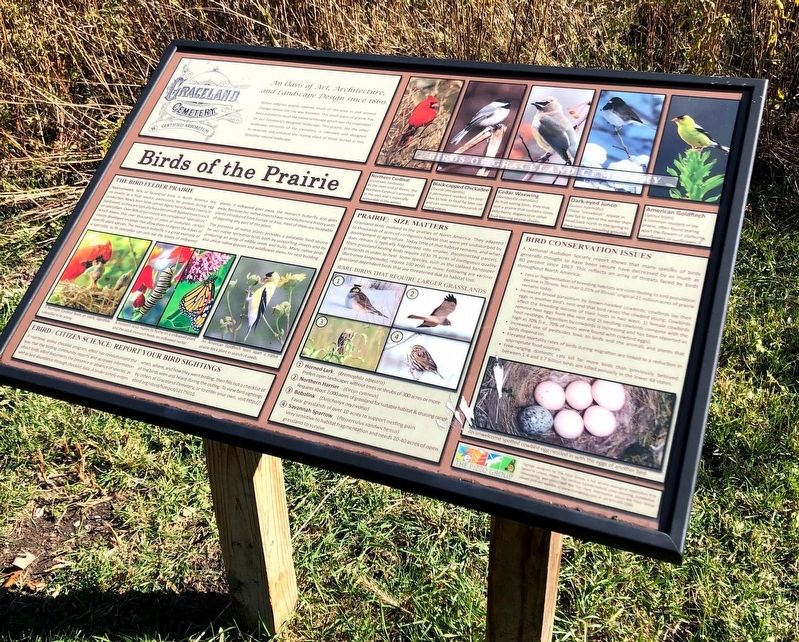
Photographed by Sean P. Flynn, October 24, 2020
1. Birds of the Prairie Marker
An Oasis of Art, Architecture, and Landscape Design since 1860.
Native tallgrass prairie covered much of the area in and around Chicago before the city was founded. This small piece of prairie has been planted to recall the native landscape which was the inspiration for our Cemetery's designed landscape. This prairie, like the other landscape elements of the Cemetery, is intended and designed to venerate and enhance the resting place of those buried in this beautiful natural landscape.
The Bird Feeder Prairie
Approximately 96% of terrestrial birds in North America rely on insects as a food source, particularly for protein during egg production. Newly born birds cannot digest hard-bodied insects or hard seeds, so they are typically fed a diet of soft-bodied insects such as caterpillars. Over 90% of our insects are considered "specialists," which means that over thousands of years of evolution, certain insects developed enzymes that allow them to digest the leaves of specific plant species. The monarch butterfly is a great example of a specialist, as its caterpillar can only eat the leaves of milkweed plants. If milkweed
this page online
The presence of native plants provides a palatable food source for our native terrestrial birds both by supporting insects and by producing an array of edible seeds and fruits. Many native birds also utilize native grasses and wildflower stems for nest building.
EBird/Citizen Science: Report Your Bird Sightings
A real-time, online checklist program, eBird has revolutionized the way that the birding community reports and accesses information about birds, eBird documents the presence or absence of species, as well as bird abundance through checklist data. A birder simply enters when, where, and how they went birding, then fills out a checklist of all the birds seen and heard during the outing. To view bird sightings by others at Graceland Cemetery, or to enter your own, visit http://ebird.org/ebird/hotspot/L2175010
Prairie: Size Matters
Grassland birds evolved in the prairies of North America. They adapted to thousands of acres of contiguous habitat that were yet undisturbed by development or agriculture. Today little of that habitat remains, and what does remain is typically fragmented into smaller, disconnected parcels. Many grassland nesting birds require 10 to 75 acres of contiguous quality grasslands in order to nest. Some species, such as the Upland Sandpiper (Bartramia longicauda), require 100 acres or more. Following are various grassland dependent birds that are threatened due to habitat loss:
1. Horned Lark (Eremophila alpestris)
Prefers open landscapes without trees or shrubs of 300 acres or more
2. Northern Harrier (Circus cyaneus)
Requires about 2,000 acres of grassland for suitable habitat & cruising range
3. Bobolink (Dolichonyx oryzivorus)
Favor grasslands of over 10 acres to support nesting pairs
4. Savannah Sparrow (Passerculus sandwichensis)
Very sensitive to habitat fragmentation and needs 20-40 acres of open grassland to survive
Bird Conservation Issues
A National Audubon Society report shows that many species of birds generally thought to have been secure have decreased by as much as 80 percent since 1967. This reflects an array of threats faced by birds throughout North America:
• Loss or fragmentation of breeding habitats are contributing to bird population decline in Illinois, less than 0.01% of Illinois original 21 million acres of prairie remains today.
• Increased brood parasitism by brown-headed cowbirds: cowbirds lay their eggs in another bird's nest and that bird raises the cowbird young. Cowbirds affect the breeding success of their hosts in two ways: 1) female cowbirds remove host eggs from the nest and 2) nestling cowbirds compete with the host nestlings. Parasitism by cowbirds is increasing and has been reported as high as 70% (i.e., 70% of nests were found with cowbird eggs).
• Increased use of pesticides toxic to birds and the animals and plants that birds depend on. Elevated mortality rates of birds during migration are linked to a reduction in appropriate food sources.
• Free-ranging domestic cats kill far more birds than previously believed: between 1.4 and 3.7 billion birds are killed annually in the lower 48 states.
Birds of Graceland Cemetery
Northern Cardinal (Cardinalis cardinalis)
As the state bird of Illinois, the Northern Cardinal is prevalent in the area and is especially noticeable in the winter.
Black-capped Chickadee (Poecile atricapillus)
A permanent resident, this bird likes to hide its food for later use and can remember thousands of hiding places.
Cedar Waxwing (Bombycilla cedrorum)
As fruit eating birds, they may visit a prairie that contains roses, elderberry, dogwood or other fruit-bearing prairie shrubs.
Dark-eyed Junco (Junco hyemalis)
These "snowbirds" appear in late fall to spend the winter then head back north in the spring to their summer breeding grounds.
American Goldfinch (Spinus tristis)
A common resident of the prairie, often found tearing apart the flowers of silphiums, coneflowers or sunflowers.
Erected by Graceland Cemetery.
Topics. This historical marker is listed in these topic lists: Animals • Cemeteries & Burial Sites • Environment. A significant historical year for this entry is 1860.
Location. 41° 57.33′ N, 87° 39.448′ W. Marker is in Chicago, Illinois, in Cook County. It is in Uptown. It can be reached from Irving Park Road (Illinois Route 19) near North Clark Street. The marker is in the southeast corner of Graceland Cemetery. Touch for map. Marker is at or near this postal address: 4001 North Clark Street, Chicago IL 60613, United States of America. Touch for directions.

Regionally, this marker is on Chicago’s North Side. It is also in the American Midwest. Globally, it is in North America, on the Great Lakes, in the Western Hemisphere, in the Western World, and in the Anglosphere. Historically, it finds itself in what was once the Viceroyalty of New France, the territory of the Mississippian Culture, and the Northwest Territory.
Other nearby markers. At least 8 other markers are within walking distance of this marker: Pollinators of the Prairie (about 300 feet away, measured in a direct line); Prairie Plant Root Depths (about 400 feet away); Graves Family Monument (about 600 feet away); John A. "Jack" Johnson (about 700 feet away); Joseph R. Scott (approx. 0.2 miles away); Alta Vista Terrace (approx. 0.2 miles away); Allan Pinkerton (approx. 0.2 miles away); Colonel Marcus M. Spiegel (approx. ¼ mile away). Touch for a list and map of all markers in Chicago.
Also see . . .
1. How Chicago’s Graceland Cemetery Built a Prairie and Lost My Ancestors. A blog post about the prairie that was constructed by Graceland Cemetery in its southeast portion. (Submitted on December 11, 2025, by Sean P. Flynn of Oak Park, Illinois.)
2. Wild About Illinois Birds!. The Illinois Department of Natural Resources looks at the birds of Illinois. (Submitted on December 11, 2025, by Sean P. Flynn of Oak Park, Illinois.)
Credits. This page was last revised on December 11, 2025. It was originally submitted on December 10, 2025, by Sean P. Flynn of Oak Park, Illinois. This page has been viewed 76 times since then and 41 times this year. Photo 1. submitted on December 10, 2025, by Sean P. Flynn of Oak Park, Illinois.
Editor’s want-list for this marker. a photo of the marker in its context • Can you help?
