Greater Grand Crossing in Chicago in Cook County, Illinois — The American Midwest (Great Lakes)
The Confederate Dead at Oak Woods Cemetery
Photographed by Sean P. Flynn, December 28, 2019
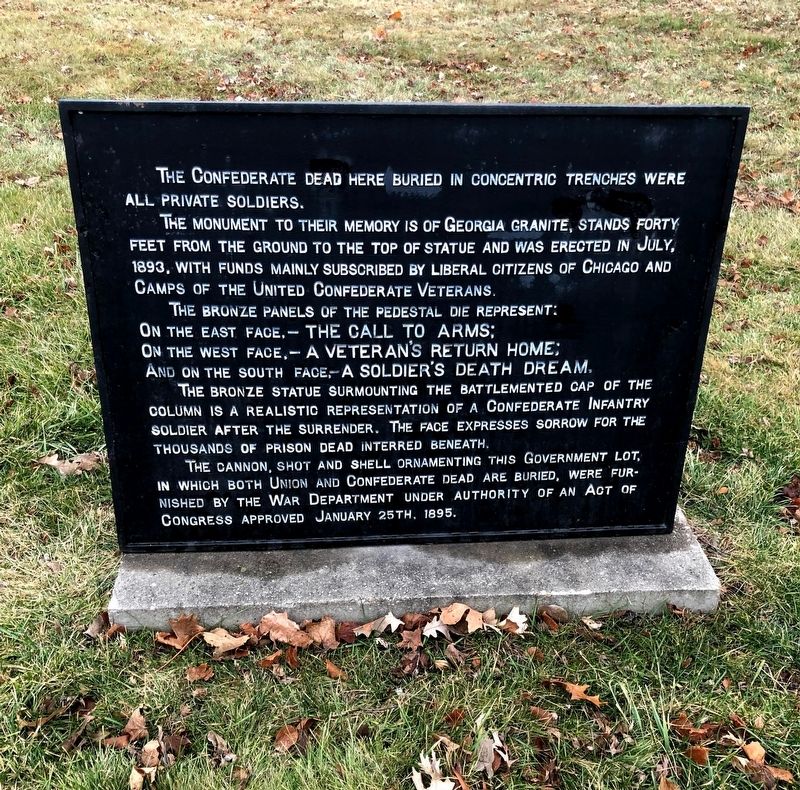
1. The Confederate Dead at Oak Woods Cemetery Marker
The monument to their memory is of Georgia granite, stands forty feet from the ground to the top of statue and was erected in July, 1893, with funds mainly subscribed by liberal citizens of Chicago and camps of the United Confederate Veterans.
The bronze panels of the pedestal die represent:
On the east face,— The call to arms;
On the west face,— A veteran's return home;
And on the south face,— A soldier's death dream.
The bronze statue surmounting the battlemented cap of the column is a realistic representation of a Confederate infantry soldier after the surrender. The face expresses sorrow for the thousands of prison dead interred beneath.
The cannon, shot and shell ornamenting this government lot, in which both Union and Confederate dead are buried, were furnished by the War Department under authority of an act of Congress approved January 25th, 1895.
Topics. This historical marker is listed in these topic lists: Arts, Letters, Music • Cemeteries & Burial Sites • Fraternal or Sororal Organizations •
this page online
Location. 41° 46.005′ N, 87° 36.165′ W. Marker is in Chicago, Illinois, in Cook County. It is in Greater Grand Crossing. It can be reached from the intersection of Magnolia Road and Memorial Drive. The marker is near the Confederate Mound inside Oak Woods Cemetery. Touch for map. Marker is at or near this postal address: 1035 East 67th Street, Chicago IL 60619, United States of America. Touch for directions.

Regionally, this marker is on Chicago’s South Side. It is also in the American Midwest. Globally, it is in North America, on the Great Lakes, in the Western Hemisphere, in the Western World, and in the Anglosphere. Historically, it finds itself in what was once the Viceroyalty of New France, the territory of the Mississippian Culture, and the Northwest Territory.
Other nearby markers. At least 8 other markers are within 2 miles of this marker, measured as the crow flies: Confederate Mound Monument (within shouting distance of this marker); Confederate Mound (within shouting distance of this marker); Charles E. Merriam Center for Public Administration (approx.
Photographed by Sean Flynn, December 28, 2019
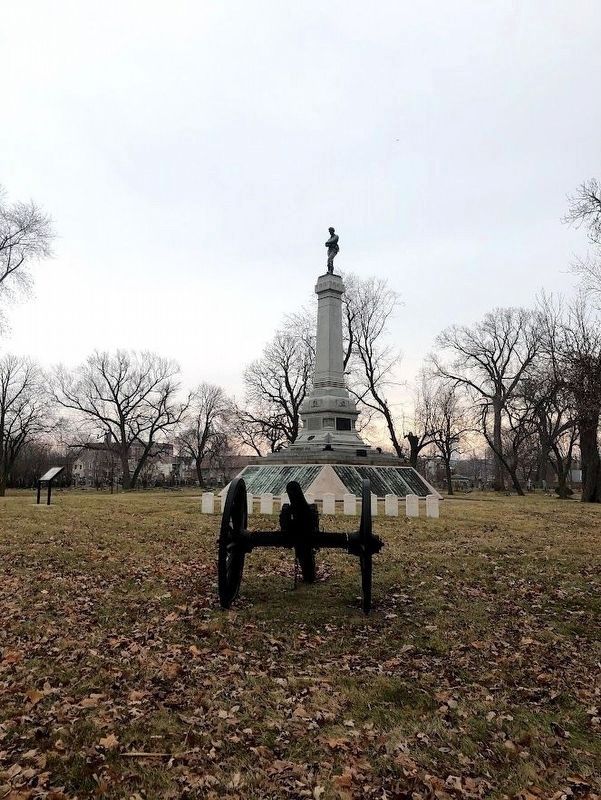
2. Confederate Mound
Thousands of Confederate soldiers who died while imprisoned in Chicago are buried beneath this memorial at Oak Woods Cemetery on Chicago's South Side.
More about this marker. It is not known when exactly this memorial, which sits on the outskirts of the Confederate Mound, was erected. Besides this memorial and the mound itself, there is also a modern historical marker by the Department of Veterans Affairs that details the history of this site.
Regarding The Confederate Dead at Oak Woods Cemetery. More than 26,000 Confederate soldiers were held as prisoners of war at Camp Douglas on Chicago's South Side during the Civil War, and at least 4,000 died and were buried in the city during the war. The men who died at Camp Douglas were originally buried at City Cemetery in what is now Lincoln Park, but the Army was forced to remove them in 1865, and they acquired five acres at Oak Woods Cemetery on the city's south side. Eventually, about 4,000
Photographed by Sean Flynn, December 28, 2019
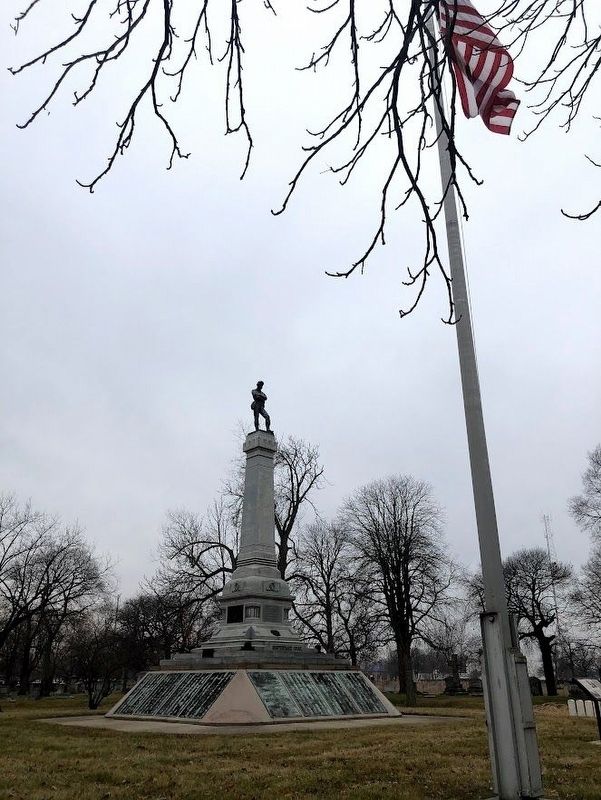
3. Confederate Mound
The VA's historical marker can be seen on the right.
In 1895, the Ex-Confederate Association of Chicago placed a memorial shaft at the Confederate Mound, and the Army supplied the artillery pieces and cannonballs placed around the memorial. An estimated 100,000 people attended the dedication ceremony.
The memorial was lifted onto a new base in 1911. The 16 bronze plaques on the memorial include the names of 4,275 Confederate soldiers that are known to have died at Camp Douglas.
Also see . . . Confederate Mound. From the Hyde Park Historical Society. (Submitted on December 10, 2025, by Sean P. Flynn of Oak Park, Illinois.)
Chicago Daily News Collection, Chicago History Museum (DN-0064548), May 1915
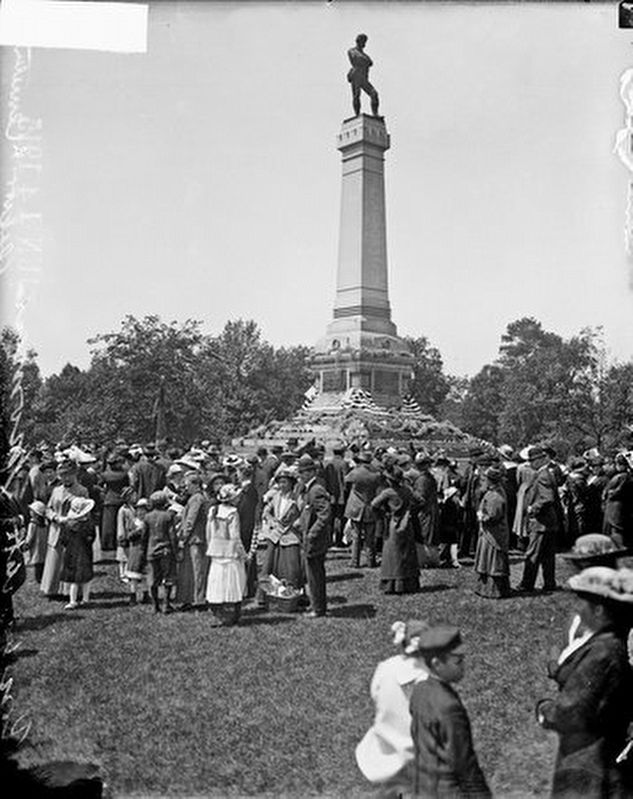
4. Confederate Mound, 1915
The caption from the Chicago History Museum: "Crowd gathered during a Memorial Day celebration around the Confederate Mound Monument at Oak Woods Cemetery."
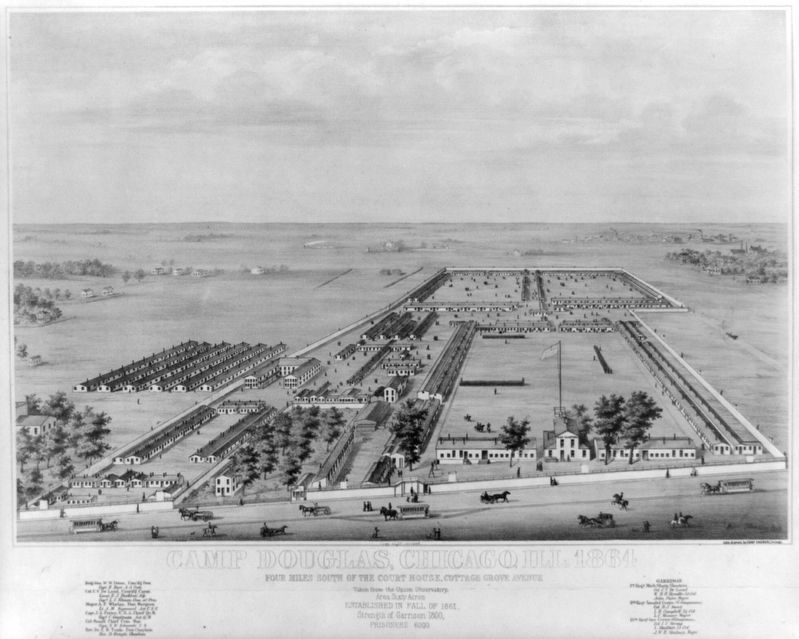
Library of Congress, Prints and Photographs Division, circa 1864
5. Camp Douglas, Chicago
The camp was located at roughly the location of modern-day 31st Street and Cottage Grove Avenue, about five miles north of Oak Woods Cemetery.
Credits. This page was last revised on December 11, 2025. It was originally submitted on December 10, 2025, by Sean P. Flynn of Oak Park, Illinois. This page has been viewed 121 times since then and 65 times this year. Photos: 1. submitted on December 10, 2025, by Sean P. Flynn of Oak Park, Illinois. 2, 3. submitted on September 14, 2023, by Sean P. Flynn of Oak Park, Illinois. 4, 5. submitted on December 10, 2025, by Sean P. Flynn of Oak Park, Illinois.
