Mississippi Township in Columbus in Hickman County, Kentucky — The American South (East South Central)
They Passed This Way
Photographed by Duane and Tracy Marsteller, November 30, 2025
1. They Passed This Way Marker
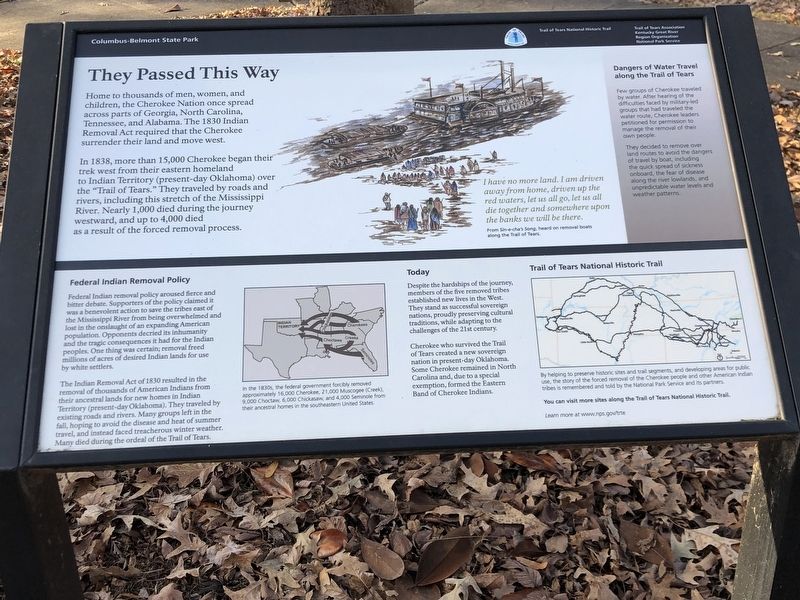
In 1838, more than 15,000 Cherokee began their trek west from their eastern homeland to Indian Territory (present-day Oklahoma) over the "Trail of Tears." They traveled by roads and rivers, including this stretch of the Mississippi River. Nearly 1,000 died during the journey westward, and up to 4,000 died as a result of the forced removal process.
I have no more land. I am driven away from home, driven up the red waters, let us all go, let us all die together and somewhere upon the banks we will be there.
From Sin-e-cha's Song, heard on removal boats along the Trail of Tears.
Dangers of Water Travel along the Trail of Tears
Few groups of Cherokee traveled by water. After hearing of the difficulties faced by military-led groups that had traveled the water route, Cherokee leaders petitioned for permission to manage the removal of their own people.
They decided to remove over
this page online
Federal Indian Removal Policy
Federal Indian removal policy aroused fierce and bitter debate. Supporters of the policy claimed it was a benevolent action to save the tribes east of the Mississippi River from being overwhelmed and lost in the onslaught of an expanding American population. Opponents decried its inhumanity and the tragic consequences it had for the Indian peoples. One thing was certain; removal freed millions of acres of desired Indian lands for use by white settlers.
The Indian Removal Act of 1830 resulted in the removal of thousands of American Indians from their ancestral lands for new homes in Indian Territory (present-day Oklahoma). They traveled by existing roads and rivers. Many groups left in the fall, hoping to avoid the disease and heat of summer travel, and instead faced treacherous winter weather. Many died during the ordeal of the Trail of Tears.
In the 1830s, the federal government forcibly removed approximately
Photographed by Duane and Tracy Marsteller, November 30, 2025
2. They Passed This Way Marker
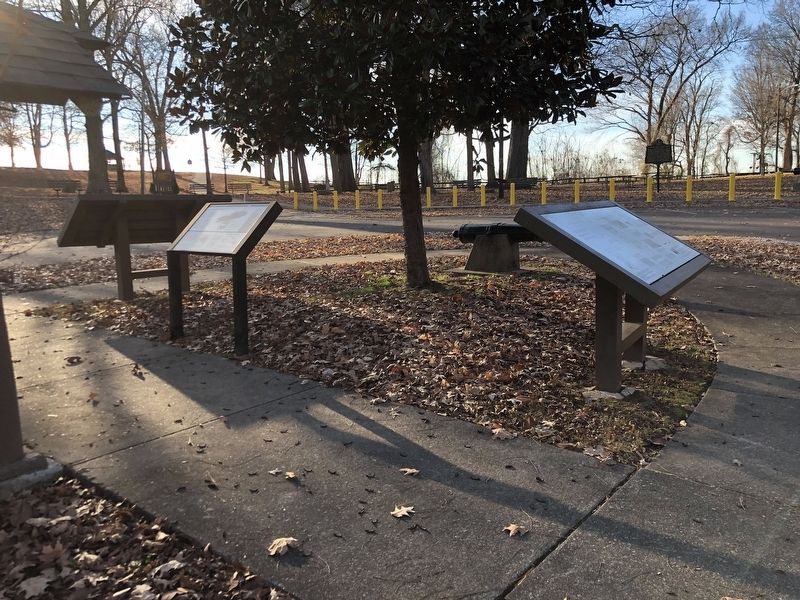
Featured marker is in the middle.
Today
Despite the hardships of the journey, members of the five removed tribes established new lives in the West. They stand as successful sovereign nations, proudly preserving cultural traditions, while adapting to the challenges of the 21st century.
Cherokee who survived the Trail of Tears created a new sovereign nation in present-day Oklahoma. Some Cherokee remained in North Carolina and, due to a special exemption, formed the Eastern Band of Cherokee Indians.
Trail of Tears National Historic Trail
By helping to preserve historic sites and trail segments, and developing areas for public use, the story of the forced removal of the Cherokee people and other American Indian tribes is remembered and told by the National Park Service and its partners.
You can visit more sites along the Trail of Tears National Historic Trail.
Learn more at www.nps.gov/trte
Erected by Columbus-Belmont State Park, Trail of Tears National Historic Trail, of Tears Association, Kentucky Great River, Region Organization, National Park Service.
Topics. This historical marker is listed in these topic lists: Indigenous Peoples and Communities • Waterways & Vessels. A significant historical year for this entry is 1830.
Location. 36° 45.941′ N, 89° 6.641′ W. Marker is in Columbus, Kentucky, in Hickman County. It is in Mississippi Township. It is on Park Road north of Carrington Street. Touch for map. Marker is at or near this postal address: 350 Park Rd, Arlington KY 42021, United States of America. Touch for directions.

Regionally, this marker is in Kentucky’s Jackson Purchase. It is also in the American Midwest, in the South, and specifically in the Upper South. Globally, it is in North America, the Western Hemisphere, the Western World, and the Anglosphere. Historically, it finds itself in what was once the territory of the Mississippian Culture and also the Antebellum South.
Other nearby markers. At least 8 other markers are within walking distance of this marker: The History of Columbus, Kentucky (here, next to this marker); The Battle at Belmont, Missouri (a few steps from this marker); "Gibraltar of the West" (a few steps from this marker); Marion Rust (1879-1958) (within shouting distance of this marker); Confederate Trenches (about 300 feet away, measured in a direct line); Anchor and Chain (about 300 feet away); Polk's Firepower (about 400 feet away); Columbus-Belmont (about 400 feet away). Touch for a list and map of all markers in Columbus.
Credits. This page was last revised on December 23, 2025. It was originally submitted on December 11, 2025, by Duane and Tracy Marsteller of Murfreesboro, Tennessee. This page has been viewed 76 times since then and 32 times this year. Photos: 1, 2. submitted on December 11, 2025, by Duane and Tracy Marsteller of Murfreesboro, Tennessee. • James Hulse was the editor who published this page.
