Winchester, Virginia — The American South (Mid-Atlantic)
The First Battle of Winchester
"Drive them out of the town!"
| — | The First Battle of Winchester (May 25, 1862) | — |
Photographed by Bernard Fisher, December 18, 2025
1. The First Battle of Winchester Marker
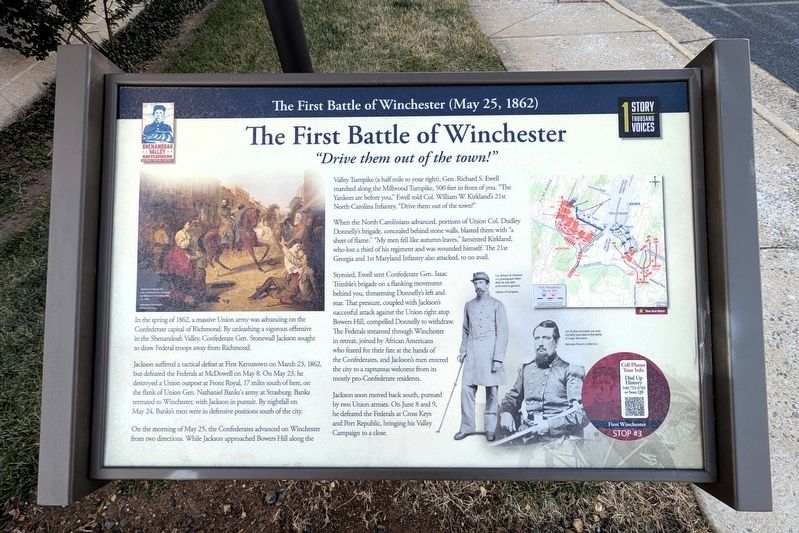
Jackson suffered a tactical defeat at First Kernstown on March 23, 1862, but defeated the Federals at McDowell on May 8. On May 23, he destroyed a Union outpost at Front Royal, 17 miles south of here, on the flank of Union Gen. Nathaniel Bank's army at Strasburg. Banks retreated to Winchester, with Jackson in pursuit. By nightfall on May 24, Banks's men were in defensive positions south of the city.
On the morning of May 25, the Confederates advanced on Winchester from two directions. While Jackson approached Bowers Hill along the Valley Tumpike (a half mile to your right), Gen Richard S. Ewell marched along the Millwood Turnpike, 500 feet in front of you. "The Yankees are before you," Ewell told Col. William W. Kirkland's 21st North Carolina Infantry, "Drive them out of the town!"
When the North Carolinians advanced, portions of Union Col. Dudley Donnelly's brigade, concealed
this page online
Stymied, Ewell sent Confederate Gen. Isaac Trimble's brigade on a flanking movement behind you, threatening Donnelly's left and rear. That pressure, coupled with Jackson's successful attack against the Union right atop Bowers Hill, compelled Donnelly to withdraw. The Federals streamed through Winchester in retreat, joined by African Americans who feared for their fate at the hands of the Confederates, and Jackson's men entered the city to a rapturous welcome from its mostly pro-Confederate residents.
Jackson soon moved back south, pursued by two Union armies. On June 8 and 9, he defeated the Federals at Cross Keys and Port Republic, bringing his Valley Campaign to a close.
(captions)
"Jackson Entering the City of Winchester, Virginia" by William D. Washington, ca. 1864. Valentine Richmond History Center.
Col. William W. Kirkland in a photograph taken after he was later promoted to general. Library of Congress.
Col. Dudley Donnelly was later mortally wounded at the Battle of Cedar Mountain. Nicholas Picerno Collection.
Erected 2025
Photographed by Bernard Fisher, December 18, 2025
2. The First Battle of Winchester Marker
Topics. This historical marker is listed in this topic list: War, US Civil. A significant historical date for this entry is May 25, 1862.
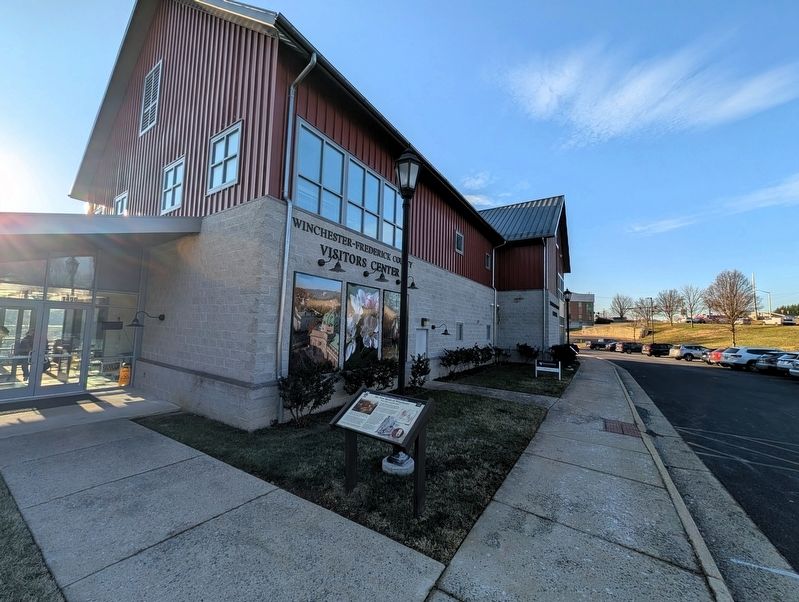
Location. 39° 10.13′ N, 78° 9.682′ W. Marker is in Winchester, Virginia. It can be reached from South Pleasant Valley Road north of Millwood Avenue, on the right when traveling north. Located at the Winchester-Frederick County Visitor Center. Touch for map. Marker is at or near this postal address: 1400 S Pleasant Valley Rd, Winchester VA 22601, United States of America. Touch for directions.

Regionally, this marker is in the Shenandoah Valley. It is also in the American South, specifically in the Upper South, and in the Mid-Atlantic. Globally, it is in North America, the Western Hemisphere, the Western World, and the Anglosphere. Historically, it finds itself in what was once the territory of the Mississippian Culture, one of the original Thirteen Colonies, one of the Confederate States of America, and the Antebellum South.
Other nearby markers. At least 8 other markers are within walking distance of this marker: Dr. James A. Davis's Legacy (a few steps from this marker); The Hollingsworth Family Settlement (a few steps from this marker); Abram's Delight (within shouting distance of this marker); a different marker also named Abram’s Delight (within shouting distance of this marker); a different marker also named Abram's Delight (within shouting distance of this marker); Wilkins Lake (about 600 feet away, measured in a direct line); Massive Tent City (approx. 0.2 miles away); The Peacemakers (approx. ¼ mile away). Touch for a list and map of all markers in Winchester.
Other markers no longer nearby. Abram’s Delight (was within shouting distance of this marker but has been reported to have been replaced with another marker now near it); Shawnee Springs Hospital (was approx. 0.2 miles away but has been replaced with another marker now near it).
Credits. This page was last revised on December 19, 2025. It was originally submitted on December 19, 2025, by Bernard Fisher of Richmond, Virginia. This page has been viewed 93 times since then and 57 times this year. Photos: 1, 2. submitted on December 19, 2025, by Bernard Fisher of Richmond, Virginia.
