Near Milam in Sabine County, Texas — The American South (West South Central)
James Taylor Gaines
Photographed by James Hulse, December 19, 2025
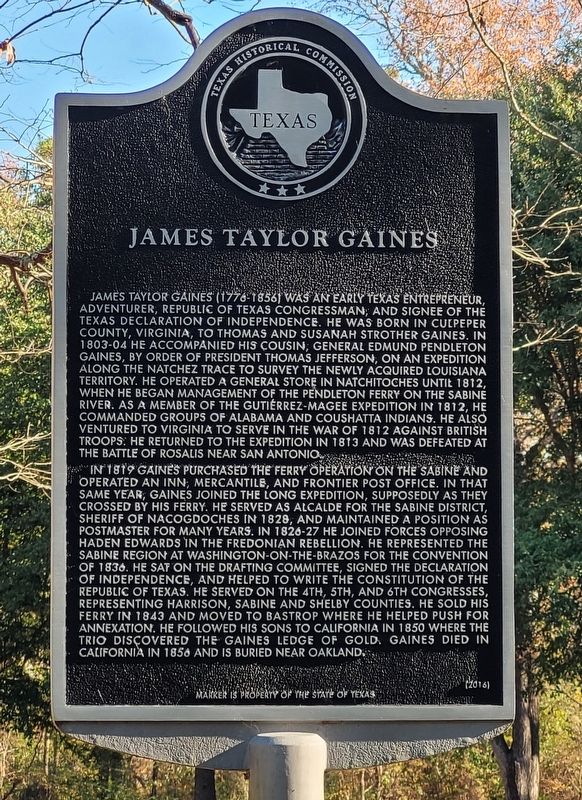
1. James Taylor Gaines Marker
In 1819 Gaines purchased the ferry operation on the Sabine and operated an inn, mercantile, and frontier post office. In that same year, Gaines joined the Long Expedition, supposedly as they crossed by his ferry. He served as alcalde for the Sabine District, Sheriff of Nacogdoches
this page online
Erected 2016 by Texas Historical Commission. (Marker Number 18393.)
Topics. This historical marker is listed in these topic lists: Exploration • Indigenous Peoples and Communities • Industry & Commerce • Wars, Non-US. A significant historical year for this entry is 1812.
Location. 31° 28.03′ N, 93° 45.442′ W. Marker is near Milam, Texas, in Sabine County. It is on Ensign Drive north of Pike Drive, on the right when traveling

Photographed by James Hulse, December 19, 2025
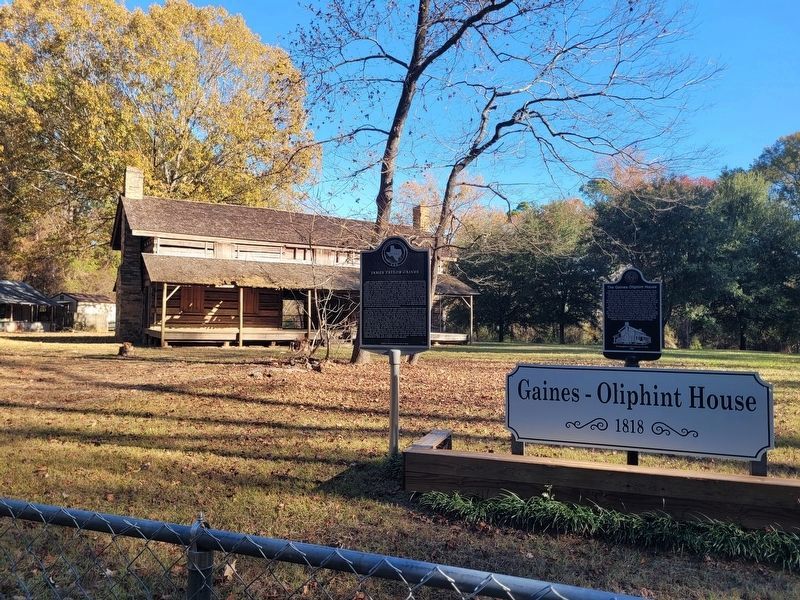
2. James Taylor Gaines Marker (left marker)

Regionally, this marker is in the American South, specifically in the Deep South, and in the Piney Woods. Globally, it is in North America, a Gulf of Mexico state, the Western Hemisphere, the Western World, and the Anglosphere. Historically, it finds itself in what was once New Spain, the Republic of Texas, one of the Confederate States of America, and the Antebellum South.
Other nearby markers. At least 8 other markers are within 2 miles of this marker, measured as the crow flies: The Gaines-Oliphint House (here, next to this marker); Alfred D. and Martha (Causey) Oliphint (here, next to this marker); Gaines Memorial Bridge (approx. 0.4 miles away); Site of Historic Crossing on the Sabine River (approx. 0.4 miles away); Site of Sabine River Crossing (approx. 0.4 miles away); Texas Louisiana Boundary (approx. 0.4 miles away); Oliphint Chapel Cemetery (approx. one mile away); Kings Highway (approx. 2 miles away).
Photographed by James Hulse, December 19, 2025
3. James Taylor Gaines Marker
The Gaines-Oliphint House is located directly behind the markers.
Also see . . . James Taylor Gaines: Signer of the Texas Declaration of Independence. Texas State Historical Association (TSHA)
James Taylor Gaines, a signer of the Texas Declaration of Independence, was born on November 14, 1776, in Culpeper County, Virginia, the son of Thomas and Susanah (Strother) Gaines and a descendant of the distinguished Pendleton family. He was a double first cousin to United States Army general Edmund Pendleton Gaines, with whom he worked in 1803–04 by order of President Thomas Jefferson to survey lands along the Natchez Trace. He was christened Robert Thomas but changed his name to James around 1810. Gaines operated a Sabine River ferry by 1812. He raised and commanded troops in the Gutiérrez-Magee expedition, an effort to wrest Texas from Spain. Tall, red-haired, and red-faced, he was "Captain Colorado" to the Alabama and Coushatta Indians he commanded. After defeat in San Antonio, Gaines went to Virginia and fought against the British in the War of 1812. In 1819 he bought the long-established ferry on El Camino Real, and with his sons and employees operated the facility over twenty years, bringing (it was said) four-fifths of the colonists across from the United States to Texas. He served as alcalde for the Sabine District of the Municipality of Nacogdoches in 1824, sheriff in Nacogdoches in 1828, and postmaster for years. Beside the ferry, he operated an inn and mercantile store and forwarded mail across the boundary into the United States. He later founded the town of Pendleton on this site.(Submitted on December 20, 2025, by James Hulse of Medina, Texas.)
Credits. This page was last revised on December 20, 2025. It was originally submitted on December 19, 2025, by James Hulse of Medina, Texas. This page has been viewed 119 times since then and 92 times this year. Photos: 1, 2, 3. submitted on December 20, 2025, by James Hulse of Medina, Texas.
