Near Dolores in Montezuma County, Colorado — The American Mountains (Southwest)
Rabbitbrush
Photographed by Cosmos Mariner, July 17, 2025
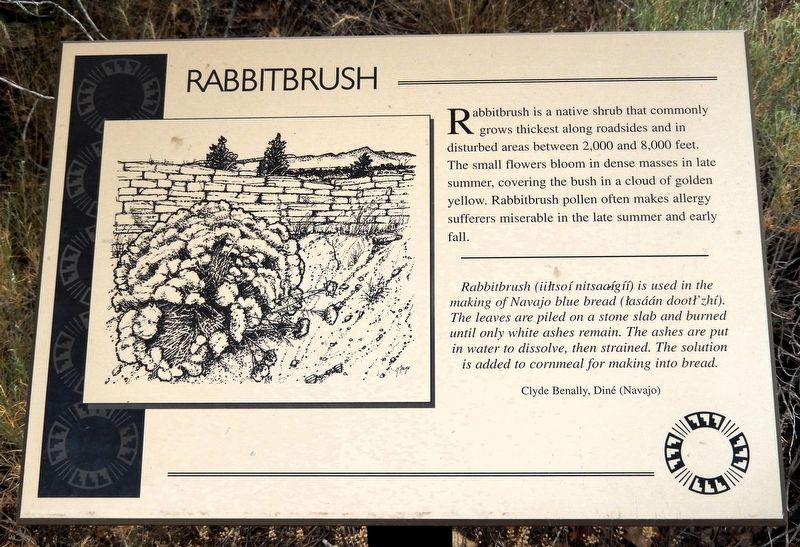
1. Rabbitbrush Marker
Rabbitbrush is a native shrub that commonly grows thickest along roadsides and in disturbed areas between 2,000 and 8,000 feet. The small flowers bloom in dense masses in late summer, covering the bush in a cloud of golden yellow. Rabbitbrush pollen often makes allergy sufferers miserable in the late summer and early fall.
Rabbitbrush (’iiłtsoí nitsaaígíí) is used in the making of Navajo blue bread (łasáán dootł zhí). The leaves are piled on a stone slab and burned until only white ashes remain. The ashes are put in water to dissolve, then strained. The solution is added to cornmeal for making into bread.
—Clyde Benally, Dine (Navajo)
Erected by The Colorado Historical Society, the Bureau of Land Management, the Family of Nellie Mulnix Joy and the Frankston Family.
Topics. This historical marker is listed in these topic lists: Anthropology & Archaeology • Indigenous Peoples and Communities.
Location. 37° 28.672′ N, 108° 32.756′ W. Marker is near Dolores, Colorado, in Montezuma County. It can be reached from State Highway 184 at milepost 7, on the
this page online

Regionally, this marker is in the American Mountain West, on the Colorado Plateau, and at the Four Corners. Globally, it is in North America, the Rocky Mountains, the Western Hemisphere, the Western World, and the Anglosphere. Historically, it finds itself in what was once the territory of the Ancestral Puebloans and also Mexico’s Alta California.
Other nearby markers. At least 8 other markers are within walking distance of this marker: Escalante Pueblo (a few steps from this marker); Mesa Verde National Park & Ute Mountain Tribal Park (within shouting distance of this marker); The People (within shouting distance of this marker); The Landscape (within shouting distance of this marker); Spanish Explorers (within shouting distance of this marker); Big Sagebrush (within shouting distance of this marker); Prickly Pear Cactus (within shouting
Photographed by Cosmos Mariner, July 17, 2025
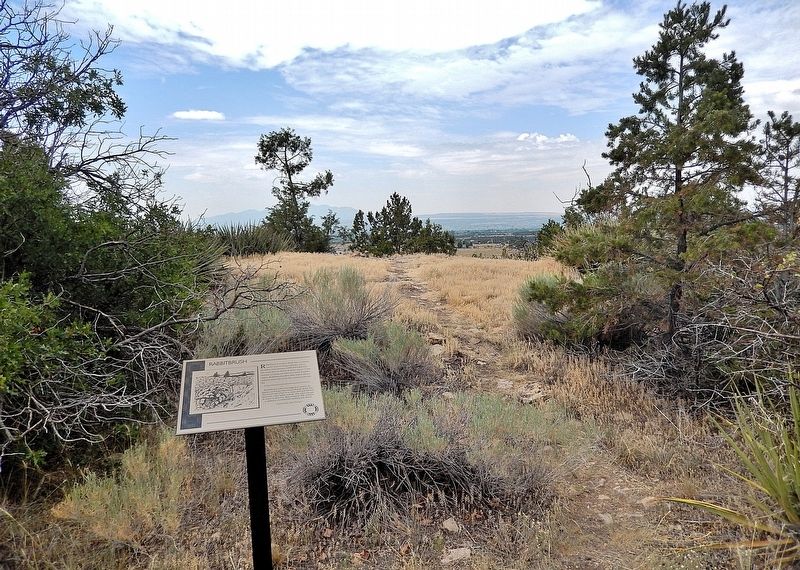
2. Rabbitbrush Marker
Also see . . . Rabbitbrush Ethnobotanical Uses (Santa Fe Botanical Gardens).
Excerpt: "The Navajo used rabbitbrush leaf tea to bring down fever, treat smallpox, and relieve arthritis pain. The flowers and roots were used to make a tea to relieve tuberculosis. Other tribes used rabbitbrush to make a sanitary napkin to promote healing after childbirth." (Finley and Nieland 52)(Submitted on December 23, 2025, by Cosmos Mariner of Cape Canaveral, Florida.)
"The roots of common rabbitbush were boiled to make a strong decoction for treating coughs, fevers, colds and old internal injuries and for easing menstrual cramps. To relieve headaches, the leaves were used to make a medicinal tea that was applied as a lotion. The leaf tea was also taken internally to reduce fevers and relieve constipation, colds and stomach problems. Mashed rabbitbush leaves were packed into decayed teeth to relieve toothaches." (Kershaw 88)
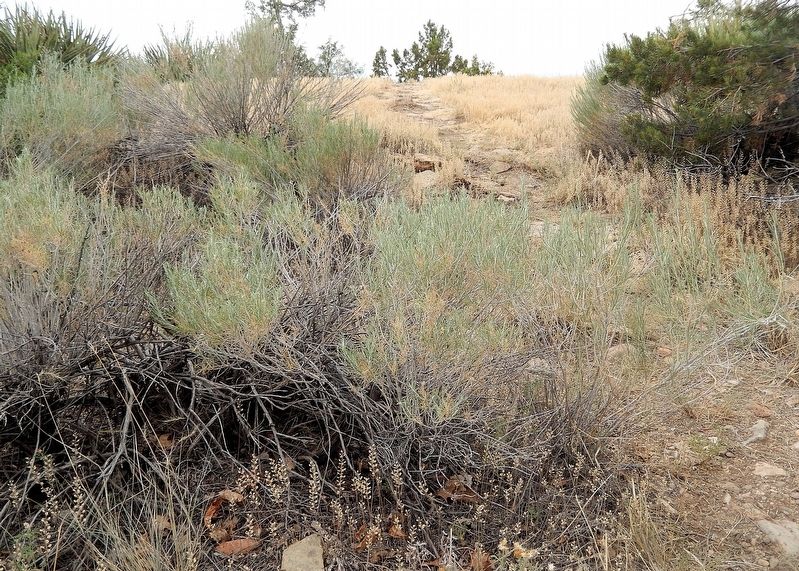
"A tea made by steeping the leaves seems to have worked for curing stomach disorders at several pueblos. This tea was also used as a gargle for coldsat Jemez and as a bath for fever patients at Isleta; at Sandia ground dry leaves mixed with cornmeal were used in treating wounds. (Dunmire and Tierney 149)Photographed by Cosmos Mariner, July 17, 20253. Rabbitbrush
Credits. This page was last revised on December 23, 2025. It was originally submitted on December 23, 2025, by Cosmos Mariner of Cape Canaveral, Florida. This page has been viewed 118 times since then and 88 times this year. Photos: 1, 2, 3. submitted on December 23, 2025, by Cosmos Mariner of Cape Canaveral, Florida.
