Dolores in Montezuma County, Colorado — The American Mountains (Southwest)
Escalante Pueblo
Photographed by Cosmos Mariner, July 17, 2025
1. Escalante Pueblo Marker
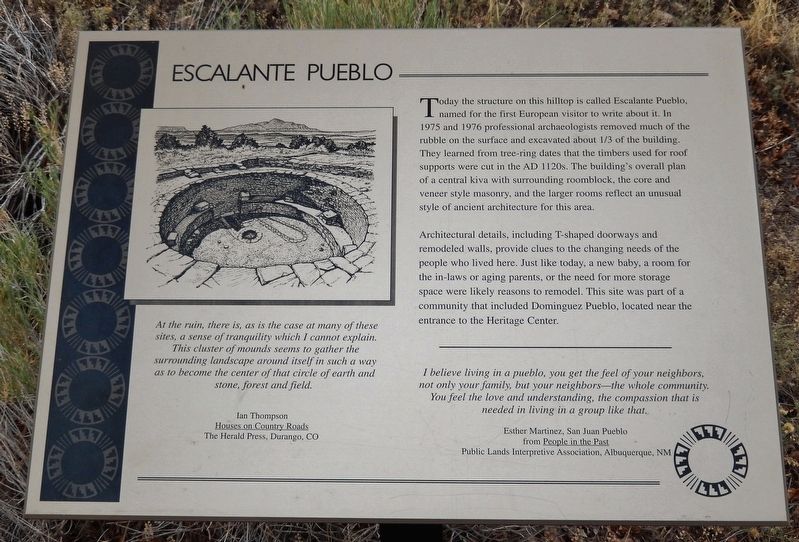
At the ruin, there is, as is the case at many of these sites, a sense of tranquility which I cannot explain. This cluster of mounds seems to gather the surrounding landscape around itself in such a way as to become the center of that circle of earth and stone, forest and field.
—Ian Thompson
Houses on Country Roads
The Herald Press, Durango, CO
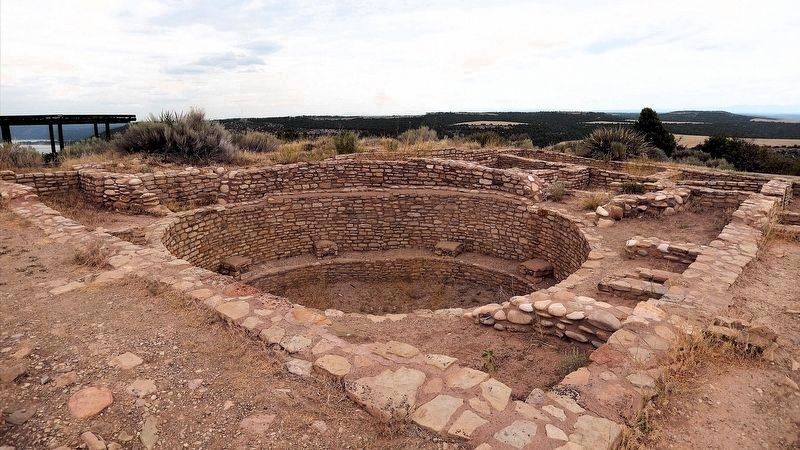
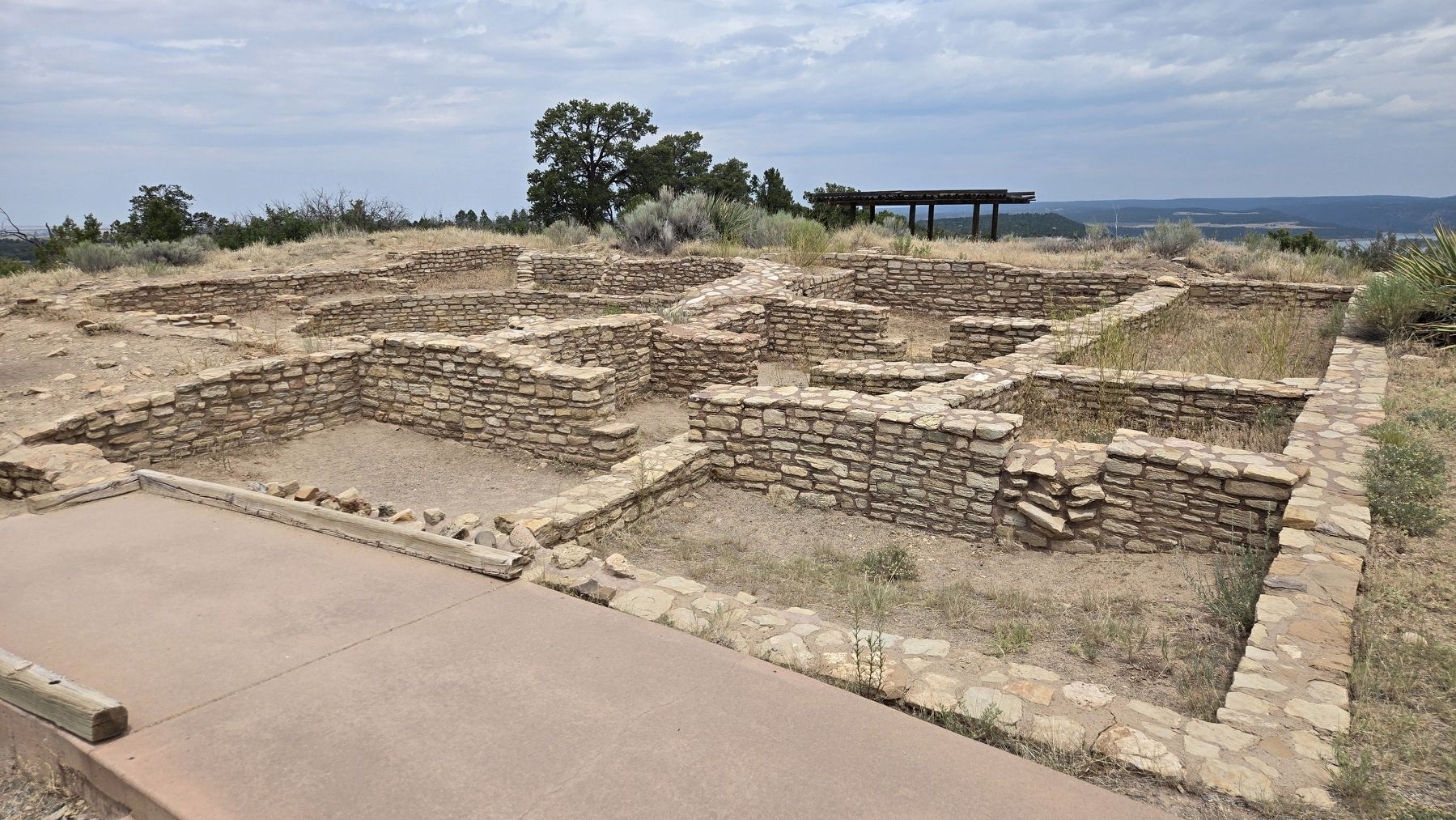
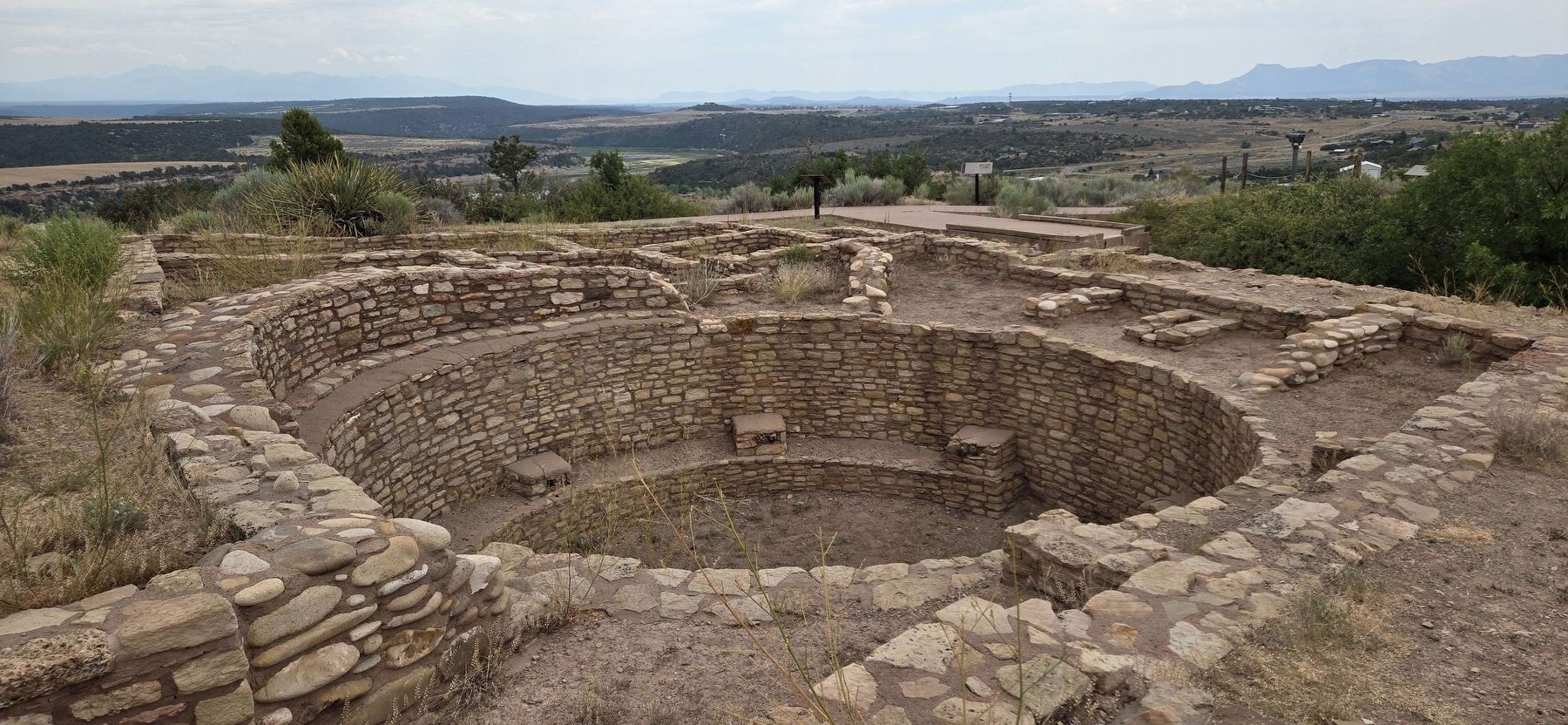
Today the structure on this hilltop is called Escalante Pueblo, named for the first European visitor to write about it. In 1975 and 1976 professional archaeologists removed much of the rubble on the surface and excavated about 1/3 of the building. They learned from tree-ring dates that the timbers used for roof supports were cut in the AD 1120s. The building's overall plan of a central kiva with surrounding roomblock, the core and veneer style masonry, and the larger rooms reflect an unusual style of ancient architecture for this area.
Architectural details, including T-shaped doorways and remodeled walls, provide clues to the changing needs of the people who lived here. Just like today, a new baby, a room for the in-laws or aging parents, or the need for more storage space were likely
this page online
I believe living in a pueblo, you get the feel of your neighbors, not only your family, but your neighbors — the whole community. You feel the love and understanding, the compassion that is needed in living in a group like that.
—Esther Martinez, San Juan Pueblo
from People in the Past
Public Lands Interpretive Association, Albuquerque, NM
Erected by The Colorado Historical Society, the Bureau of Land Management, the Family of Nellie Mulnix Joy and the Frankston Family.
Topics. This historical marker is listed in these topic lists: Anthropology & Archaeology • Architecture • Indigenous Peoples and Communities. A significant historical year for this entry is 1120.
Location. 37° 28.672′ N, 108° 32.748′ W. Marker is in Dolores, Colorado, in Montezuma County. It can be reached from State Highway 184 at milepost 7, on the right when traveling west. The marker is on the Escalante Pueblo Trail at the Canyons of the Ancients National Monument Visitor Center. Touch for map. Marker is at or near this
Photographed by Cosmos Mariner, July 17, 2025
2. Escalante Pueblo Marker
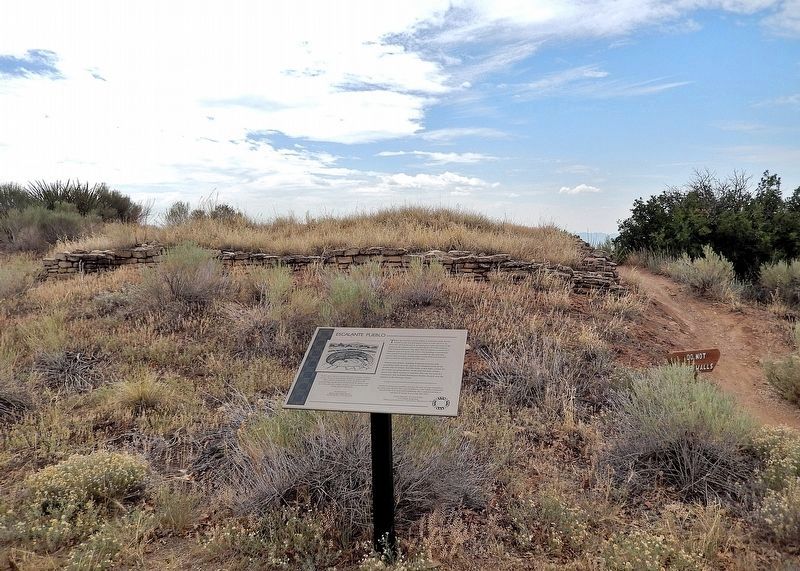
Looking south from the Escalante Pueblo Trail, the lodge structures and kiva are at the top of the hill.

Regionally, this marker is in the American Mountain West, on the Colorado Plateau, and at the Four Corners. Globally, it is in North America, the Rocky Mountains, the Western Hemisphere, the Western World, and the Anglosphere. Historically, it finds itself in what was once the territory of the Ancestral Puebloans and also Mexico’s Alta California.
Other nearby markers. At least 8 other markers are within walking distance of this marker: Rabbitbrush (a few steps from this marker); The Landscape (within shouting distance of this marker); The People (within shouting distance of this marker); Spanish Explorers (within shouting distance of this marker); Mesa Verde National Park & Ute Mountain Tribal Park (within shouting distance of this marker); Big Sagebrush (within shouting distance of this marker); Prickly Pear Cactus (within shouting distance of this marker); Wildlife or Relatives? (within shouting distance of this marker). Touch for a list and map of all markers in Dolores.
Also see . . .
1. Escalante Ruin (History Colorado).
Photographed by Cosmos Mariner, July 17, 2025
3. Escalante Pueblo
Excerpt: Noted in the journals of Father Silvestre Escalante during a 1776 expedition, this is the first recorded archaeological site in what is now the state of Colorado.(Submitted on December 24, 2025, by Cosmos Mariner of Cape Canaveral, Florida.)
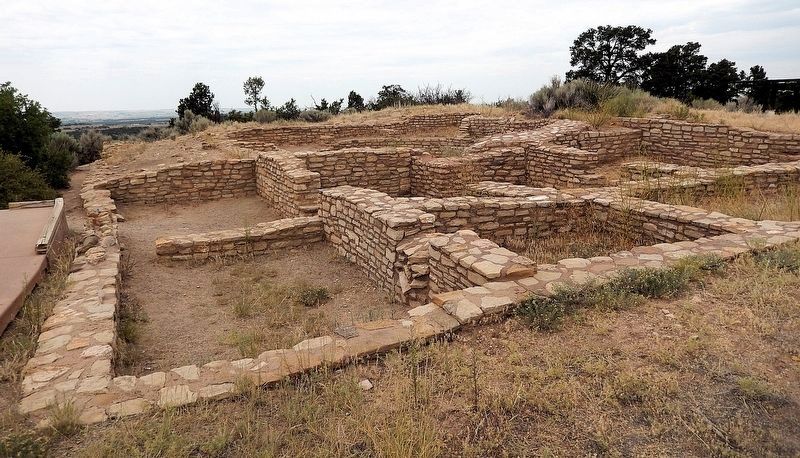
Comprised of a nine-room surface pueblo with an enclosed kiva, it was originally constructed during the Pueblo II period (AD 900 to 1100) and continued in use into the Pueblo III phase (AD 1100 to 1300). The partially excavated Chacoan outlier is part of the Anasazi Heritage Center and is open to the public.
2. Canyons of the Ancients Visitor Center (Wikipedia).
Excerpt: Two 12th-century archaeological sites, the Escalante and Dominguez Pueblos, were once home to Ancient Pueblo peoples. The museum's permanent and special exhibits display some of the 3 million mostly Ancestral Puebloan artifacts curated at the facility.(Submitted on December 24, 2025, by Cosmos Mariner of Cape Canaveral, Florida.)
Escalante Pueblo was constructed approximately 1120 to 1130 AD and made of groupings of stone walled family and communal rooms, including kivas. The architecture is like that of the Chaco Canyon in present-day New Mexico. The pueblo was also occupiedabout 1150 AD and again 1200 AD.Photographed by Cosmos Mariner, July 17, 20254. Escalante Pueblo — Kiva
Photographed by Cosmos Mariner, July 17, 2025
5. Escalante Pueblo
Photographed by Cosmos Mariner, July 17, 2025
6. Escalante Pueblo — Kiva
Credits. This page was last revised on December 24, 2025. It was originally submitted on December 23, 2025, by Cosmos Mariner of Cape Canaveral, Florida. This page has been viewed 150 times since then and 117 times this year. Photos: 1, 2, 3, 4, 5, 6. submitted on December 24, 2025, by Cosmos Mariner of Cape Canaveral, Florida.
