
Near Pleasant View in Montezuma County, Colorado — The American Mountains (Southwest)
Footprints
Lowry Pueblo National Historic Landmark
| — | Canyons of the Ancients National Monument | — |
Photographed by Cosmos Mariner, July 17, 2025
1. Footprints Marker
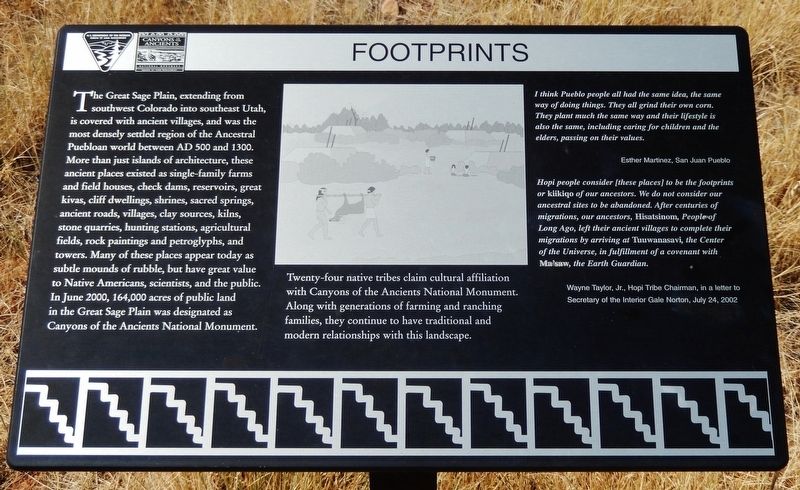
The Great Sage Plain, extending from southwest Colorado into southeast Utah, is covered with ancient villages, and was the most densely settled region of the Ancestral Puebloan world between AD 500 and 1300. More than just islands of architecture, these ancient places existed as single-family farms and field houses, check dams, reservoirs, great kivas, cliff dwellings, shrines, sacred springs, ancient roads, villages, clay sources, kilns, stone quarries, hunting stations, agricultural fields, rock paintings and petroglyphs, and towers. Many of these places appear today as subtle mounds of rubble, but have great value to Native Americans, scientists, and the public. In June 2000, 164,000 acres of public land in the Great Sage Plain was designated as Canyons of the Ancients National Monument.
Twenty-four native tribes claim cultural affiliation with Canyons of the Ancients National Monument. Along with generations of farming and ranching families, they continue to have traditional and modern relationships with this landscape.
I think Pueblo people all had the same idea, the same way of doing things. They all grind their own corn. They plant much the same way and their lifestyle is also the same, including caring for children and the elders, passing on their values.
—Esther Martinez, San Juan Pueblo
this page online
Hopi people consider [these places] to be the footprints or kiikiqo of our ancestors. We do not consider our ancestral sites to be abandoned. After centuries of migrations, our ancestors, Hisatsinom, People of Long Ago, left their ancient villages to complete their migrations by arriving at Tuuwanasavi, the Center of the Universe, in fulfillment of a covenant with Ma'saw, the Earth Guardian.
Wayne Taylor, Jr., Hopi Tribe Chairman, in a letter to Secretary of the Interior Gale Norton, July 24, 2002
Erected by United States Department of the Interior, Bureau of Land Management.
Topics. This historical marker is listed in these topic lists: Anthropology & Archaeology • Architecture • Indigenous Peoples and Communities. A significant historical year for this entry is 500 CE.
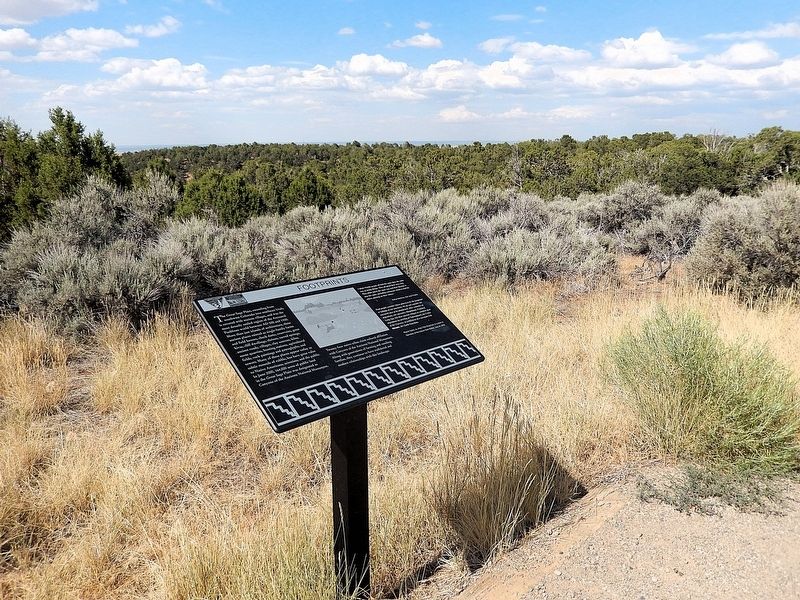
Location. 37° 35.099′ N, 108° 55.204′ W. Marker is near Pleasant View, Colorado, in Montezuma County. It can be reached from County Road 7.25 0.3 miles County Road CC. The marker is located on the Lowry Pueblo National Historic Landmark interpretive trail. Touch for map. Marker is in this post office area: Pleasant View CO 81331, United States of America.
Photographed by Cosmos Mariner, July 17, 2025
2. Footprints Marker

Regionally, this marker is in the American Mountain West, on the Colorado Plateau, and at the Four Corners. Globally, it is in North America, the Rocky Mountains, the Western Hemisphere, the Western World, and the Anglosphere. Historically, it finds itself in what was once Mexico’s Alta California.
Other nearby markers. At least 8 other markers are within walking distance of this marker: Life Outside (within shouting distance of this marker); Lowry Ruin (within shouting distance of this marker); Painted Kivas (within shouting distance of this marker); What Did it Look Like? (within shouting distance of this marker); The Best Rooms in Town (within shouting distance of this marker); Construction, Expansion & Remodeling (within shouting distance of this marker); The Great Kiva (about 300 feet away, measured in a direct line); Common Ground (about 300 feet away). Touch for a list and map of all markers in Pleasant View.
Related markers. Click here for a list of markers that are related to this marker. Lowry Pueblo National Historic Landmark
Also see . . . Canyons of the Ancients National Monument (Wikipedia).
Excerpt: A national monument protecting an archaeologically significant landscape located in the southwestern region of the U.S. state of Colorado. The monument's 176,056 acres are managed by the Bureau of Land Management. The monument was proclaimed in order to preserve the largest concentration of archaeological sites in the United States, primarily Ancestral Puebloan ruins. As of 2022, over 8,500 individual archeological sites had been documented within the monument.(Submitted on December 28, 2025, by Cosmos Mariner of Cape Canaveral, Florida.)
The Lowry Pueblo National Historic Landmark consists of 8 kivas, a great kiva and 40 rooms built as high as three stories. The underground great kiva was built about 1090 AD and had murals painted over about 5 layers of plaster. About 1110 AD, another kiva was built on top of the original kiva. Based upon the size of the kiva it's thought that the Lowry Pueblo may have been a local center for religious gatherings and celebration.
Credits. This page was last revised on December 30, 2025. It was originally submitted on December 26, 2025, by Cosmos Mariner of Cape Canaveral, Florida. This page has been viewed 50 times since then and 30 times this year. Photos: 1, 2. submitted on December 28, 2025, by Cosmos Mariner of Cape Canaveral, Florida.
