Near Pleasant View in Montezuma County, Colorado — The American Mountains (Southwest)
Construction, Expansion & Remodeling
Lowry Pueblo National Historic Landmark
| — | Canyons of the Ancients National Monument | — |
Photographed by Cosmos Mariner, July 17, 2025
1. Construction, Expansion & Remodeling Marker
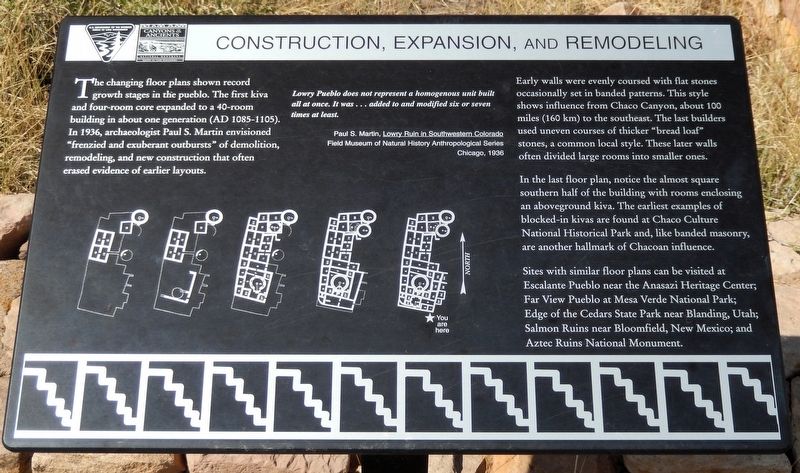
The changing floor plans shown record growth stages in the pueblo. The first kiva and four-room core expanded to a 40-room building in about one generation (AD 1085-1105). In 1936, archaeologist Paul S. Martin envisioned "frenzied and exuberant outbursts" of demolition, remodeling, and new construction that often erased evidence of earlier layouts.
Lowry Pueblo does not represent a homogenous unit built all at once. It was… added to and modified six or seven times at least.
—Paul S. Martin, Lowry Ruin in Southwestern Colorado
Field Museum of Natural History Anthropological Series
Chicago, 1936
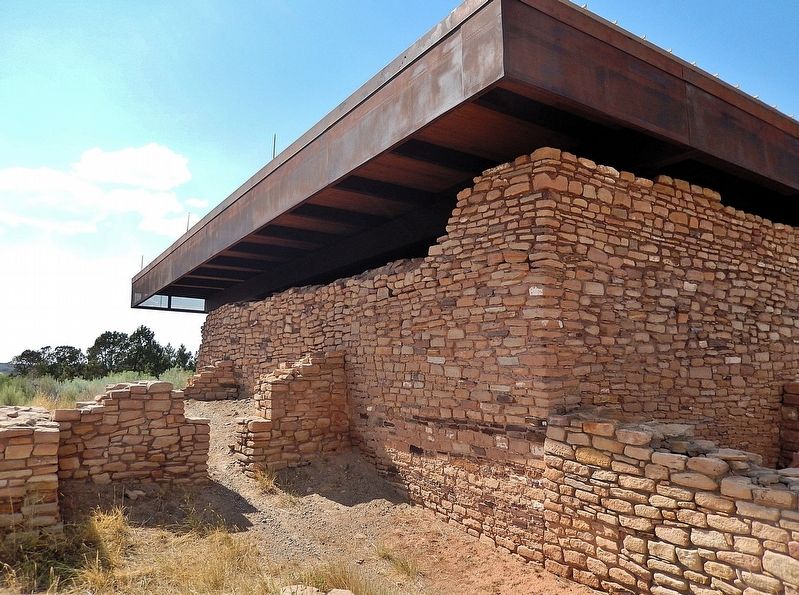
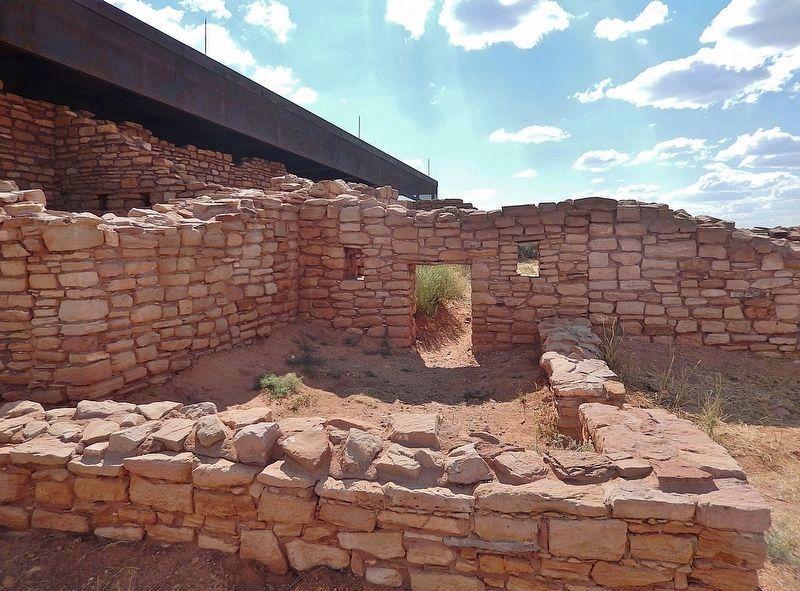
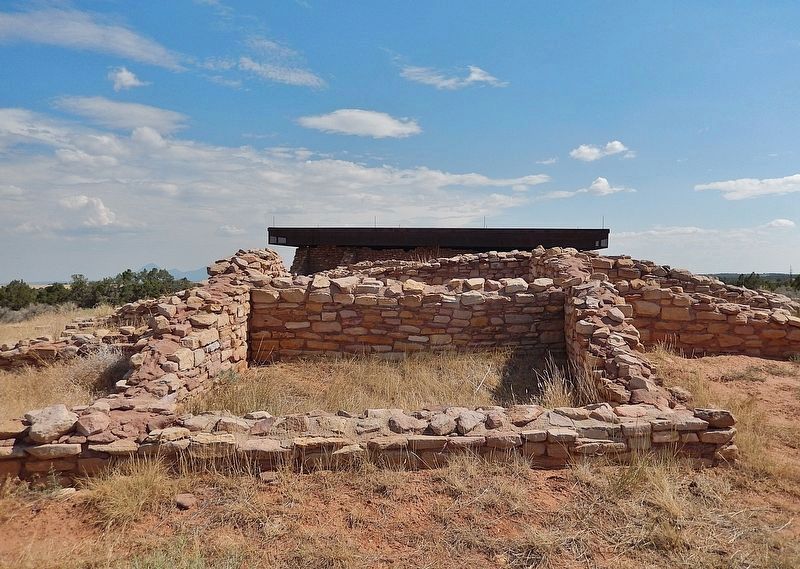
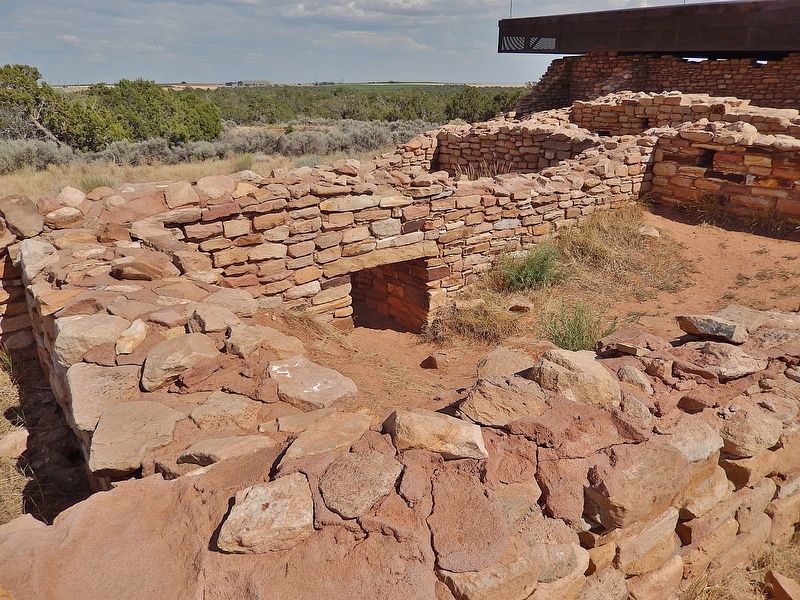
Early walls were evenly coursed with flat stones occasionally set in banded patterns. This style shows influence from Chaco Canyon, about 100 miles (160 km) to the southeast. The last builders used uneven courses of thicker "bread loaf" stones, a common local style. These later walls often divided large rooms into smaller ones.
In the last floor plan, notice the almost square southern half of the building with rooms enclosing an aboveground kiva. The earliest examples of blocked-in kivas are found at Chaco Culture National Historical
this page online
Sites with similar floor plans can be visited at Escalante Pueblo near the Anasazi Heritage Center; Far View Pueblo at Mesa Verde National Park; Edge of the Cedars State Park near Blanding, Utah; Salmon Ruins near Bloomfield, New Mexico; and Aztec Ruins National Monument.
Erected by United States Department of the Interior, Bureau of Land Management.
Topics. This historical marker is listed in these topic lists: Anthropology & Archaeology • Architecture • Indigenous Peoples and Communities.
Location. 37° 35.071′ N, 108° 55.203′ W. Marker is near Pleasant View, Colorado, in Montezuma County. It can be reached from County Road 7.25 0.3 miles south of County Road CC. The marker is located on the Lowry Pueblo National Historic Landmark interpretive trail. Touch for map. Marker is in this post office area: Pleasant View CO 81331, United States of America. Touch for directions.

Regionally, this marker is in the American Mountain West, on the Colorado Plateau, and at the Four Corners. Globally, it
Photographed by Cosmos Mariner, July 17, 2025
2. Construction, Expansion & Remodeling Marker
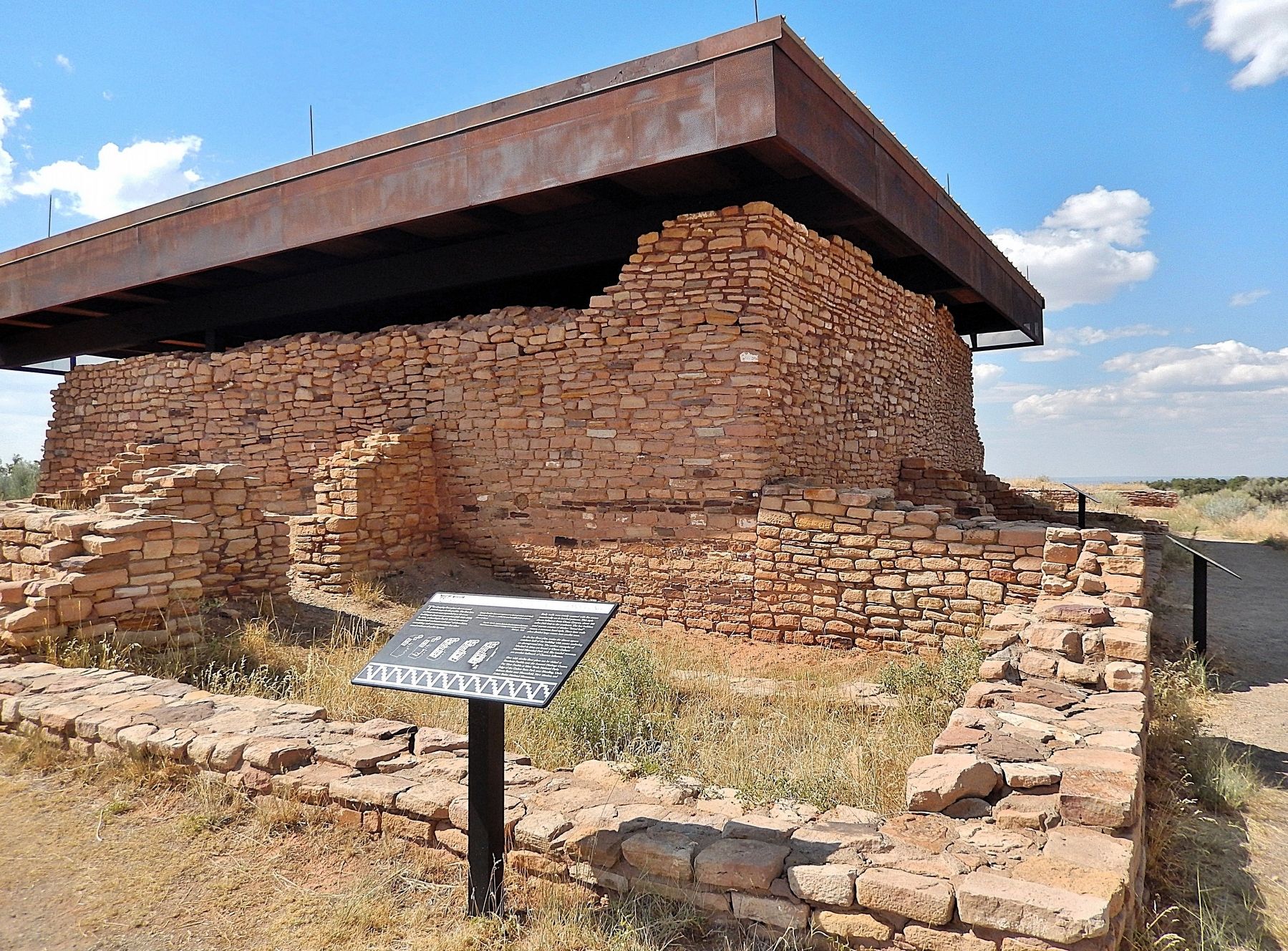
The marker is located near the southeast corner of the main pueblo ruins. Today the historic structures are protected by a contemporary free-standing steel canopy.
Other nearby markers. At least 8 other markers are within walking distance of this marker: The Best Rooms in Town (here, next to this marker); Painted Kivas (a few steps from this marker); What Did it Look Like? (a few steps from this marker); Life Outside (within shouting distance of this marker); Footprints (within shouting distance of this marker); The Great Kiva (within shouting distance of this marker); Lowry Ruin (within shouting distance of this marker); Common Ground (within shouting distance of this marker). Touch for a list and map of all markers in Pleasant View.
Related markers. Click here for a list of markers that are related to this marker. Lowry Pueblo National Historic Landmark
Also see . . . Lowry Pueblo National Historic Landmark (www.cyark.org).
Excerpt: The Lowry Pueblo National Historic Landmark is a Puebloan “Great House” that contains thirty-seven rooms, eight kivas, and one Great Kiva. Archaeologists have(Submitted on December 29, 2025, by Cosmos Mariner of Cape Canaveral, Florida.)dated the construction and occupation of the site to 100 years in the 11th Century though there is evidence that people continued to use the site into the mid-1200s. Lowry Pueblo was first recorded in 1918 by the Jesse Walter Fewkes of the Smithsonian Institution's Bureau of American ethnology and was first excavated by Paul S. Martin from the Chicago based Field Museum in 1930, 1931, 1933 and 1934.Photographed by Cosmos Mariner, July 17, 20253. Lowry Pueblo (southeast elevation)
Photographed by Cosmos Mariner, July 17, 2025
4. Lowry Pueblo (northeast view)
Photographed by Cosmos Mariner, July 17, 2025
5. Lowry Pueblo (north view)
Photographed by Cosmos Mariner, July 17, 2025
6. Lowry Pueblo (northwest view)
Credits. This page was last revised on December 30, 2025. It was originally submitted on December 26, 2025, by Cosmos Mariner of Cape Canaveral, Florida. This page has been viewed 61 times since then and 30 times this year. Photos: 1, 2, 3, 4, 5, 6. submitted on December 29, 2025, by Cosmos Mariner of Cape Canaveral, Florida.
