Near Pleasant View in Montezuma County, Colorado — The American Mountains (Southwest)
Painted Kivas
Lowry Pueblo National Historic Landmark
| — | Canyons of the Ancients National Monument | — |
Photographed by Cosmos Mariner, July 17, 2025
1. Painted Kivas Marker
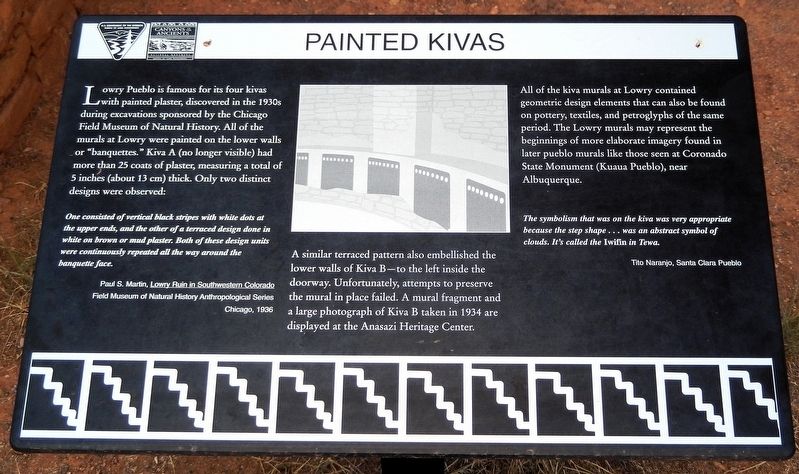
Lowry Pueblo is famous for its four kivas with painted plaster, discovered in the 1930s during excavations sponsored by the Chicago Field Museum of Natural History. All of the murals at Lowry were painted on the lower walls or "banquettes." Kiva A (no longer visible) had more than 25 coats of plaster, measuring a total of 5 inches (about 13 cm) thick. Only two distinct designs were observed:
One consisted of vertical black stripes with white dots at the upper ends, and the other of a terraced design done in white on brown or mud plaster. Both of these design units were continuously repeated all the way around the banquette face.
—Paul S. Martin, Lowry Ruin in Southwestern Colorado
Field Museum of Natural History Anthropological Series
Chicago, 1936
A similar terraced pattern also embellished the lower walls of Kiva B — to the left inside the doorway. Unfortunately, attempts to preserve the mural in place failed. A mural fragment and a large photograph of Kiva B taken in 1934 are displayed at the Anasazi Heritage Center.
All of the kiva murals at Lowry contained geometric design elements that can also be found on pottery, textiles,
this page online
The symbolism that was on the kiva was very appropriate because the step shape… was an abstract symbol of clouds. It's called the Iwifin in Tewa.
—Tito Naranjo, Santa Clara Pueblo
Erected by United States Department of the Interior, Bureau of Land Management.
Topics. This historical marker is listed in these topic lists: Anthropology & Archaeology • Architecture • Arts, Letters, Music • Indigenous Peoples and Communities.
Location. 37° 35.077′ N, 108° 55.201′ W. Marker is near Pleasant View, Colorado, in Montezuma County. It can be reached from County Road 7.25 0.3 miles south of County Road CC. The marker is located on the Lowry Pueblo National Historic Landmark interpretive trail. Touch for map. Marker is in this post office area: Pleasant View CO 81331, United States of America. Touch for directions.

Regionally, this marker is in the American Mountain
Photographed by Cosmos Mariner, July 17, 2025
2. Painted Kivas Marker
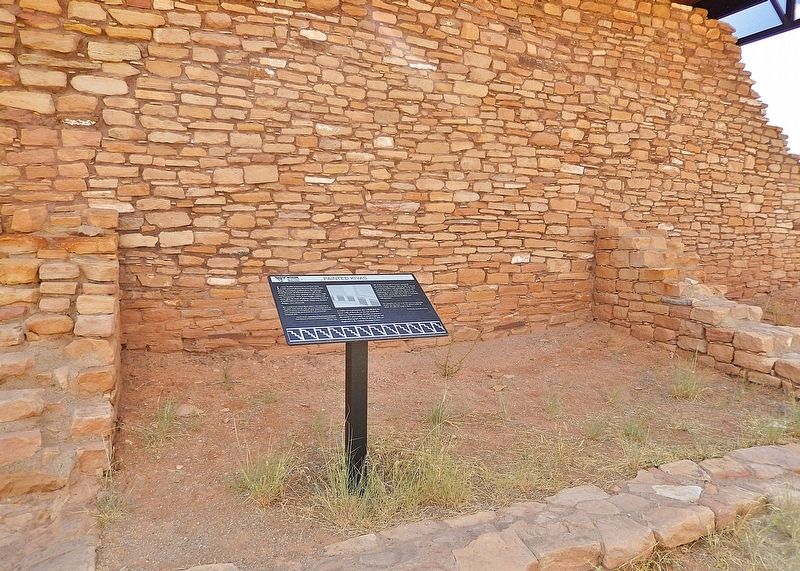
The marker is located on the east side of the main pueblo ruins. Today the historic structures are protected by a contemporary free-standing steel canopy.
Other nearby markers. At least 8 other markers are within walking distance of this marker: The Best Rooms in Town (here, next to this marker); Construction, Expansion & Remodeling (a few steps from this marker); What Did it Look Like? (a few steps from this marker); Life Outside (within shouting distance of this marker); Footprints (within shouting distance of this marker); Lowry Ruin (within shouting distance of this marker); The Great Kiva (within shouting distance of this marker); Common Ground (within shouting distance of this marker). Touch for a list and map of all markers in Pleasant View.
Related markers. Click here for a list of markers that are related to this marker. Lowry Pueblo National Historic Landmark
Also see . . . Lowry Pueblo National Historic Landmark (www.cyark.org).
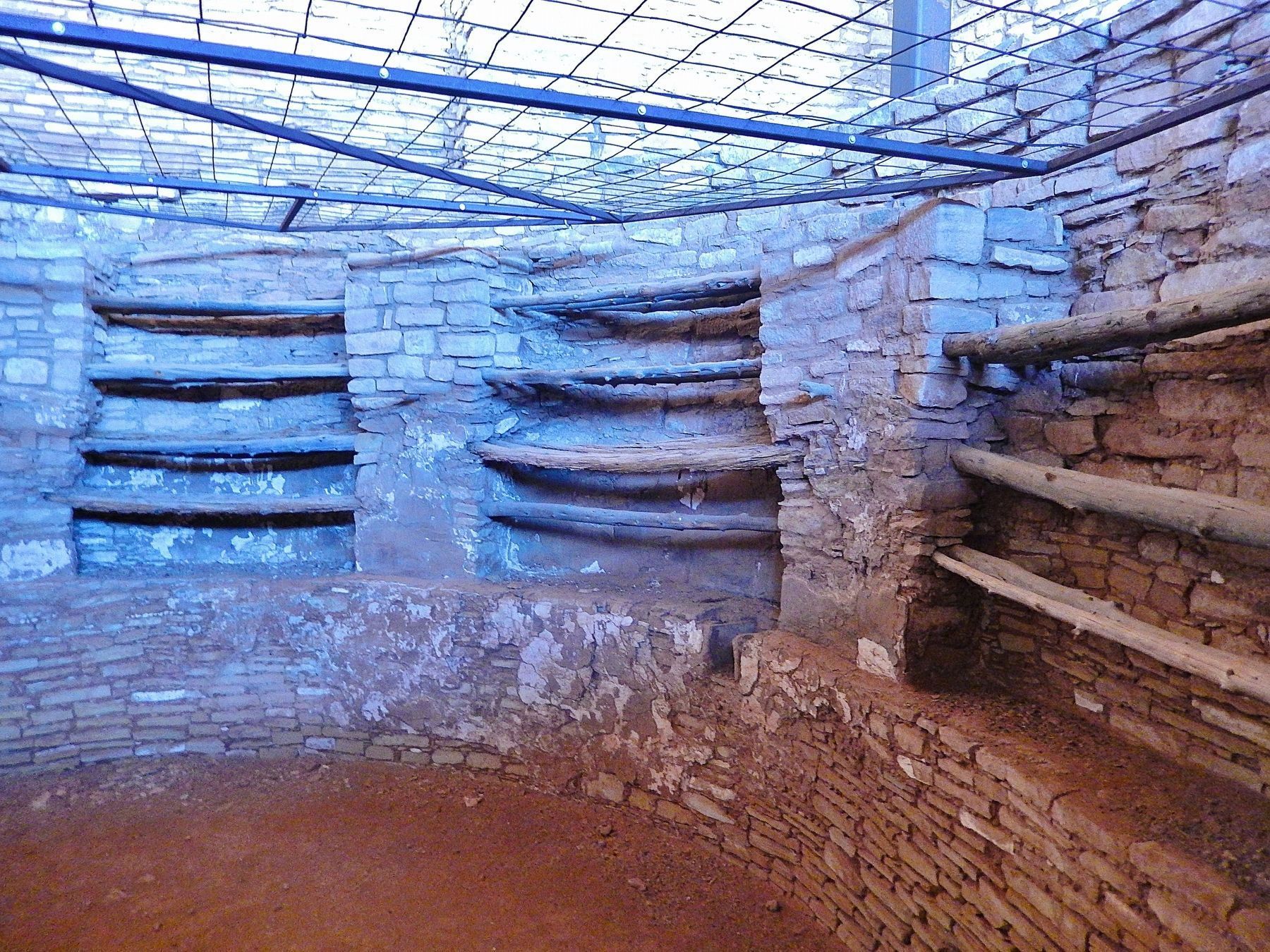
Excerpt: The Lowry Pueblo National Historic Landmark is a Puebloan “Great(Submitted on December 30, 2025, by Cosmos Mariner of Cape Canaveral, Florida.)House” that contains thirty-seven rooms, eight kivas, and one Great Kiva. Archaeologists have dated the construction and occupation of the site to 100 years in the 11th Century though there is evidence that people continued to use the site into the mid-1200s. Lowry Pueblo was first recorded in 1918 by the Jesse Walter Fewkes of the Smithsonian Institution's Bureau of American ethnology and was first excavated by Paul S. Martin from the Chicago based Field Museum in 1930, 1931, 1933 and 1934.Photographed by Cosmos Mariner, July 17, 20253. Kiva BKiva B is on the inside of the east wall. Access is via a short doorway near the southeast corner of the ruins. Traces of paint and plaster can be seen on the walls.
Credits. This page was last revised on December 30, 2025. It was originally submitted on December 26, 2025, by Cosmos Mariner of Cape Canaveral, Florida. This page has been viewed 67 times since then and 46 times this year. Photos: 1, 2, 3. submitted on December 30, 2025, by Cosmos Mariner of Cape Canaveral, Florida.
