Near St. Francisville in Clark County, Missouri — The American Midwest (Upper Plains)
Marquette and Joliet
Photographed by Connor Olson, October 17, 2025
1. Marquette and Joliet Marker
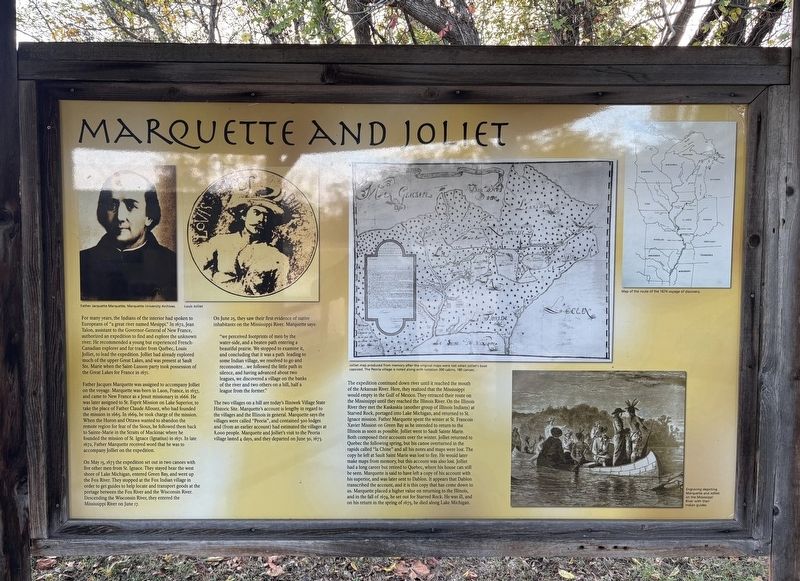
For many years, the Indians of the interior had spoken to Europeans of "a great river named Mesippi." In 1672, Jean Talon, assistant to the Governor-General of New France, authorized an expedition to find and explore the unknown river. He recommended a young but experienced French-Canadian explorer and fur trader from Québec, Louis Jolliet, to lead the expedition. Jolliet had already explored much of the upper Great Lakes, and was present at Sault Ste. Marie when the Saint-Lusson party took possession of the Great Lakes for France in 1671.
Father Jacques Marquette was assigned to accompany Jolliet on the voyage. Marquette was born in Laon, France, in 1637, and came to New France as a Jesuit missionary in 1666. He was later assigned to St. Esprit Mission on Lake Superior, to take the place of Father Claude Allouez, who had founded the mission in 1665. In 1669, he took charge of the mission. When the Huron and Ottawa wanted to abandon the remote region for fear of the Sioux, he followed them back to Sainte-Marie in the Straits of Mackinac where he founded the mission of St. Ignace (Ignatius) in 1671. In late 1672, Father
this page online
On May 15, 1673 the expedition set out in two canoes with five other men from St. Ignace. They stayed hear the west shore of Lake Michigan, entered Green Bay, and went up the Fox River. They stopped at the Fox Indian village in order to get guides to help locate and transport goods at the portage between the Fox River and the Wisconsin River.
Descending the Wisconsin River, they entered the Mississippi River on June 17.
On June 25, they saw their first evidence of native inhabitants on the Mississippi River. Marquette says:
"we perceived footprints of men by the water-side, and a beaten path entering a beautiful prairie. We stopped to examine it, and concluding that it was a path leading to some Indian village, we resolved to go and reconnoitre...we followed the little path in silence, and having advanced about two leagues, we discovered a village on the banks of the river and two others on a hill, half a league from the former."
The two villages on a hill are today's Iliniwek Village State Historic Site. Marquette's account is lengthy in
Photographed by Connor Olson, October 17, 2025
2. Marquette and Joliet Marker
The expedition continued down river until it reached the mouth of the Arkansas River. Here, they realized that the Mississippi would empty in the Gulf of Mexico. They retraced their route on the Mississippi until they reached the Illinois River. On the Illinois River they met the Kaskaskia (another group of Illinois Indians) at Starved Rock, portaged into Lake Michigan, and returned to St. Ignace mission. Father Marquette spent the winter at St. Francois Xavier Mission on Green Bay as he intended to return to the Illinois as soon as possible. Jolliet went to Sault Sainte Marie.
Both composed their accounts over the winter. Jolliet returned to Quebec the following spring, but his canoe overturned in the rapids called "la Chine" and all his notes and maps were lost. The copy he left at Sault Saint Marie was lost to fire. He would later make maps from memory, but this account was also lost. Jolliet had a long career but retired to Quebec, where his house can still be seen. Marquette is said to have left a copy of his account with his superior, and was later sent to Dablon. It appears that Dablon transcribed the account, and it is this copy that has come down to us. Marquette placed a higher value on returning to the Illinois, and in the fall of 1674, he set out for Starved Rock. He was ill, and on his return in the spring of 1675, he died along Lake Michigan.
Erected by Missouri Department of Natural Resources.
Topics. This historical marker is listed in these topic lists: Exploration • Indigenous Peoples and Communities • Waterways & Vessels. A significant historical date for this entry is May 15, 1673.
Location. 40° 25.739′ N, 91° 33.45′ W. Marker is near St. Francisville, Missouri, in Clark County. It can be reached from County Road 188 north of County Road 200, on the right when traveling north. Touch for map. Marker is at or near this postal address: 22569 County Rd 188, Wayland MO 63472, United States of America. Touch for directions.

Regionally, this marker is in North Missouri. It is also in the American Lewis & Clark Corridor, in the Corn Belt, and in the Great River Road Region. Globally, it is in North America, the Western Hemisphere, the Western World, and the Anglosphere. Historically, it finds itself in what was once the territory of the Mississippian Culture, the Louisiana Purchase, and the Antebellum South.
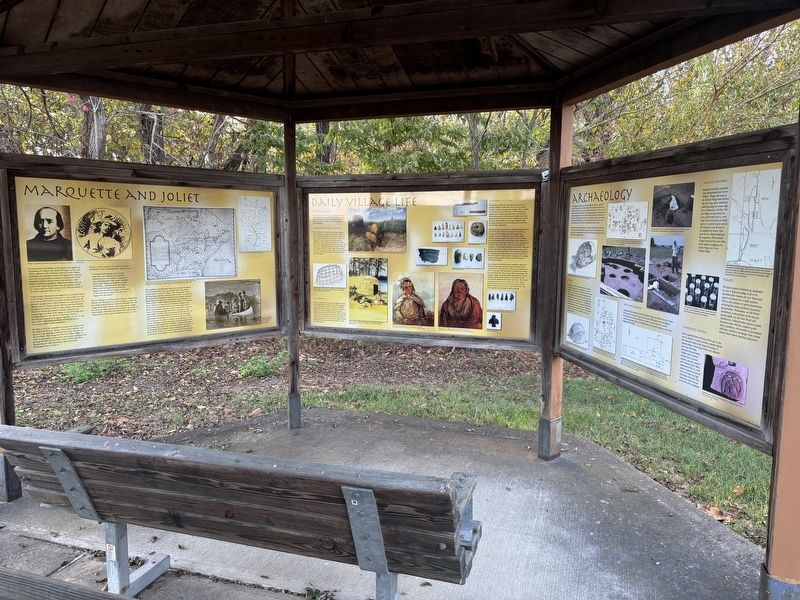
Other nearby markers. At least 8 other markers are within 8 miles of this marker, measured as the crow flies: The Illinois in History (here, next to this marker); Daily Village Life (here, next to this marker); Archeology (here, next to this marker); Origins, Groups, and Encounters (here, next to this marker); Iliniwek Village State Historic Site (here, next to this marker); The Longhouse (approx. 0.2 miles away); Fort Edwards (approx. 7.8 miles away in Illinois); Fort Edwards Monument (approx. 7.8 miles away in Illinois). Touch for a list and map of all markers in St. Francisville.
Credits. This page was last revised on December 28, 2025. It was originally submitted on December 28, 2025, by Connor Olson of Menomonee Falls, Wisconsin. This page has been viewed 89 times since then and 59 times this year. Photos: 1, 2. submitted on December 28, 2025, by Connor Olson of Menomonee Falls, Wisconsin. • Devry Becker Jones was the editor who published this page.
