Bemidji in Beltrami County, Minnesota — The American Midwest (Upper Plains)
Tragedy and Survival
Photographed by Cosmos Mariner, September 7, 2023
1. Tragedy and Survival Marker
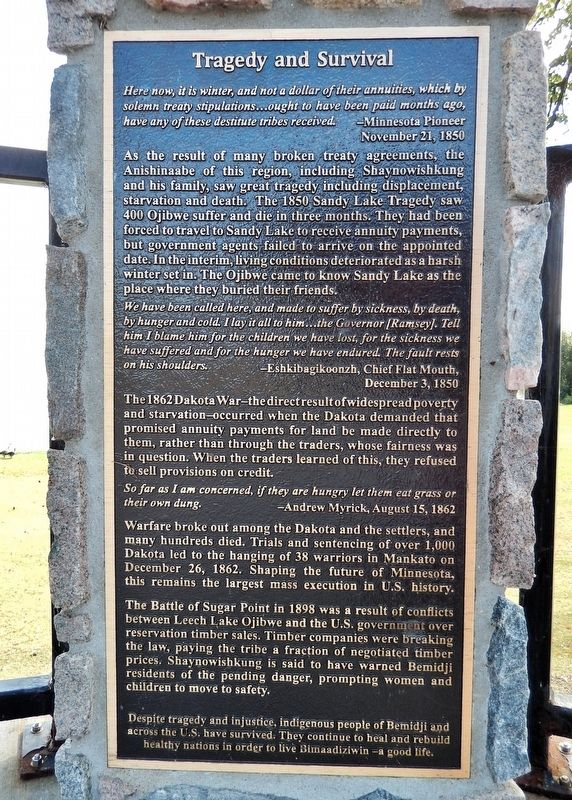
Here now, it is winter, and not a dollar of their annuities, which by solemn treaty stipulations… ought to have been paid months ago, have any of these destitute tribes received.
—Minnesota Pioneer, November 21, 1850
As a result of many broken treaty agreements, the Anishinaabe of this region, including Shaynowishkung and his family, saw great tragedy including displacement, starvation and death. The 1850 Sandy Lake Tragedy saw 400 Ojibwe suffer and die in three months. They had been forced to travel to Sandy Lake to receive annuity payments, but government agents failed to arrive on the appointed date. In the interim, living conditions deteriorated as a harsh winter set in. The Ojibwe came to know Sandy Lake as the place where they buried their friends.
We have been called here, and made to suffer by sickness, by death, by hunger and cold. I lay it all to him… the Governor [Ramsey]. Tell him I blame him for the children we have lost, for the sickness we have suffered and for the hunger we have endured. The fault rests on his shoulders.
—Eshkibagikoonzh, Chief Flat Mouth, December 3, 1850
The 1862 Dakota War — the direct result
this page online
So far as I am concerned, if they are hungry let them eat grass or their own dung.
—Andrew Myrick, August 15, 1862
Warfare broke out among the Dakota and the settlers, and many hundreds died. Trials and sentencing of over 1,000 Dakota led to the hanging of 38 warriors in Mankato on December 26, 1862. Shaping the future of Minnesota, this remains the largest mass execution in U.S. history.
The Battle of Sugar Point in 1898 was a result of conflicts between Leech Lake Ojibwe and the U.S. government over reservation timber sales. Timber companies were breaking the law, paying the tribe a fraction of negotiated timber prices. Shaynowishkung is said to have warned Bemidji residents of the pending danger, prompting women and children to move to safety.
Despite tragedy and injustice, indigenous people of Bemidji and across the U.S. have survived. They continue to heal
Photographed by Cosmos Mariner, September 7, 2023
2. Tragedy and Survival Marker
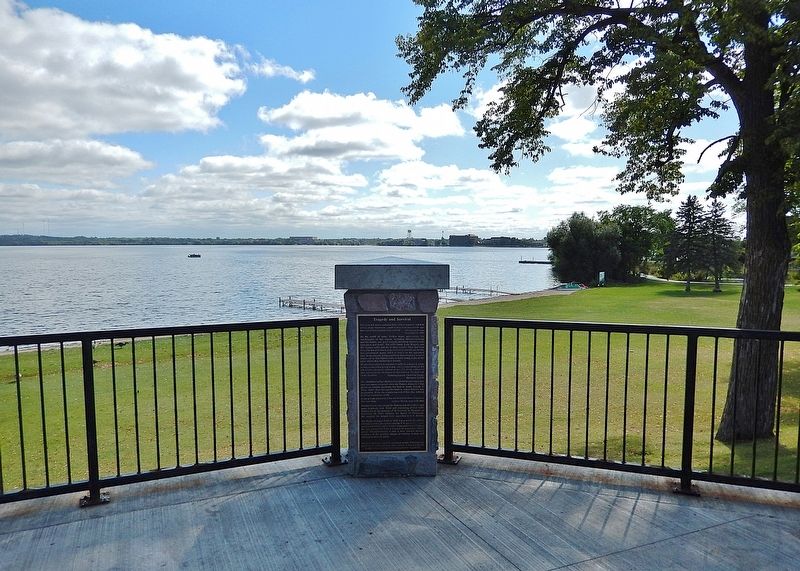
Looking southeast from the Paul Bunyan State Trail. Lake Bemidji is in the background.
Erected 2015 by City of Bemidji.
Topics. This historical marker is listed in these topic lists: Indigenous Peoples and Communities • Wars, US Indian. A significant historical year for this entry is 1850.
Location. 47° 28.317′ N, 94° 52.759′ W. Marker is in Bemidji, Minnesota, in Beltrami County. It is on Bemidji Avenue North (State Highway 197) just north of 4th Street Northwest, on the right when traveling north. The marker is beside the Paul Bunyan State Trail, overlooking Lake Bemidji. Touch for map. Marker is in this post office area: Bemidji MN 56601, United States of America. Touch for directions.

Regionally, this marker is in the Northland. It is also in the American Midwest and in the Corn Belt. Globally, it is in North America, the Great North Woods, the Western Hemisphere, the Western World, and the Anglosphere. Historically, it finds itself in what was once Rupert’s Land, the territory of the Mississippian Culture, the Louisiana Purchase, and the Northwest Territory.
Other nearby markers. At least 8 other markers are within walking
Photographed by Cosmos Mariner, September 7, 2023
3. Shaynowishkung Memorial Landing
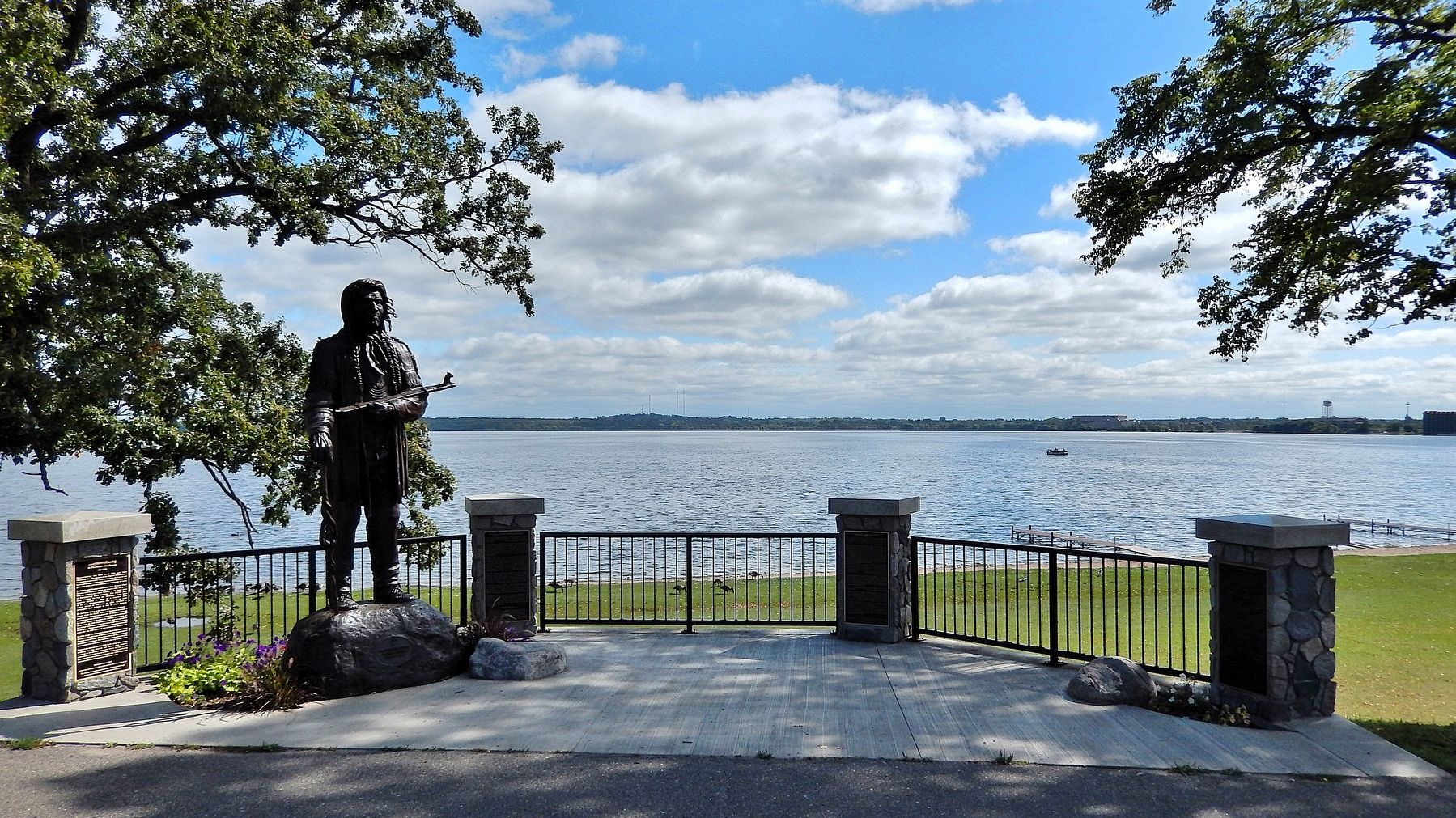
Looking east from the Paul Bunyan State Trail. Lake Bemidji is in the background. This is the 2nd from the right of 4 related historical markers at this location.
Related markers. Click here for a list of markers that are related to this marker.
Also see . . .
1. Sandy Lake Tragedy (Wikipedia).
Excerpt: The Sandy Lake Tragedy was the culmination in 1850 of a series of events centered in Big Sandy Lake, Minnesota that resulted in the deaths of several hundred Lake Superior Chippewa. Officials of the Zachary Taylor Administration and Minnesota Territory sought to relocate several bands of the tribe to areas west of the Mississippi River. By changing the location for fall annuity payments, the officials intended the Chippewa to stay at the new site for the winter, hoping to lower their resistance to relocation. Due to delayed and inadequate payments of annuities and lack of promised supplies, about 400 Ojibwe, mostly men and 12% of the tribe, died of disease, starvation and cold. The outrage increased Ojibwe resistance to removal. The bands effectively gained widespread public support to achieve permanent reservations in their traditional territories.(Submitted on December 29, 2025, by Cosmos Mariner of Cape Canaveral, Florida.)
2. Dakota War of 1862 (Wikipedia).
Excerpt: An armed conflict between the United States and several eastern bands of Dakota collectively known as the Santee Sioux. It began on August 18, 1862, when the Dakota, who were facing starvation and displacement, attacked the Lower Sioux Agency and white settlements along the Minnesota River valley in southwest Minnesota. The war lasted for five weeks and resulted in the deaths of hundreds of settlers and the displacement of thousands more. In the aftermath, the Dakota people were exiled from their homelands, forcibly sent to reservations in the Dakotas and Nebraska, and the State of Minnesota confiscated and sold all their remaining land in the state.(Submitted on December 29, 2025, by Cosmos Mariner of Cape Canaveral, Florida.)
3. Battle of Sugar Point (Wikipedia).
Excerpt: Fought on October 5, 1898 between the 3rd U.S. Infantry and members of the Pillager Band of Chippewa Indians in a failed attempt to apprehend Pillager Ojibwe Bugonaygeshig ("Old Bug" or "Hole-In-The-Day"), as the result of a dispute with Indian Service officials on the Leech Lake Reservation in Cass County, Minnesota. Often referred to as "the last Indian Uprising in the United States", the engagement was also the first battle to be fought in the area of the United States known as the Old Northwest since the Black Hawk War in 1832.(Submitted on December 29, 2025, by Cosmos Mariner of Cape Canaveral, Florida.)
Credits. This page was last revised on December 29, 2025. It was originally submitted on December 28, 2025, by Cosmos Mariner of Cape Canaveral, Florida. This page has been viewed 87 times since then and 42 times this year. Photos: 1, 2, 3. submitted on December 28, 2025, by Cosmos Mariner of Cape Canaveral, Florida.
