Delta in Delta County, Colorado — The American Mountains (Southwest)
Historic Fort Uncompahgre
On the Old Spanish Trail 1828-1844
Photographed by Cosmos Mariner, July 19, 2025
1. Historic Fort Uncompahgre Marker
The Story of a Western Colorado Fur Trader / By Ken Reyher, 1998
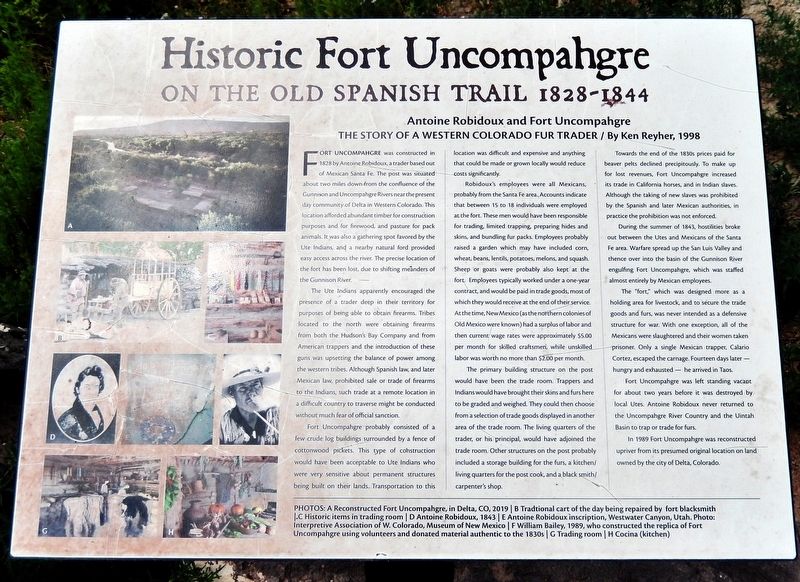
Fort Uncompahgre was constructed in 1828 by Antoine Robidoux, a trader based out of Mexican Santa Fe. The post was situated about two miles down from the confluence of the Gunnison and Uncompahgre Rivers near the present day community of Delta in Western Colorado. This location afforded abundant timber for construction purposes and for firewood, and pasture for pack animals. It was also a gathering spot favored by the Ute Indians, and a nearby natural ford provided easy access across the river. The precise location of the fort has been lost, due to shifting meanders of the Gunnison River.
The Ute Indians apparently encouraged the presence of a trader deep in their territory for purposes of being able to obtain firearms. Tribes located to the north were obtaining firearms from both the Hudson's Bay Company and from American trappers and the introduction of these guns was upsetting the balance of power among the western tribes. Although Spanish law, and later Mexican law, prohibited sale or trade of firearms to the Indians,
this page online
Fort Uncompahgre probably consisted of a few crude log buildings surrounded by a fence of cottonwood pickets. This type of construction would have been acceptable to Ute Indians who were very sensitive about permanent structures being built on their lands. Transportation to this location was difficult and expensive and anything that could be made or grown locally would reduce costs significantly.
Robidoux's employees were all Mexicans, probably from the Santa Fe area. Accounts indicate that between 15 to 18 individuals were employed at the fort. These men would have been responsible for trading, limited trapping, preparing hides and skins, and bundling fur packs. Employees probably raised a garden which may have included corn, wheat, beans, lentils, potatoes, melons, and squash. Sheep or goats were probably also kept at the fort. Employees typically worked under a one-year contract, and would be paid in trade goods, most of which they would receive at the end of their service. At the time, New Mexico (as the
2. Marker detail: Photos
The primary building structure on the post would have been the trade room. Trappers and Indians would have brought their skins and furs here to be graded and weighed. They could then choose from a selection of trade goods displayed in another area of the trade room. The living quarters of the trader, or his principal, would have adjoined the trade room. Other structures on the post probably included a storage building for the furs, a kitchen/living quarters for the post cook, and a black smith/carpenter's shop.
Towards the end of the 1830s prices paid for beaver pelts declined precipitously. To make up for lost revenues, Fort Uncompahgre increased its trade in California horses, and in Indian slaves. Although the taking of new slaves was prohibited by the Spanish and later Mexican authorities, in practice the prohibition was not enforced.
During the summer of 1843, hostilities broke out between the Utes and Mexicans of the Santa
Photographed by Cosmos Mariner, July 19, 2025
3. Historic Fort Uncompahgre Marker
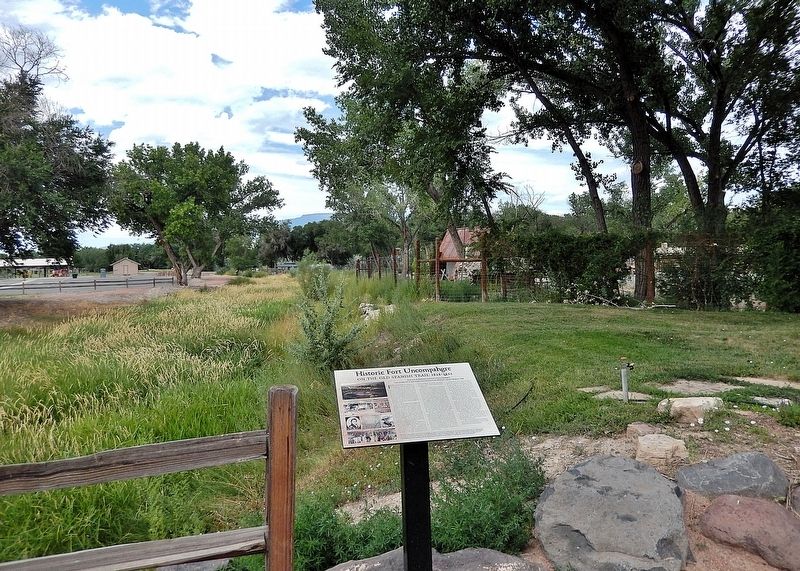
Looking west; Fort Uncompahgre Interpretive Center is in the right background.
The “fort,” which was designed more as a holding area for livestock, and to secure the trade goods and furs, was never intended as a defensive structure for war. With one exception, all of the Mexicans were slaughtered and their women taken prisoner. Only a single Mexican trapper, Calario Cortez, escaped the carnage. Fourteen days later — hungry and exhausted — he arrived in Taos.
Fort Uncompahgre was left standing vacant for about two years before it was destroyed by local Utes. Antoine Robidoux never returned to the Uncompahgre River Country and the Uintah Basin to trap or trade for furs.
In 1989 Fort Uncompahgre was reconstructed upriver from its presumed original location on land owned by the city of Delta, Colorado.
[photo captions]
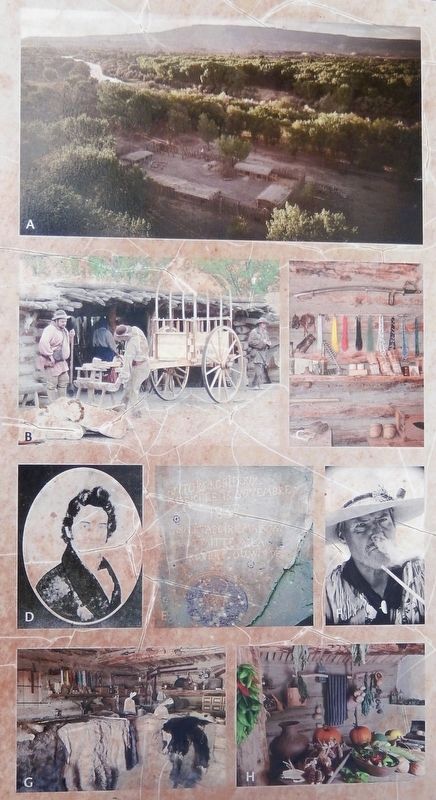
A — Reconstructed Fort Uncompahgre, in Delta, CO, 2019
B — Traditional cart of the day being repaired by fort blacksmith
C — Historic items in trading room
D — Antoine Robidoux, 1843
E — Antoine Robidoux inscription, Westwater Canyon, Utah. Photo: Interpretive Association of W. Colorado, Museum of New Mexico
F — William Bailey, 1989, who constructed the replica of Fort Uncompahgre using volunteers and donated material authentic to the 1830s
G — Trading room
H — Cocina (kitchen)
Topics and series. This historical marker is listed in these topic lists: Forts and Castles • Indigenous Peoples and Communities • Industry & Commerce • Waterways & Vessels. In addition, it is included in the Old Spanish National Trail series list. A significant historical year for this entry is 1828.
Location. 38° 44.969′ N, 108° 4.417′ W. Marker is in Delta, Colorado, in Delta County. It can be reached from Gunnison River Drive (North Palmer Street) 0.3 miles west of U.S. 50. The marker is on the Fort Uncompahgre Interpretive Center grounds. Touch for map. Marker is at or near this postal address: 330 Gunnison River Drive, Delta CO 81416, United States of America. Touch for directions.

Regionally, this marker is in the Western Slope. It is also in the American Mountain West and on the Colorado Plateau. Globally, it is in North America, the Rocky Mountains, the Western Hemisphere, the Western World, and the Anglosphere. Historically, it finds itself in what was once Mexico’s Alta California.
Other nearby markers. At least 8 other markers are within walking distance of this marker: Old Spanish National Historic Trail (a few steps from this marker); This is Ute Country (within shouting distance of this marker); Fort Uncompahgre (within shouting distance of this marker); The Tipi and the Wickiup (within shouting distance of this marker); The Ute Council Tree (within shouting distance of this marker); Western Slope Agriculture / Delta County (about 300 feet away, measured in a direct line); “Modern” Ferry (about 500 feet away); a different marker also named Ute Council Tree (approx. 0.4 miles away). Touch for a list and map of all markers in Delta.
Also see . . .
1. Antoine Robidoux (Wikipedia).
Excerpt: Robidoux was born in 1794 in Saint Louis, the fourth of six sons of Joseph Robidoux III, the owner of a Saint Louis-based fur trading company, and his wife Catherine Marie Rollet dit Laderoute. The Robidoux family is strongly connected to the history of the North American fur trade, with all of Joseph Robidoux's sons having participated to one degree or another in the family business.(Submitted on January 2, 2026, by Cosmos Mariner of Cape Canaveral, Florida.)
In 1829, Antoine and his younger brother Louis Robidoux petitioned for and were granted Mexican citizenship, which freed them to trade and settle in Mexican territory without having to worry about expensive tariffs and other international restrictions, as well as near-exclusive license to trap and trade in the Ute country of what is now western Colorado and eastern Utah. Around the same time, and possibly in partnership with Louis, Antoine established Fort Uncompahgre near the confluence of the Gunnison River (then known as the Río San Xavier) and the Uncompahgre River in west-central Colorado. Though the exact date of its completion is unknown, Robidoux's post was arguably the first permanent trading operation west of the continental divide.
2. Fort Uncompahgre (Wikipedia).
Excerpt: Fort Uncompahgre was a fur trading post constructed in 1828 by Antoine Robidoux, a trader based out of Mexican Santa Fe. The post was situated about two miles down from the confluence of the Gunnison River and the Uncompahgre River, near the present-day community of Delta, Colorado. Its design was more to secure goods and livestock than to be defensive and was abandoned in 1844 when hostilities broke out between Ute and Mexicans.(Submitted on January 2, 2026, by Cosmos Mariner of Cape Canaveral, Florida.)
Credits. This page was last revised on January 2, 2026. It was originally submitted on December 31, 2025, by Cosmos Mariner of Cape Canaveral, Florida. This page has been viewed 128 times since then and 127 times this year. Photos: 1, 2, 3. submitted on January 1, 2026, by Cosmos Mariner of Cape Canaveral, Florida.
