
Central Ward in Newark in Essex County, New Jersey — The American Northeast (Mid-Atlantic)
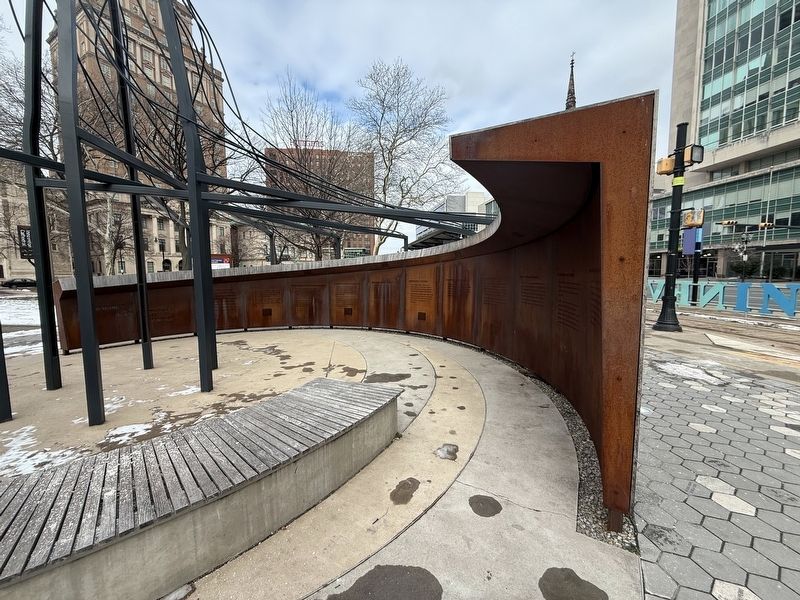
Harriet Tubman Monument
Shadow of a Face

Newark's Black Liberation Heritage
Newark's Black community has a long history of activism for liberation. For more than 250 years, free and enslaved Blacks worked for the liberation of themselves and others, building a community of activists and standing up boldly for their civil rights. This work served as the foundation for the political activism and cultural force of today's Newark.
First Africans in New Jersey
The African presence in New Jersey dates back to the 1600s. The earliest known evidence of enslaved Africans in Newark appears in slave owner Azariah Crane's will, dates 1721.
The earliest documented "self-liberation" in Newark was by a 35-year-old Black man named Charles, who ran away from his enslaver, Emanuel Cocker in 1748.
Black Soldiers in the American Revolution
The American Revolutionary War (1775-83) advanced the ideals of universal human equality but left intact the economic and social underpinnings of slavery. Some enslaved Africans saw the Revolution as an opportunity to advance their individual and community liberation.
Jack Cudjo Banquante, a native-born African enslaved by Benjamin
this page online
Freedom Seekers in New Jersey
Beginning in the early 1800s, fugitive slaves from Southern states increasingly came through New Jersey on their journey to Northern states and Canada, where they hoped to live as free individuals.
The Underground Railroad — the secretly organized network of institutions, safe houses, and like-minded Black and White abolitionist activists — operated in several states including New Jersey and assisted individuals in their strategies for freedom.
New Jersey Safe Houses
New Jersey had twelve confirmed safe houses as part of the Underground Railroad. Newark's known safe house, located at 70 Warren Street, was built in 1830 by Jacob D. King, a leader in the African Methodist Episcopal Zion Church (the first Black church in Newark) and a founding member of the Colored Anti-Slavery Society of Newark.
Newark's Black Churches
Newark's Black religious institutions were multifaceted sites for racial pride, education, community organizing, Underground Railroad activism, and fundraising

In 1849, Frederick Douglass spoke at the Colored Presbyterian Church to promote his newspaper, The North Star, and to rally the city's vibrant Black abolitionist community for the cause of freedom.
Colored Anti-Slavery Society
The Colored Anti-Slavery Society of Newark was one of the first Black-led antislavery organizations in the country. Organized in 1834 by local clergy and working-class Blacks, the Society called for an immediate end to slavery in New Jersey and worked tirelessly towards it.
White Abolitionists
Newark-based White abolitionists also fought for the immediate end to slavery. Some, not all, believed that Blacks should have full civil rights here in the United States, while some advocated for a mass relocation of free Blacks to Africa.
The goal of the American Colonization Society, for instance, was to gradually settle free Blacks and emancipated slaves in Liberia.
Black Business Owners
Many of the earliest successful Black Newark business owners were important supporters of the Underground Railroad. For instance, it is believed that Black stagecoach owners were essential to the
Anti-Abolitionist Interests
In the mid-1800s, Newark's leaders openly opposed abolitionist calls to federally end slavery, fearing it would destroy the city's valuable customer base in the South.
In 1839, a public meeting chaired by Newark's mayor and attended by the city's leading politicians, industrialists, and merchants resolved that the federal government should not intervene in Southern states' choice to continue slavery, thus preserving their economic and financial interests.
New Jersey Abolished Slavery
In his first act as governor of New Jersey, Marcus L. Ward, a Newark native who lived at 51 Washington Street, secured the state's ratification of the 13th Amendment to the U.S. Constitution on January 23, 1866. As the last state in the Union to fully abolish slavery, New Jersey joined its neighbors in supporting the freedom of all Black people.
Harriet Tubman's Life
c. 1822 Born into slavery in Maryland
c. 1827 Rented out as domestic servant
c. 1834 Protects enslaved man

1844 Marries John Tubman
1849 Escapes slavery to Pennsylvania
1850-1851 Rescues enslaved family members
1852 Works in Cape May to fund rescue missions
1854-1860 Conducts 12 Underground Railroad missions
1858 Speaks at antislavery meetings
1859 Buys a home in Auburn, New York
1861 Establishes the Fugitive Aid Society in Canada
1861-65 Serves as a Union Army spy
1863 First woman to lead an armed Civil War expedition
1868 Hosts orphaned children in her home
1869 Marries Nelson Davis and adopts daughter Gertie
1890s Joins the movement for women's right to vote
1896 Helps found the National Association of Colored Women
1913 Died on March 10 in Auburn
1990 March 10 is proclaimed National Harriet Tubman Day
2020 Harriet Tubman Museum opens in Cape May
2022 Harriet Tubman Square is dedicated in Newark
Erected 2022.
Topics and series. This historical marker and monument is listed in these topic lists: Abolition & Underground RR • African Americans • Industry & Commerce • Women. In addition, it is included in the African Methodist Episcopal Zion (AME Zion) Church series list. A significant historical date for this entry is January 23, 1866.
Location. 40° 44.608′ N,


Regionally, this marker and monument is in North Jersey and in the New York City Metropolitan Area. It is also in the American Northeast, in the Mid-Atlantic, and on the Eastern Seaboard. Globally, it is in the North Atlantic Region, North America, the Western Hemisphere, the Western World, and the Anglosphere. Historically, it finds itself in what was once New Netherland and also one of the original Thirteen Colonies.
Other nearby markers. At least 8 other markers are within walking distance of this marker: A different marker also named Harriet Tubman Monument (a few steps from this marker); Harriet Tubman Square (a few steps from this marker); Seth Boyden (a few steps from this marker); a different marker also named Seth Boyden (within shouting distance of this marker); Jose G. Artigas (within shouting distance of this marker); Line of March of Washington’s Army (within shouting distance of this marker); Columbus Square (about 300 feet away, measured in a direct line); 15 Washington Street (about 300 feet away). Touch for a list and map of all markers in Newark.
Another marker is no longer nearby. Christopher Columbus (was here, next to this marker but has been permanently removed).
Credits. This page was last revised on January 3, 2026. It was originally submitted on January 3, 2026, by Devry Becker Jones of Washington, District of Columbia. This page has been viewed 60 times since then. Photos: 1, 2, 3, 4, 5. submitted on January 3, 2026, by Devry Becker Jones of Washington, District of Columbia.
