Lakeview in Regina in Sherwood No. 159, Saskatchewan — The Prairie Region (North America)
Pile of Bones Creek

Photographed by Cosmos Mariner, June 20, 2022
1. Pile of Bones Creek Marker
Between 1857 and 1860 a British funded expedition led by Captain John Palliser sought to increase scientific knowledge of the Canadian west. When the group reached what is now the Regina area their September 1857 journal entry talked about “crossing the creek where the bones lie.”
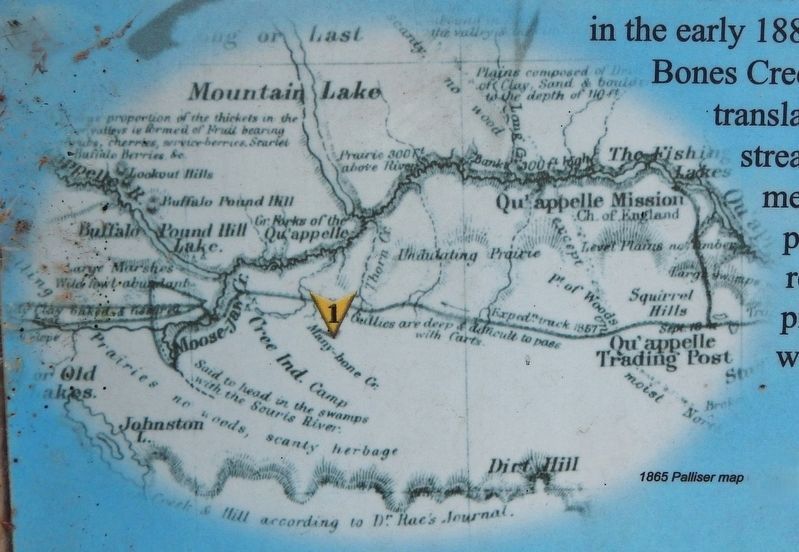
In 1865 a map of the Palliser study area was released. On this map the little creek described by Palliser was called “Many-bone Cr.”
When the first settlers began to arrive in Regina in the early 1880s, it was known as Pile O’ Bones Creek. “Pile-of-Bones” was a rough translation of the Cree term for the stream, Oskana-Ka-asateki, which means “the place that the bones are piled together.” This name was a reference to a well-known pile of bison bones which was arranged in a specific circular pattern on a small hill just west of the town. The bone pile had been erected by First Nations people (Cree) who believed the bison would not leave an area where the remains of their ancestors lay.
Perhaps drawn by the bones, bison were plentiful in the area around Wascana Creek prior to the arrival of the settlers. Birds and other animals were also common in
this page online
“In the evening reached the Creek where the Bones lie, where we found water and very little grass; a few willows also grew here but no wood fit for fuel”
(John Palliser journal, September 15, 1857)
Life along the creek changed dramatically during the late 19th century. Hunters were replaced by farmers and the bison disappeared completely from the prairies. The famous pile of bones was gathered up, along with millions of other bones from the prairies, and shipped east by rail to be made into fertilizer. Gone but not forgotten, the early residents of Regina chose to maintain a connection to this past by again returning to the Cree term for inspiration for the name “Wascana Creek.”
“If you had a lit-tle more wood, and a lit-tle more water, and here and there a hill, I think the prospect would be improved.”
—Sir John A. Macdonald, 1886.
Reply to Reginan who asked about the “prospect” of the city.

Glenbow Archives, Calgary
2. Marker detail: Captain John Palliser
[photo captions]
• Shipping Buffalo Bones by Rail
• North-West Mounted Police at barracks on Pile O’ Bones Creek, c.1885
Topics. This historical marker is listed in these topic lists: Animals • Exploration • Indigenous Peoples and Communities • Waterways & Vessels. A significant historical date for this entry is September 15, 1857.
Location. 50° 26.179′ N, 104° 37.068′ W. Marker is in Regina, Saskatchewan, in Sherwood No. 159. It is in Lakeview. It is on Albert Street Promenade north of Walter Scott Way. The marker is on the north side of Wascana Creek overlooking the creek and Albert Memorial Bridge. Touch for map. Marker is in this post office area: Regina SK S4P 2V9, Canada. Touch for directions.

Regionally, this marker is in Southeast Saskatchewan. It is also in the Prairies. Globally, it is in North America, the Western Hemisphere, the Western World, and the Anglosphere. Historically, it finds itself in what was once a British colony and also Rupert’s Land.
Other nearby markers. At least 8 other markers are within walking distance of this marker: The Evolution of a Bridge (within shouting distance of this marker); Regina's Lake 1883–1960 (within shouting distance of this marker); The Albert Memorial Bridge (about 120 meters away, measured in a direct line); Military Nurses of Canada / Les infirmières militaires du Canada (approx. 0.4 kilometers away); Saskatchewan Legislative Building (approx. 0.4 kilometers away); Saskatchewan Government Telephones Head Office (approx. 0.6 kilometers away); Chief Payepot (approx. 1.2 kilometers away); Regina Land Titles Building (approx. 1.2 kilometers away). Touch for a list and map of all markers in Regina.
Also see . . . Palliser Expedition (Wikipedia).
Excerpt: The Palliser expedition, officially the British North American Exploring Expedition,(Submitted on January 7, 2026, by Cosmos Mariner of Cape Canaveral, Florida.)explored and surveyed the open prairies and rugged wilderness of western Canada from 1857 to 1860. The expedition was led by Irish-born explorer John Palliser and accompanied by a party of four other men: James Hector, Eugène Bourgeau, Thomas Blakiston and John W. Sullivan. With the support of the British government and the Royal Geographical Society it became an official expedition with the stated purpose of gathering scientific information about the landscapes of British-claimed north-western North America (today's western Canada), in particular the territory of Rupert's Land, including information on the geography, climate, soil, flora and fauna, in order to discover its capabilities for settlement and transportation. The expedition was the first detailed and scientific survey of the region between Lake Superior and the southern passes of the Rockies in British North America.Library and Archives Canada3. Marker detail: 1865 Palliser Map

Photographed by Cosmos Mariner, June 20, 2022
4. Pile of Bones Creek Marker
Looking southwest from Albert Street Promenade. Wascana Creek and the Albert Memorial Bridge are in the background.
Credits. This page was last revised on January 7, 2026. It was originally submitted on January 5, 2026, by Cosmos Mariner of Cape Canaveral, Florida. This page has been viewed 108 times since then. Photos: 1, 2, 3, 4. submitted on January 7, 2026, by Cosmos Mariner of Cape Canaveral, Florida.
