Near Moncks Corner in Berkeley County, South Carolina — The American South (South Atlantic)
Wassamassaw
Photographed by Cindy Bullard, March 24, 2010
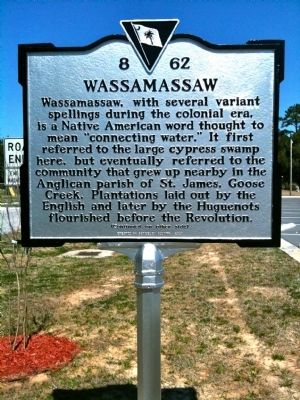
1. Wassamassaw Marker (front)
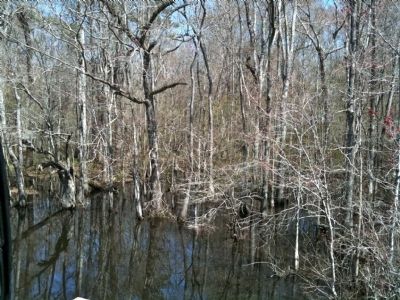
Wassamassaw, with several variant spellings during the colonial era, is a Native American word thought to mean “connecting water.” It first referred to the large cypress swamp here, but eventually referred to the community that grew up nearby in the Anglican parish of St. James, Goose Creek. Plantations laid out by the English and later by the Huguenots flourished before the Revolution.
[Reverse]
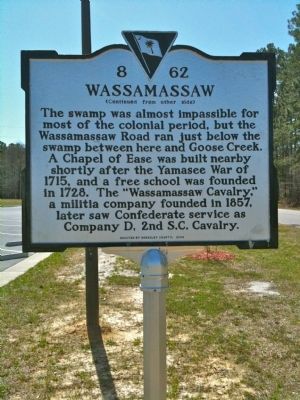
The swamp was almost impassible for most of the colonial period, but the Wassamassaw Road ran just below the swamp between here and Goose Creek. A Chapel of Ease was built nearby shortly after the Yamasee War of 1715, and a free school was founded in 1728. The “Wassamassaw Cavalry,” a militia company founded in 1857, later saw Confederate service as Company D, 2nd S.C. Cavalry.
Erected 2009 by Berkeley County. (Marker Number 8-62.)
Topics. This historical marker is listed in these topic lists: Colonial Era • War, US Civil. A significant historical year for this entry is 1715.
Location. 33° 8.954′ N, 80° 9.723′ W. Marker is near Moncks Corner, South Carolina, in Berkeley County. It is on Wassamassaw Lane 0.3
this page online

Regionally, this marker is in the Lowcountry and in Santee Cooper Country. It is also in the American South, specifically in the Deep South, and on the Eastern Seaboard. Globally, it is in the North Atlantic Region, North America, the Western Hemisphere, the Western World, and the Anglosphere. Historically, it finds itself in what was once the territory of the Mississippian Culture, one of the original Thirteen Colonies, one of the Confederate States of America, and the Antebellum South.
Other nearby markers. At least 8 other markers are within 9 miles of this marker, measured as the crow flies: Varner Town Indian Community (approx. 6.9 miles away); Cypress Methodist Camp Ground (approx. 7.2 miles away); Carnes Crossroads (approx. 7.3 miles away); St. John's Church (approx. 8.1 miles away); Berkeley County (approx. 8.1 miles away); Mulberry Plantation (approx. 8.3 miles away); Oakley School
Photographed by Cindy Bullard, March 24, 2010
2. Wassamassaw Marker (reverse)
Photographed by Cindy Bullard, March 24, 2010
3. Wassamassaw Cypress Swamp
Photographed by Cindy Bullard, March 24, 2010
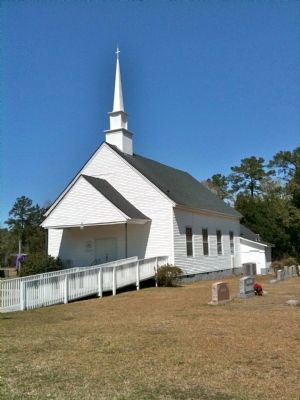
4. Wassamassaw Baptist Church
During the Civil War, General Sherman's army supposedly camped here during their march from Savannah to Columbia, and build a hospital to treat their wounded. When Sherman resumed his march, he burned the hospital, the orginal church and everything else. The church was rebuilt in 1882.
Photographed by Cindy Bullard, March 24, 2010
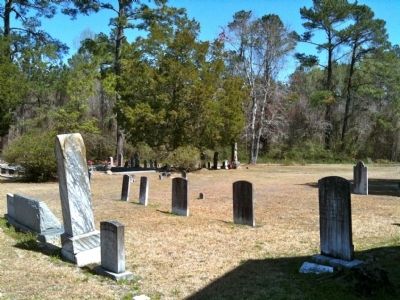
5. Wassamassaw Cemetery
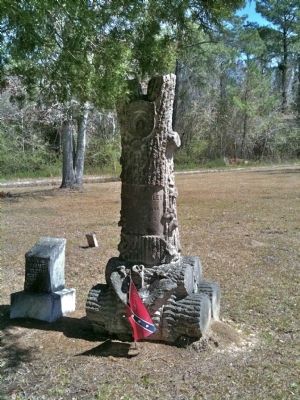
This cemetery is the burial place of 21 Confederate solders, possibly the largest number in any cemetery in South Carolina.
Photographed by Cindy Bullard, March 24, 2010
6. Grave of One Confederate Solder
Credits. This page was last revised on August 19, 2022. It was originally submitted on March 26, 2010, by David Bullard of Seneca, South Carolina. This page has been viewed 5,100 times since then and 175 times this year. Photos: 1, 2, 3, 4, 5, 6. submitted on March 26, 2010, by David Bullard of Seneca, South Carolina. • Craig Swain was the editor who published this page.
