Durango in La Plata County, Colorado — The American Mountains (Southwest)
Stuart Allen Roosa

Photographed by Cosmos Mariner, July 14, 2025
1. Stuart Allen Roosa Marker
In 1971, Stuart “Stu” Roosa, a Durango native, was the command module pilot on the Apollo 14 mission. Roosa was born in Durango in 1933 and called Durango home.
Stuart “Stu” Allen Roosa was born in Durango on August 16, 1933 and graduated from the University of Colorado. He enlisted in the military and became an Air Force test pilot. In 1966 Roosa was selected for NASA's elite astronaut corps.
As the command module pilot on the Apollo 14 mission, Roosa orbited the moon in February 1971 while fellow astronauts Alan Shepard and Edgar Mitchell explored the lunar surface.
Accompanied by his family, Stuart Roosa received a hero's welcome in Durango in July 1971. It was during ceremonies honoring Roosa that Roosa Park and the adjacent street, Roosa Avenue, were renamed as a tribute to Durango's space explorer.
Stuart Roosa retired from NASA and the Air Force in 1976. As a civilian, he became a corporate executive and entrepreneur. Roosa died in 1994 and is buried at Arlington National Cemetery in Virginia.
Erected by City of Durango and Colorado Historical Society.
Topics and series. This historical marker is listed
this page online
Location. 37° 16.736′ N, 107° 52.918′ W. Marker is in Durango, Colorado, in La Plata County. It is on Roosa Avenue just south of El Paso Street, on the left when traveling south. Touch for map. Marker is in this post office area: Durango CO 81301, United States of America. Touch for directions.

Regionally, this marker is in the American Mountain West and at the Four Corners. Globally, it is in North America, the Rocky Mountains, the Western Hemisphere, the Western World, and the Anglosphere. Historically, it finds itself in what was once the territory of the Ancestral Puebloans.
Other nearby markers. At least 8 other markers are within walking distance of this marker: La Plata County Vietnam Veteran Memorial (about 500 feet away, measured in a direct line); The “Fancy” Ladies (about 500 feet away); Electric Revolution (about 500 feet away); Swivel End-dump Car (about 600 feet away); The American Dream (about 600 feet away);
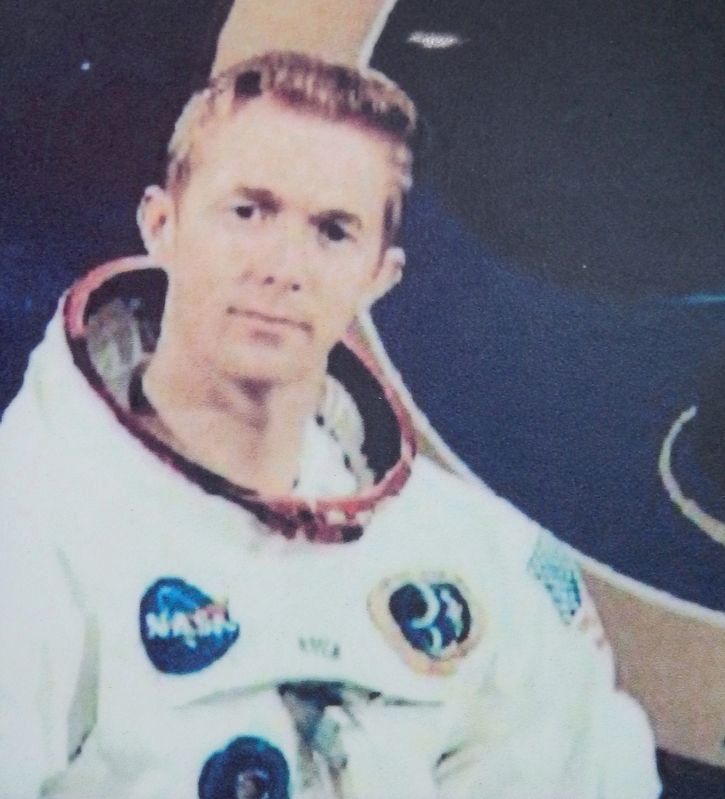
Courtesy NASA
2. Marker detail: Stuart Allen Roosa wearing his command module flight suit
Also see . . .
1. Stuart Allen Roosa (Wikipedia).
Excerpt: American aeronautical engineer, smokejumper, United States Air Force pilot, test pilot, and NASA astronaut, who was the Command Module Pilot for the Apollo 14 mission. The mission lasted from January 31 to February 9, 1971, and was the third mission to land astronauts (Alan Shepard and Edgar Mitchell) on the Moon. While Shepard and Mitchell spent two days on the lunar surface, Roosa conducted experiments from orbit in the Command Module Kitty Hawk. He was one of 24 men to travel to the Moon, which he orbited 34 times. Apollo 14 was Roosa’s only spaceflight.(Submitted on January 10, 2026, by Cosmos Mariner of Cape Canaveral, Florida.)
Roosa, who attended Harvard Business School's six-week Advanced Management Program in 1973, later held a number of positions in international and U.S. businesses. He founded Gulf Coast Coors in 1981, and served as its president until his death.
2. Apollo 14 (Wikipedia).
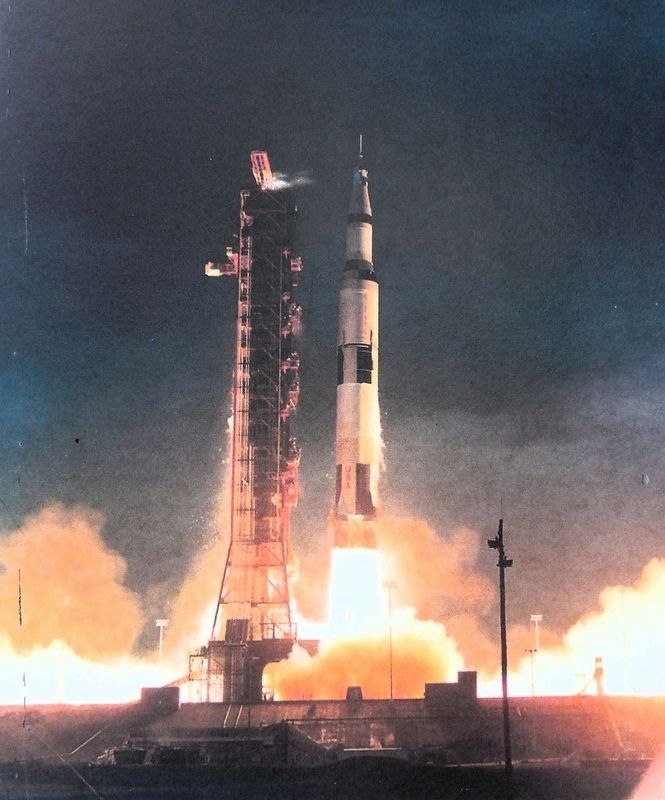
Courtesy NASA
3. Marker detail: Apollo 14 — Saturn V Rocket climbs from Cape Canaveral
Launch on January 31, 1971, carrying Alan Shepard, Edgar Mitchell, and Stuart Roosa.
Excerpt: Apollo 14 was the eighth crewed mission in the United States Apollo program, the third to land on the Moon, and the first to land in the lunar highlands. It was the last of the “H missions”, landings at specific sites of scientific interest on the Moon for two-day stays with two lunar extravehicular activities (EVAs or moonwalks). The mission was originally scheduled for 1970 but was postponed because of the investigation following the failure of Apollo 13 to reach the Moon's surface, and the need for modifications to the spacecraft as a result.(Submitted on January 10, 2026, by Cosmos Mariner of Cape Canaveral, Florida.)
While Shepard and Mitchell were on the surface, Roosa remained in lunar orbit aboard the Command and Service Module, performing scientific experiments and photographing the Moon, including the landing site of the future Apollo 16 mission.
Roosa, who worked in forestry in his youth, took several hundred tree seeds on the flight. These were germinated after the return to Earth and were widely distributed around the world as commemorative Moon trees. Some seedlings were given to state forestry associations in 1975 and 1976 to mark the United States Bicentennial.
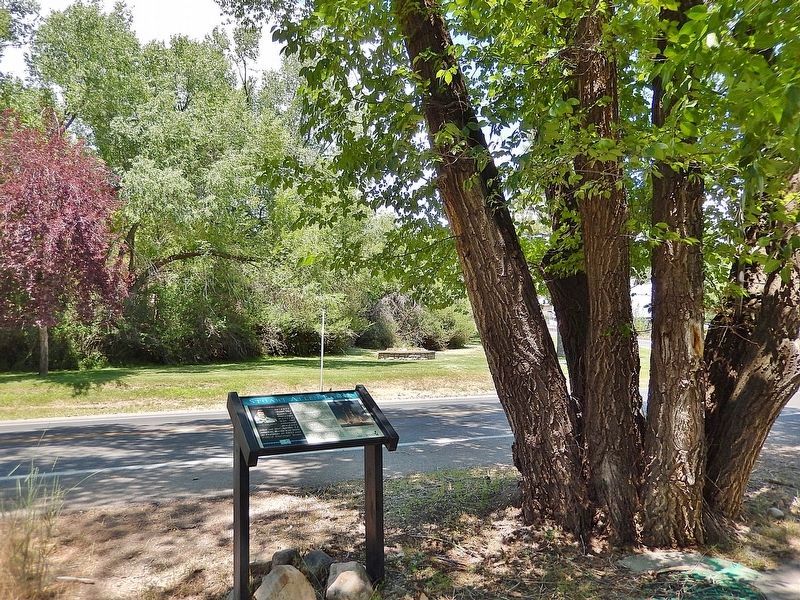
Photographed by Cosmos Mariner, July 14, 2025
4. Stuart Allen Roosa Marker
Roosa Avenue crosses behind the marker.
Credits. This page was last revised on January 10, 2026. It was originally submitted on January 7, 2026, by Cosmos Mariner of Cape Canaveral, Florida. This page has been viewed 113 times since then. Photos: 1, 2, 3, 4. submitted on January 10, 2026, by Cosmos Mariner of Cape Canaveral, Florida.
