Buckland in Prince William County, Virginia — The American South (Mid-Atlantic)
The Buckland Plan
Journey Through Hallowed Ground National Scenic Byway
Photographed by Devry Becker Jones (CC0), January 10, 2026
1. The Buckland Plan Marker
Inscription.
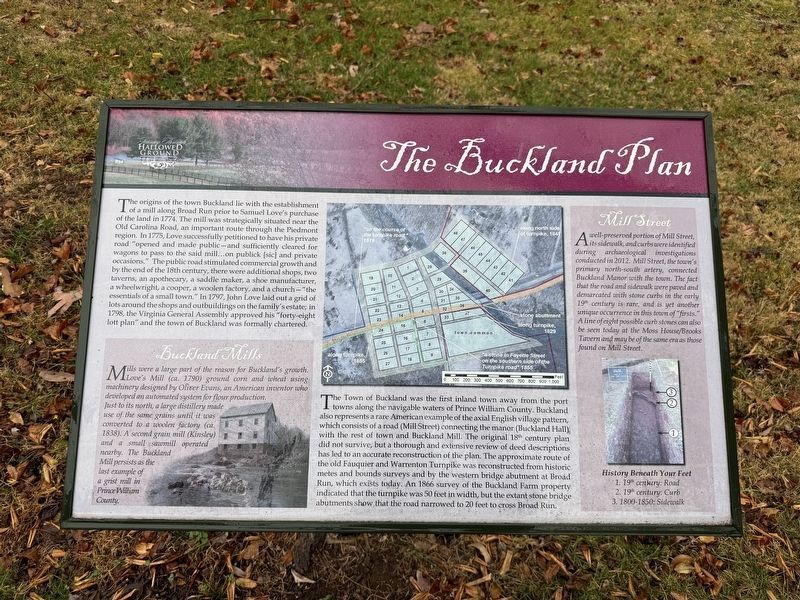
The Buckland Plan. . , The origins of the town Buckland lie with the establishment of a mill along Broad Run prior to Samuel Love's purchase of the land in 1774. The mill was strategically situated near the Old Carolina Road, an important route through the Piedmont region. In 1775, Love successfully petitioned to have his private road "opened and made public, and sufficiently cleared for wagons to pass to the said mill on publick [sic] and private occasions." The public road stimulated commercial growth and by the end of the 18th century, there were additional shops, two taverns, an apothecary, a saddle maker, a shoe manufacturer, a wheelwright, a cooper, a woolen factory, and a church , "the essentials of a small town." In 1797, John Love laid out a grid of lots around the shops and outbuildings on the family's estate; in 1798, the Virginia General Assembly approved his "forty-eight lott plan" and the town of Buckland was formally chartered., The Town of Buckland away from the port towns along the navigable waters of Prince William County. Buckland also represents a rare American example of the axial English village pattern, which consists of a road (Mill Street) connecting the manor (Buckland Hall) with the rest of town and Buckland Mill. The original 18th century plan did not survive, but a thorough and extensive review of deed descriptions has led to an accurate reconstruction of the plan. The approximate route of the old Fauquier and Warrenton Tunpike was reconstructed from historic metes and boundsd surveys and by the western bridge abutment at Broad Run, which exists today. An 1866 survey of the Buckland Farm property indicated that the turnpike was 50 feet in width, but the extant stone bridge abutments show that the road narrowed to 20 feet to cross Broad Run., [Sidebars:] ,
Buckland Mills. Mills were a large part of the reason for Buckland's growth. Love's Mill (ca. 1790) ground corn and wheat using machinery designed by Oliver Evans, an American inventor who developed an automated system for flour production. Just to its north, a large distillery made use of the same grains until it was converted to a woolen factory (ca. 1838). A second grain mill (Kinsley) and a small sawmill operated nearby. The Buckland Mill persists as the last example of a grist mill in Prince William County.,
Mill Street. A well-preserved portion of Mill Street, its sidewalk, and curbs were identified archaeological investigations conducted in 2012. Mill Street, the town's primary north-south artery, connected Buckland Manor with the town. The fact that the road and sidewalk were paved and demarcated with stone curbs in the early 19th century is rare, and is yet another unique occurrence in this town of "firsts." A line of eight possible curb stones can also be seen today at the Moss House/Brook Tavern and may be of the same era as those found on Mill Street.,
History Beneath Your Feet , 1. 19th century: Road , 2. 19th century: Curb , 3. 1800-1850: Sidewalk.
The origins of the town Buckland lie with the establishment of a mill along Broad Run prior to Samuel Love's purchase of the land in 1774. The mill was strategically situated near the Old Carolina Road, an important route through the Piedmont region. In 1775, Love successfully petitioned to have his private road "opened and made publicand sufficiently cleared for wagons to pass to the said mill on publick [sic] and private occasions." The public road stimulated commercial growth and by the end of the 18th century, there were additional shops, two taverns, an apothecary, a saddle maker, a shoe manufacturer, a wheelwright, a cooper, a woolen factory, and a church "the essentials of a small town." In 1797, John Love laid out a grid of lots around the shops and outbuildings on the family's estate; in 1798, the Virginia General Assembly approved his "forty-eight lott plan" and the town of Buckland was formally chartered.
The Town of Buckland away from the port towns along the navigable waters of Prince William County. Buckland also represents a rare American example of the axial English village pattern, which consists of a road (Mill Street) connecting the manor (Buckland Hall) with the rest of town and
Buckland Mill. The original 18th century plan did not survive, but a thorough and
Click or scan to see this page online
extensive review of deed descriptions has led to an accurate reconstruction of the plan. The approximate route of the old Fauquier and Warrenton Tunpike was reconstructed from historic metes and boundsd surveys and by the western bridge abutment at Broad Run, which exists today. An 1866 survey of the Buckland Farm property indicated that the turnpike was 50 feet in width, but the extant stone bridge abutments show that the road narrowed to 20 feet to cross Broad Run.
[Sidebars:]
Buckland Mills
Mills were a large part of the reason for Buckland's growth. Love's Mill (ca. 1790) ground corn and wheat using machinery designed by Oliver Evans, an American inventor who developed an automated system for flour production. Just to its north, a large distillery made use of the same grains until it was converted to a woolen factory (ca. 1838). A second grain mill (Kinsley) and a small sawmill operated nearby. The Buckland Mill persists as the last example of a grist mill in Prince William County.
Mill Street
A well-preserved portion of Mill Street, its sidewalk, and curbs were identified archaeological investigations conducted in 2012. Mill Street, the town's primary north-south artery, connected Buckland Manor with the town. The fact that the road and sidewalk were paved and demarcated with stone curbs
Photographed by Devry Becker Jones (CC0), January 10, 2026
2. The Buckland Plan Marker
in the early 19th century is rare, and is yet another unique occurrence in this town of "firsts." A line of eight possible curb stones can also be seen today at the Moss House/Brook Tavern and may be of the same era as those found on Mill Street.
History Beneath Your Feet
1. 19th century: Road
2. 19th century: Curb
3. 1800-1850: Sidewalk
Location. 38° 46.875′ N, 77° 40.441′ W. Marker is in Buckland, Virginia, in Prince William County. It is on Buckland Mill Road north of Lee Highway (U.S. 15/29), on the right when traveling north. Touch for map. Marker is at or near this postal address: 8111 Buckland Mill Rd, Gainesville VA 20155, United States of America. Touch for directions.

Regionally, this marker is in the Washington Metropolitan Area, in Northern Virginia, and in the Piedmont. It is also in the American South, specifically in the Upper South, and in the Mid-Atlantic. Globally, it is in the North Atlantic Region, North America, the Western Hemisphere, the Western World, and the Anglosphere. Historically, it finds itself in what was once the territory of the Mississippian Culture, one of the original Thirteen Colonies, one of the Confederate States of America, and the Antebellum South.
Credits. This page was last revised on January 10, 2026. It was originally submitted on January 10, 2026, by Devry Becker Jones of Washington, District of Columbia. This page has been viewed 46 times since then. Photos:1, 2. submitted on January 10, 2026, by Devry Becker Jones of Washington, District of Columbia.