
Downtown in Trenton in Mercer County, New Jersey — The American Northeast (Mid-Atlantic)
Honoring the Enslaved at William Trent House

Photographed by New Jersey Black Heritage Trail
1. Honoring the Enslaved at William Trent House Marker
Upon the death of wealthy merchant William Trent in 1724, eleven enslaved people (last names unknown) worked at his home and other properties along the Delaware River and were listed on his probate inventory: six men (Yaff, Julius, Bossin, Harry, Cupid, and Pedro), one woman (Joan), three boys (Bob, Dick, and Tom), and one girl (Nanny). After Trent’s death, it is believed that all or most of these enslaved individuals were sold to settle the estate and provide for his widow and young son. This history illustrates the vital role that enslaved people played in the creation of wealth among the colonial elite.
Erected 2025 by New Jersey Historical Commission, a division of the New Jersey Department of State. (Marker Number 2024.A.08.)
Topics. This historical marker is listed in these topic lists: African Americans • Civil Rights • Colonial Era. A significant historical year for this entry is 1724.
Location. 40° 12.791′ N, 74° 45.943′ W. Marker is in Trenton, New Jersey, in Mercer County. It is in Downtown. It is at the intersection of Market Street and William Trent Place, on the right when traveling east on Market
this page online

Regionally, this marker is in Central Jersey and in Greater Princeton. It is also in the American Northeast and in the Mid-Atlantic. Globally, it is in North America, the Western Hemisphere, the Western World, and the Anglosphere. Historically, it finds itself in what was once New Netherland and also one of the original Thirteen Colonies.
Other nearby markers. At least 8 other markers are within walking distance of this marker: William Trent House (a few steps from this marker); a different marker also named William Trent House (a few steps from this marker); a different marker also named William Trent House (within shouting distance of this marker); William Trent House (NHL) (within shouting distance of this marker); Trent House (within shouting distance of this marker); Trenton Ferry (approx. 0.2 miles away); Mercer County Courthouse (approx. ¼ mile away); Church of the Sacred Heart (approx. ¼ mile away). Touch for a list and map of all markers in Trenton.
Also see . . .
1. Welcome to the Trent House.
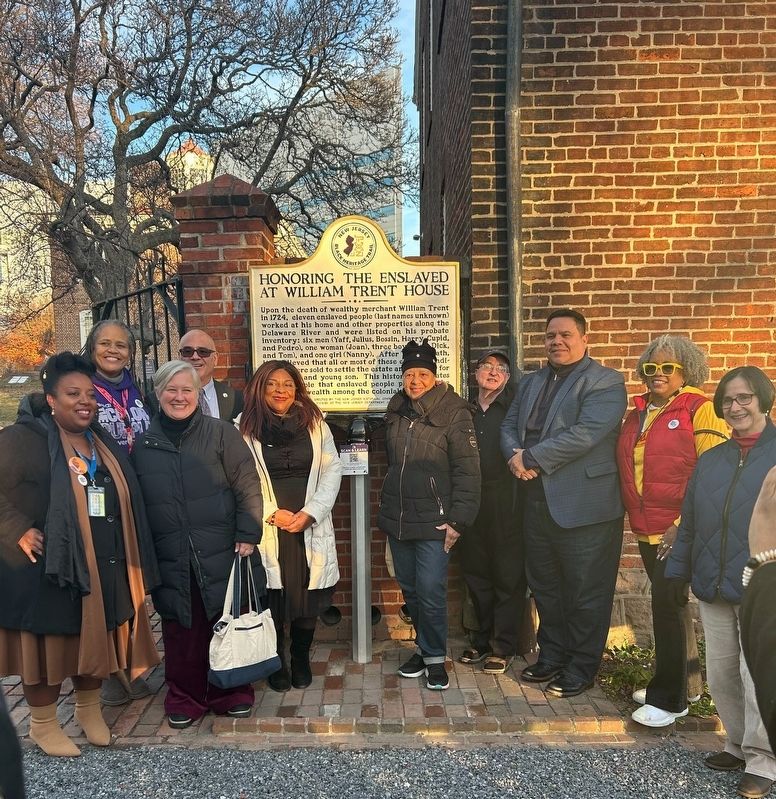
Photographed by New Jersey Black Heritage Trail, December 3, 2025
2. Marker Unveiling Ceremony
On December 3, 2025, the New Jersey Historical Commission unveiled a marker to recognize Honoring the Enslaved at William Trent House in Trenton, New Jersey. Interpretation at the Trent House today illustrates the vital role that enslaved people played in the creation of individual wealth among the colonial elite and the development of the colonial economy, laying the foundation for the wealth gap and other racial disparities of today.
2. William Trent House (Wikipedia). (Submitted on January 20, 2026, by Michael Herrick of Southbury, Connecticut.)

3. The 1719 William Trent House Museum

Photographed by 1719 William Trent House Museum
4. A portion of the Inventory of William Trent’s household

Photographed by 1719 William Trent House Museum.
5. Two reenactors representing enslaved women in the basement of the 1719 William Trent House Museum.

Photographed by New Jersey Black Heritage Trail
6. Mannequin representing Yaff, an enslaved man who worked at the home of William Trent.
Credits. This page was last revised on March 11, 2026. It was originally submitted on January 16, 2026, by New Jersey Black Heritage Trail of Trenton, New Jersey. This page has been viewed 91 times since then. Photos: 1, 2, 3, 4, 5, 6. submitted on January 16, 2026, by New Jersey Black Heritage Trail of Trenton, New Jersey. • Michael Herrick was the editor who published this page.
