Terry Sanford in Fayetteville in Cumberland County, North Carolina — The American South (South Atlantic)
Marquis de Lafayette
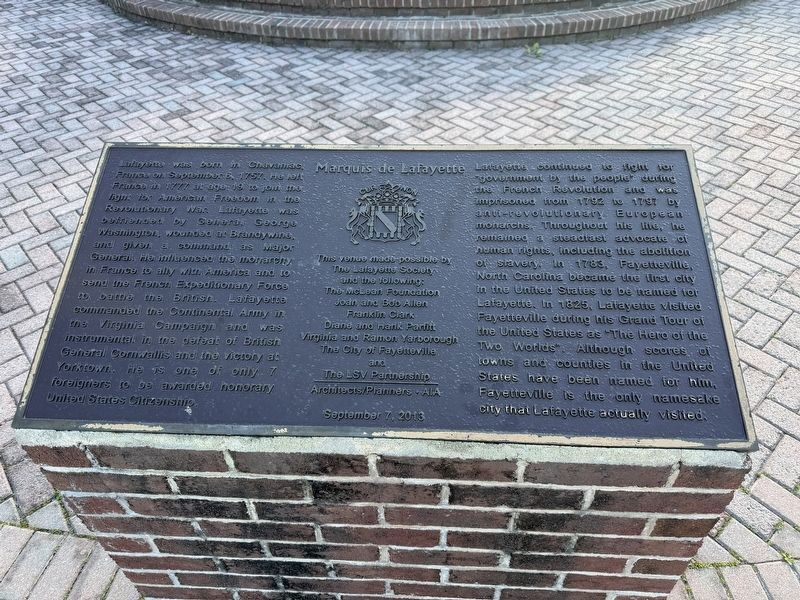
Lafayette was born in Chavaniac, France on September 6, 1757. He left France in 1777 at age 19 to join the fight for American Freedom in the Revolutionary War. Lafayette was befriended by General George Washington, wounded at Brandywine, and given a command as Major General. He influenced the monarchy in France to ally with America and to send the French Expeditionary Force to battle the British. Lafayette commanded the Continental Army in the Virginia Campaign and was instrumental in the defeat of British General Cornwallis and the victory at Yorktown. He is one of only 7 foreigners to be awarded honorary United States Citizenship.
Lafayette continued to fight for "government by the people" during the French Revolution and was imprisoned from 1792 to 1797 by anti-revolutionary European monarchs. Throughout his life, he remained a steadfast advocate of human rights, including the abolition of slavery. In 1783, Fayetteville, North Carolina became the first city in the United States to be named for Lafayette. In 1825, Lafayette visited Fayetteville during his Grand Tour of the United States as "The Hero of the Two Worlds".
this page online
Erected 2013 by The Lafayette Society; The McLean Foundation; Joan and Bob Allen; Franklin Clark; Diane and Hank Parfitt; Virginia and Raymond Yarborough; The City of Fayetteville and The LSV Partnership, Architects/Planners • AIA.
Topics and series. This historical marker is listed in these topic lists: Abolition & Underground RR • Patriots & Patriotism • War, US Revolutionary • Wars, Non-US. In addition, it is included in the Lafayette’s Farewell Tour series list. A significant historical date for this entry is September 6, 1757.
Location. 35° 3.229′ N, 78° 52.605′ W. Marker is in Fayetteville, North Carolina, in Cumberland County. It is in Terry Sanford. It is on Green Street north of Bow Street, on the right when traveling north. Touch for map. Marker is at or near this postal address: 212 Green St, Fayetteville NC 28301, United States of America. Touch for directions.

Regionally, this marker is in North Carolina’s Coastal Plain. It is also in the American South

Other nearby markers. At least 8 other markers are within walking distance of this marker: Lafayette (here, next to this marker); Lafayette Plaza (a few steps from this marker); Harry F. Shaw Cross Creek Linear Park (a few steps from this marker); Beth Dail Finch (within shouting distance of this marker); Lafayette's Tour (about 300 feet away, measured in a direct line); William Bartram Trail (about 300 feet away); Cornwallis (about 400 feet away); John Newberry (about 400 feet away). Touch for a list and map of all markers in Fayetteville.
Credits. This page was last revised on January 19, 2026. It was originally submitted on January 19, 2026, by Devry Becker Jones of Washington, District of Columbia. This page has been viewed 72 times since then. Photos: 1, 2. submitted on January 19, 2026, by Devry Becker Jones of Washington, District of Columbia.
