
Portsmouth, Virginia — The American South (Mid-Atlantic)
Gosport Shipyard
Revolutionary Naval Technology

Photographed by Mike McKeown, January 18, 2026
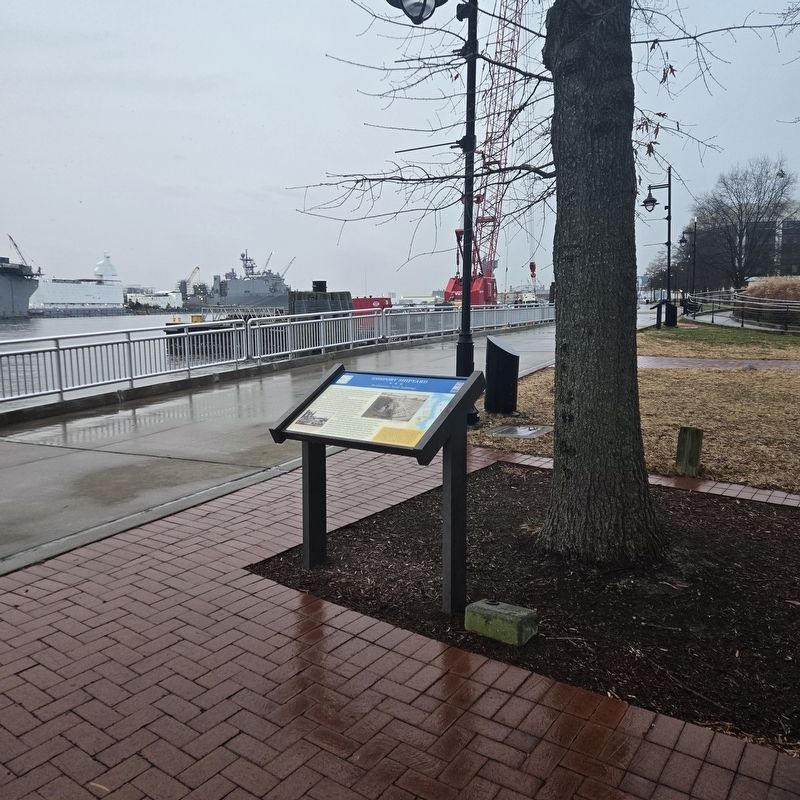
1. Gosport Shipyard Marker
This shipyard was so valuable that on April 21, 1861, Capt. Charles McCauley ordered the supplies, structures, and ships here to be burned before it was captured by the Confederacy. Almost immediately after taking command of the yard, the Confederates began salvaging the vessels and materials for the war effort. Among the smoldering ruins, they found the remains of the steam-powered USS Merrimack. After a local diving company raised the hull and placed it in historic Drydock No. 1, workers set about converting the 1856 steam frigate into the ironclad CSS Virginia.
On March 8, 1862, CSS Virginia steamed past this spot heading into Hampton Roads behind you. Virginia easily destroyed the wooden-hulled USS Cumberland and USS Congress, causing panic among Union officials. The following day, CSS Virginia and the ironclad
this page online
(sidebar)
Gosport Shipyard's historic Drydock No. 1 received its first ship in June 1833. It was the first drydock for building and repairing ships in America. The dock, constructed of enormous hand-cut granite slabs by white and enslaved laborers, is still in use today in its near-original configuration. During the construction of the dock, the use of enslaved skilled African American stonecutters led to protests by white stonecutters who objected to the manager's use of discounted labor rather than paying white workers the going rate. Enslaved workers at the shipyard performed the duties of masons, shipwrights and blacksmiths, among other occupations.
(captions)
This Dec. 1864 photograph by James Gardner shows combat artist Alfred R. Waud seated amidst the ruins of the Norfolk Navy Yard, which the Confederates had burned in 1862. - Courtesy Library of Congress
Drydock No. I looking west, ca. 1875. - Courtesy U.S. Navy
Erected by Virginia

Photographed by C. Ryan Dodson, April 10, 2026
2. Gosport Shipyard Marker
Topics and series. This historical marker is listed in these topic lists: Industry & Commerce • War, US Civil • Waterways & Vessels. In addition, it is included in the Virginia Civil War Trails series list. A significant historical date for this entry is April 21, 1861.
Location. 36° 50.102′ N, 76° 17.777′ W. Marker is in Portsmouth, Virginia. It can be reached from Water Street south of High Street, on the left when traveling south. Located on the waterfront near the Ferry Stop. Touch for map. Marker is at or near this postal address: 1 High St, Portsmouth VA 23704, United States of America. Touch for directions.

Regionally, this marker is in Virginia’s Hampton Roads, specifically in Coastal Virginia, and in the Hampton Roads Metropolitan Area. It is also in the American South, specifically in the Upper South, in the Tidewater, and on the Eastern Seaboard. Globally, it is in the North Atlantic Region, North America, the Western Hemisphere, the Western World, and the Anglosphere. Historically, it finds itself in what was once the territory of the Mississippian Culture, one of the original Thirteen
Photographed by Mike McKeown, January 18, 2026
3. Gosport Shipyard Marker
Other nearby markers. At least 8 other markers are within walking distance of this marker: First Order Fresnel Lens from the Hog Island Light (within shouting distance of this marker); Seaboard Air Line Railroad (within shouting distance of this marker); Portsmouth Medal of Honor Memorial (within shouting distance of this marker); The Elizabeth River (within shouting distance of this marker); In Commemoration of the Last Public Appearance of William F. “Buffalo Bill” Cody (within shouting distance of this marker); John Luke Porter (about 300 feet away, measured in a direct line); Naval Shipyard Museum (about 300 feet away); Cornwallis' Embarkation (about 300 feet away). Touch for a list and map of all markers in Portsmouth.
Related marker. Click here for another marker that is related to this marker. Old CWT Marker Near This Location titled "Gosport Navy Yard".
Also see . . .
1. The Gosport Navy Yard in the Civil War (American Battlefield Trust). (Submitted on January 18, 2026, by Mike McKeown of Baltimore, Maryland.)
2. Disaster at Gosport (US Naval Institute).
Photographed by Evan Dwyer, October 18, 2025
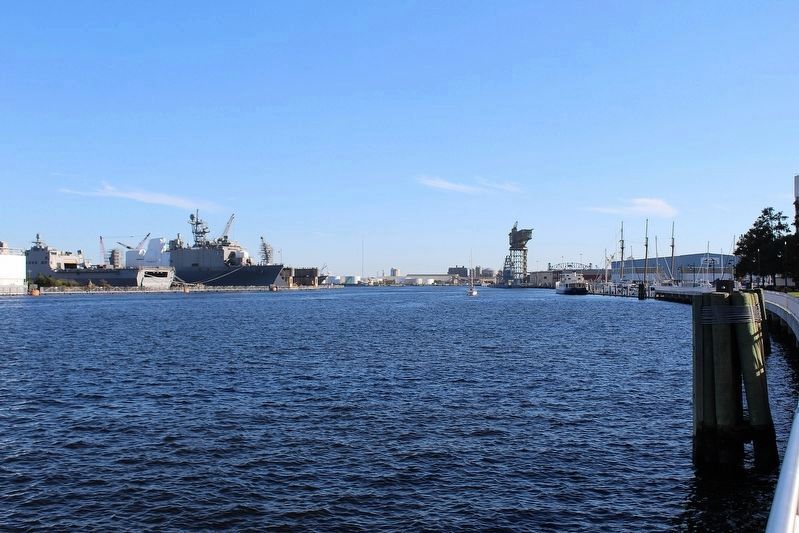
4. Gosport Shipyard Location
Looking down the Southern Branch Elizabeth River, Norfolk Naval Shipyard (original site of Gosport Nay Yard) is at right under the massive hammerhead crane. BAE Systems (formerly the shipyard's St Helena Annex) is at left, with USS Carter Hall (LSD-50) moored with her bow facing the river channel.
Photographed by Evan Dwyer, June 2, 2024
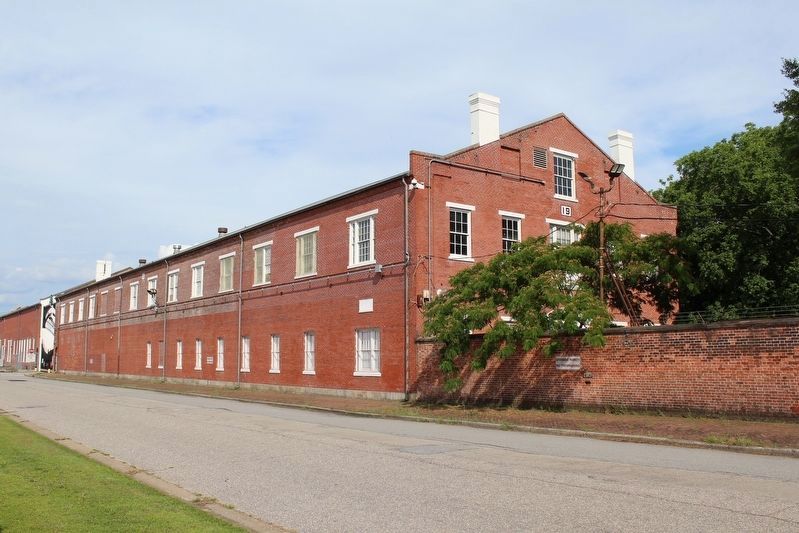
5. Gosport Shipyard Building 19
Built as a Rigging Loft, Armory, and Administrative Offices in 1852, this building's north end originally contained a clock tower between it and Building 51 on the opposite side. The main entrance to the Civil War-era shipyard was through the base of the tower between the two buildings. Today it is Gate 3. The original entrance is visible as the white gap between the brick buildings shown here. It was through that entrance that the yard was evacuated by Federal forces.

Photographed by Evan Dwyer, June 2, 2024
6. Gosport Shipyard
This corner of the shipyard features the perimeter wall, built in 1803, with Quarters Quarters B & C at left. All of this infrastructure was in place during the Civil War. This view is from Gosport Park. The 1837 Commandant's Quarters is out of frame to the left, between these quarters and Building 19.
Credits. This page was last revised on April 13, 2026. It was originally submitted on January 18, 2026, by Mike McKeown of Baltimore, Maryland. This page has been viewed 131 times since then. Last updated on January 19, 2026, by Mike McKeown of Baltimore, Maryland. Photos: 1. submitted on January 18, 2026, by Mike McKeown of Baltimore, Maryland. 2. submitted on April 12, 2026, by C. Ryan Dodson of Danville, Virginia. 3. submitted on January 18, 2026, by Mike McKeown of Baltimore, Maryland. 4, 5, 6. submitted on February 10, 2026, by Evan Dwyer of Richmond, Virginia. • Bernard Fisher was the editor who published this page.
