Gambles Hill in Richmond, Virginia — The American South (Mid-Atlantic)
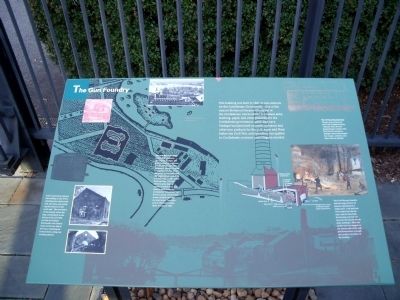
The Gun Foundry
Photographed by Bernard Fisher, November 3, 2009
1. The Gun Foundry Marker
This building was built in 1861 to cast cannons for the Confederate Government. One of the reasons Richmond became the capital of the Confederacy was its ability to produce arms, clothing, paper, and other essentials for the Confederate government, army, and navy. Tredegar had produced cannons, ordnance and other iron products for the U.S. Army and Navy before the Civil War, and this effort was applied to Confederate contracts once Virginia seceded.
The Civil War at Tredegar
Joseph Reid Anderson, the head of Tredegar, was given control of coal mines near Richmond and blast furnaces in western Virginia to maintain his flow of raw materials. He also reopened the Virginia Manufactory of Arms building, a state armory built between 1798 and 1810 for arms making. Another close-by arms production facility was the Confederate “laboratory” on Brown’s Island, where white women loaded cartridges for small arms. An explosion at the facility killed thirty women in 1863.
The 12 Pound Howitzer Gun
The gun you see here was cast in the Tredegar Foundry, 7 January 1862, and was designated gun number 1432. The Civil War records
this page online
[Sidebar:]
The Civil War gun foundry had two large exterior air furnaces operating on a single stack. Coal and iron were loaded into the furnace, and the heat from the burning coal was carried over the iron by the air draft, melting it. Then the molten iron was tapped on the interior side of the wall and flowed down a trough into molds in the floor of the foundry.
Topics. This historical marker is listed in these topic lists: Industry & Commerce • War, US Civil. A significant historical date for this entry is January 7, 1862.
Location. Marker has been permanently removed. It was located near 37° 32.119′ N, 77° 26.711′ W. Marker was in Richmond, Virginia. It was in Gambles Hill. It could be reached from Tredegar Street 0.1 miles west of South 5th Street. This marker is located outside the American Civil War Center at Historic Tredegar. Touch for map. Marker was at or near this postal address: 500 Tredegar Street, Richmond VA 23219, United States of America.
We have been informed that this marker is no longer there and will not be replaced. This page is an archival view of what was.
Regionally,
Photographed by Bernard Fisher, November 3, 2009
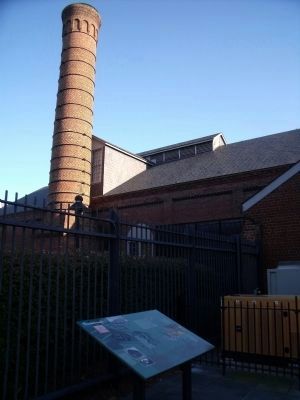
2. The Gun Foundry Stack

Other nearby markers. At least 2 other markers are within walking distance of this location: The Tredegar Iron Works (within shouting distance of this marker); a different marker also named Tredegar Iron Works (within shouting distance of this marker). Touch for a list and map of all markers in Richmond.
Other markers no longer nearby. Enterprise and Iron (was a few steps from this marker but has been permanently removed); Joseph Reid Anderson (was within shouting distance of this marker but has been permanently removed); The Cupola Furnace and Foundry (was within shouting distance of this marker but has been permanently removed); Civil War Visitor Center (was within shouting distance of this marker but has been
Photographed by Bernard Fisher, November 3, 2009
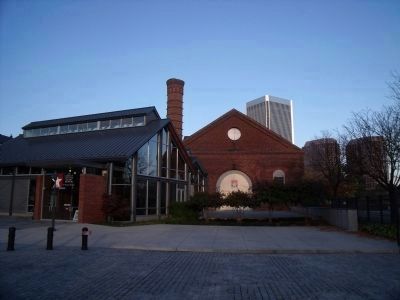
3. The Gun Foundry
Photographed by Bernard Fisher, November 3, 2009
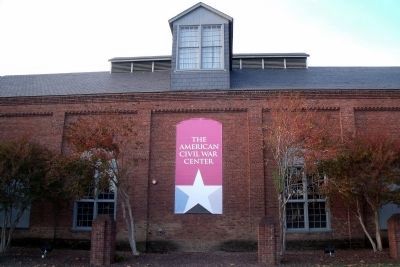
4. Home of the American Civil War Center at Historic Tredegar
More about this marker. On the upper left is a period photograph of the "Confederate Laboratories at Brown’s Island."
On the lower left are two photos of the foundry prior to restoration. The caption reads, "Ethyl Corporation restored this building in the 1970’s, rebuilding the whole south wall, the stack, and recreating the furnaces on the north side. The restoration of the foundry shows the deep commitment to the history of the Civil War era that has defined Richmond’s civic history. Much of the iron had to be recast, including furnace doors, using new wooden patterns."
On the right is a painting of the foundry interior showing the cannon casting process.
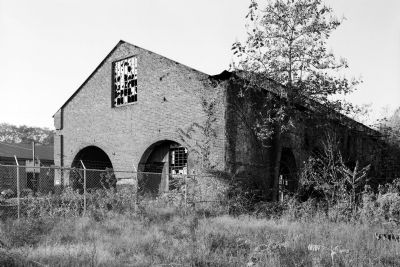
Photographed by Jack Boucher, 1971
5. Tredegar Iron Works - exterior view showing gabled end of structure.
"Vacant and fire-ridden, the several structures that housed the mills and foundries remain in various stages of ruin, and a majority of the large rooms required for operating of the foundry stand open to the sky." Library of Congress [HAER VA,44-RICH,104-1]
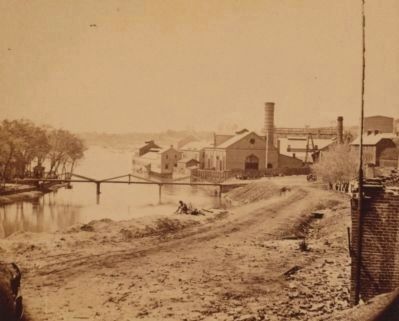
Photographed by Alexander Gardner, Apr 1865
6. The Gun Foundry at Tredegar Iron Works
Library of Congress [LC-USZC4-7968]
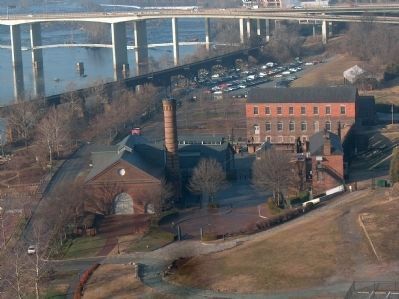
Photographed by David Tatum Jr, January 8, 2003
7. View of the Foundry Site Today
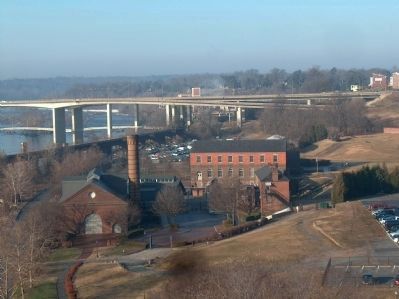
Photographed by David Tatum Jr, January 8, 2007
8. The Gun Foundry Marker
A view of the Foundry form the Construction Tower Crane
Credits. This page was last revised on January 20, 2026. It was originally submitted on November 5, 2009, by Bernard Fisher of Richmond, Virginia. This page has been viewed 2,480 times since then and 48 times this year. Last updated on January 19, 2026, by Evan Dwyer of Richmond, Virginia. Photos: 1, 2, 3, 4, 5, 6. submitted on November 5, 2009, by Bernard Fisher of Richmond, Virginia. 7, 8. submitted on November 6, 2009, by David Tatum Jr of Suffolk, Virginia. • Devry Becker Jones was the editor who published this page.
