Gambles Hill in Richmond, Virginia — The American South (Mid-Atlantic)
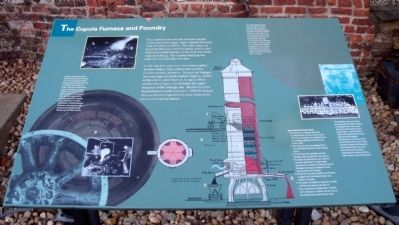
The Cupola Furnace and Foundry
Photographed by Bernard Fisher, November 3, 2009
1. The Cupola Furnace and Foundry Marker
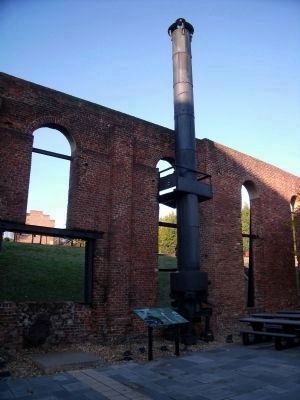
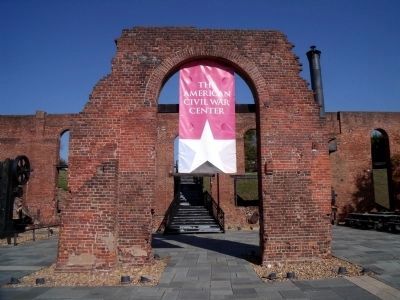
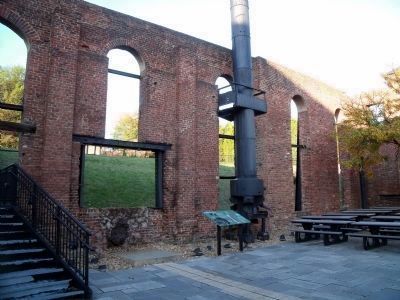
The cupola furnace was last used here as part of the carwheel foundry, where railroad carwheels were cast until the 1950’s. The wall in front of you is the back wall of the building, and the arch behind you is the remains of the front wall of the original building. The foundry building was expanded considerably over time.
In the cupola furnace, iron was heated until it became molten, then poured into molds to produce various cast items. Furnaces at Tredegar once used pig iron from western Virginia, carried to this site by canal boats on the James River and Kanawha Canal, which forms the upper boundary of the Tredegar site. Electric furnaces replaced most cupola furnaces c. 1960-70 because they are easier to operate and more easily fulfill environmental regulations.
[Sidebar:]
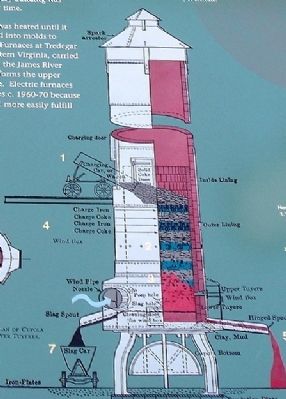
How cupola furnaces work
1. The furnace is charged with coke (a refined form of coal used as fuel) and iron is brought on small rail cars to a loading platform near the top of the stack.
2. The coke and iron are dumped into the brick-lined furnace in alternating layers.
3. As each layer of fuel falls into the melting zone, it melts iron above.
4. To make the fire hotter, air is blown into the wind belt through a pipe connected to a blower, and air is forced through openings or tuyeres in the inner part of the furnace.
5. When the iron has melted, the furnace is tapped, and hot metal flows into a ladle or crucible.
6. The ladle or crucible is taken to a mold and the hot metal is poured in.
7. Slag, composed of impurities created by the furnace, is taken off of the top of the melted iron and carried away.
Topics.
this page online
Location. Marker has been permanently removed. It was located near 37° 32.131′ N, 77° 26.727′ W. Marker was in Richmond, Virginia. It was in Gambles Hill. It could be reached from Tredegar Street 0.1 miles west of South 5th Street. This marker is located outside the Civil War Visitor Center at Tredegar Iron Works. Touch for map. Marker was at or near this postal address: 470 Tredegar Street, Richmond VA 23219, United States of America.
We have been informed that this marker is no longer there and will not be replaced. This page is an archival view of what was.
Regionally, this marker was in Central Virginia. It was also in the American South and specifically in the Upper South. Globally, it was in North America, the Western Hemisphere, the Western World, and the Anglosphere. Historically, it found itself in what was once the territory of the Mississippian Culture, one of the original Thirteen Colonies, one of the Confederate

Photographed by Bernard Fisher, November 3, 2009
2. The Cupola Furnace
Other nearby markers. At least one other marker is within walking distance of this location: A different marker also named The Tredegar Iron Works (within shouting distance of this marker). Touch for a list and map of all markers in Richmond.
Other markers no longer nearby. Toledo 1000-ton Press (was a few steps from this marker but has been permanently removed); Enterprise and Iron (was a few steps from this marker but has been permanently removed); Tredegar Iron Works (was a few steps from this marker but has been permanently removed); The Gun Foundry (was within shouting distance of this marker but has been permanently removed); Civil War Visitor Center (was within shouting distance of this marker but has been permanently removed); Overshot Waterwheel (was within shouting distance of this marker but has been reported to have been replaced with another marker now near it); Raceways (was within shouting distance of this marker but has been permanently removed); Adapting Power (was within shouting distance of this marker but has been permanently removed); Early Industrial Patterns
Photographed by Bernard Fisher, November 8, 2009
3. Remains of the front wall of the foundry
More about this marker. On the left are images illustrating the carwheel casting process bearing the caption, “Tredegar made railroad carwheels over much of its history. In the photograph below, workers pour molten iron into a carwheel flask, a type of mold. Patterns for carwheels made at Tredegar, pictured below, had interchangeable plates bearing the initials of the railroads they served, including the ACL (Atlantic
Photographed by Bernard Fisher, November 3, 2009
4. Back wall of the foundry building
In the center is a "Sectional plan of cupola through lower tuyeres". The caption above reads, “The small Tredegar cupola and the larger cupola are good examples of cupola furnaces. The larger furnace was recovered from a foundry about two miles from here, and dates from around 1910. It was used by the James W. Carr Foundry, later the O. G. McGee& Son Foundry and finally Capital Foundry, Inc., and was probably last fired around 1964. When traveling around the city, notice the many manhole and water meter covers cast by O. G. McGee.”
On the right is a photograph of iron workers with the caption, “Ironmolders were one of the many groups of skilled workers at Tredegar who were organized into craft unions in the metal trades. Local Number 128 of the Ironmolders Union represented Tredegar’s foundrymen, as well as molders in Richmond’s stove works, machine shops, and foundries. Unions provided some sickness and injury benefits, important to workers with no other source of health benefits.”
Photographed by Bernard Fisher, November 3, 2009
5. Sectional plan of cupola through lower tuyeres.
Credits. This page was last revised on January 20, 2026. It was originally submitted on November 6, 2009, by Bernard Fisher of Richmond, Virginia. This page has been viewed 4,357 times since then and 71 times this year. Last updated on January 19, 2026, by Evan Dwyer of Richmond, Virginia. Photos: 1, 2. submitted on November 6, 2009, by Bernard Fisher of Richmond, Virginia. 3. submitted on November 8, 2009, by Bernard Fisher of Richmond, Virginia. 4, 5. submitted on November 6, 2009, by Bernard Fisher of Richmond, Virginia. • Devry Becker Jones was the editor who published this page.
