Gambles Hill in Richmond, Virginia — The American South (Mid-Atlantic)
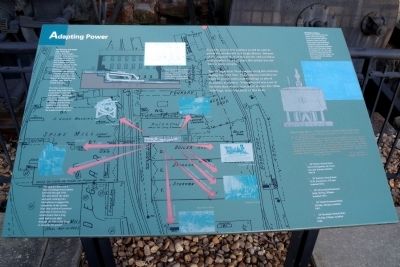
Adapting Power
Photographed by Bernard Fisher, November 3, 2009
1. Adapting Power Marker
The Raceway and Earlier Uses of the Site
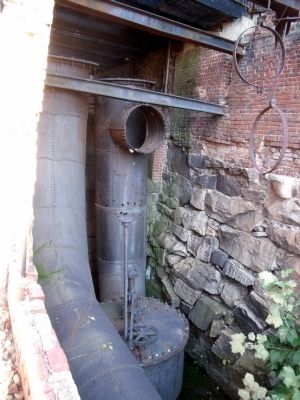
This raceway brought water from the James River and Kanawha Canal to power waterwheels, and later turbines, that drove machinery. During its earliest use, the raceway contained at least two overshot waterwheels that powered a corn mill, a cotton mill, and a flour mill. The stone base of the Pattern Building probably dates from the earliest structures.
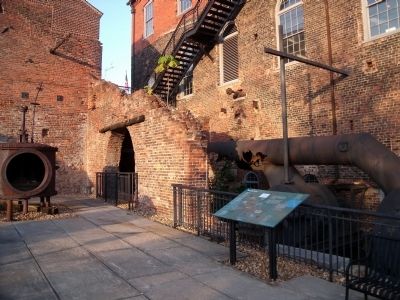
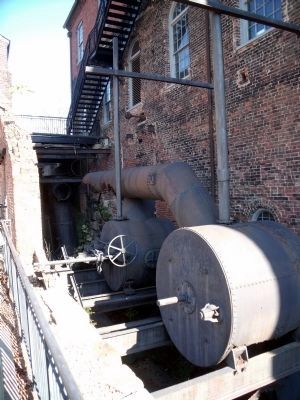
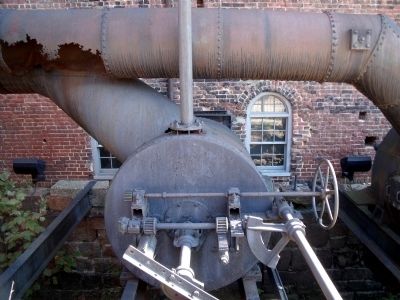
The tubes or penstocks you see here, carry water into the round metal casings that hold turbines. This system had 22 feet of head, the distance between the forebay, or holding tank above the turbine, and the tailrace, which carried the water from the turbine toward the river.
This graphic shows how many buildings these tubines powered through 1935. We have rebuilt the shafts and gears coming from the turbines to suggest the complexity of the system. Note that turbine #5 powered machines in the foundry, which meant that a long shaft had to run right through the Pattern Building to transmit the power!
From the raceway, turbines transmitted power widely, through thousands of feet of shafts, gears, pulleys, and leather belt,
this page online
Typically, one or two turbines would be used to power machinery in a single factory. Because of the adaptive reuse of this site for various industrial purposes over 150 years, the system you see here is more complex.
The Tredegar Iron Works began using this raceway during the Civil War. The company installed turbines to power individual buildings or sets of machines as needed. What evolved was a set of turbines that were connected to at least five other buildings, some hundreds of feet away.
Identifying Turbines
Turbines are identified by their maker and by their design, which is associated with the inventor’s name. We have listed makers and identifying information below for each turbine, including the diameter of the runner that spins inside the casing (40", 18", etc.), the horsepower generated at full power, how fast the runner can turn, and when the turbine was installed.
1. 40" Bodine Vertical Shaft 104.65 horsepower, 69 revolutions per minute, installed 1897-8
2. 36" Burham Vertical Shaft 76.21 horsepower, 158 rpm installed 1871.
3. 18" McCormick Horizontal Shaft, 58.7 hp, 302rpm, installed 1910.
4.
Photographed by Bernard Fisher, November 3, 2009
2. Adapting Power Marker
5. 36" Burham Vertical Shaft, 114.3hp, 159 rpm, installed 1920.
Topics. This historical marker is listed in these topic lists: Industry & Commerce • Waterways & Vessels. A significant historical year for this entry is 1935.
Location. Marker has been permanently removed. It was located near 37° 32.123′ N, 77° 26.758′ W. Marker was in Richmond, Virginia. It was in Gambles Hill. It could be reached from Tredegar Street 0.1 miles west of South 5th Street. This marker is located outside the Civil War Visitor Center at Tredegar Iron Works. Touch for map. Marker was at or near this postal address: 470 Tredegar Street, Richmond VA 23219, United States of America.
We have been informed that this marker is no longer there and will not be replaced. This page is an archival view of what was.
Regionally, this marker was in Central Virginia. It was also in the American South and specifically in the Upper South. Globally, it was in North America, the Western Hemisphere, the Western World, and the Anglosphere. Historically, it found itself in what was once the territory of

Photographed by Bernard Fisher, November 8, 2009
3. The stone base of the Pattern Building dates back to Crenshaw's Milll
Other nearby markers. within walking distance of this location: Touch for a list and map of all markers in Richmond.
Other markers no longer nearby. Francis Turbine (was here, next to this marker but has been permanently removed); Early Industrial Patterns (was here, next to this marker but has been permanently removed); Historic Tredegar (was a few steps from this marker but has been permanently removed); The Bulldozer Press (was a few steps from this marker but has been permanently removed); President Lincoln Visits Richmond (was within shouting distance of this marker but has been permanently removed); Raceways (was within shouting distance of this marker but has been permanently removed); Toledo 1000-ton Press (was within shouting distance of this marker but has been permanently removed); Tredegar in 1951 (was within shouting distance of this marker but has been permanently removed); a different marker also named President Lincoln Visits Richmond (was within shouting distance of
Photographed by Bernard Fisher, November 8, 2009
4. Tailrace
More about this marker. On the right is a laudatory letter from Tredegar to the turbine manufacturer:
"Rolling Mill: Two 36 inch. wheels under a 22 ft. head.
Tredegar Iron Works, Richmond, Va., April 26th, 1873.
N. F. Burnham, Esq.
I take pleasure in adding my testimonial
Photographed by Bernard Fisher, November 8, 2009
5. Penstock and Turbine
Yours, Very Truly,
E. R. Archer
Engineer Tredegar Co."
Also see . . . Richmond City: Tredegar Iron Works. National Park Service (Submitted on November 11, 2009.)
Credits. This page was last revised on January 20, 2026. It was originally submitted on November 11, 2009, by Bernard Fisher of Richmond, Virginia. This page has been viewed 1,145 times since then and 34 times this year. Last updated on January 19, 2026, by Evan Dwyer of Richmond, Virginia. Photos: 1, 2, 3, 4, 5. submitted on November 11, 2009, by Bernard Fisher of Richmond, Virginia. • Devry Becker Jones was the editor who published this page.
