Gambles Hill in Richmond, Virginia — The American South (Mid-Atlantic)
Tredegar Rolling Mills
Photographed by Bernard Fisher, November 3, 2009
1. Tredegar Rolling Mills Marker
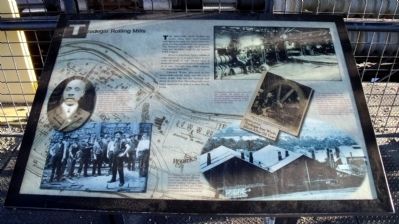
The Tredegar Iron Works had several rolling mills, which produced rails, bars to be made into spikes, connecting plates for rails, merchant bar iron, and plates. The Tredegar rolling mill’s most famous work was the plates made for the ironclad C.S.S. Virginia
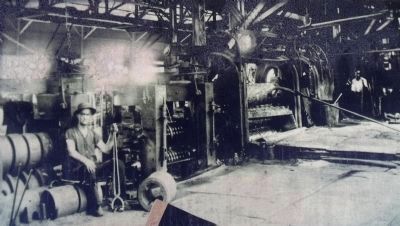
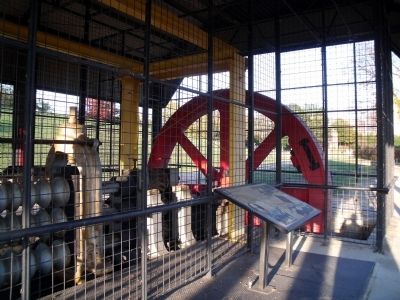
. Power is transferred from a turbine or waterwheel to a set of gears, which drive a series of stands of rolls. Heated metal is elongated and shaped as it passes through each set of rolls. The rolls here, called roughing rolls, shape the metal first.
Edward Wade, pictured in the foreground with his tongs, was the son of James Wade, who ran the Tredegar mill during the Civil War. The rolling mills were highly dependent on skilled workers like the Wades.
Topics. This historical marker is listed in these topic lists: Industry & Commerce • War, US Civil.
Location. Marker has been permanently removed. It was located near 37° 32.121′ N, 77° 26.813′ W. Marker was in Richmond, Virginia. It was in Gambles Hill. It could be reached from Tredegar Street 0.1 miles west of South 5th Street. This marker is located outside
this page online
We have been informed that this marker is no longer there and will not be replaced. This page is an archival view of what was.
Regionally, this marker was in Central Virginia. It was also in the American South and specifically in the Upper South. Globally, it was in North America, the Western Hemisphere, the Western World, and the Anglosphere. Historically, it found itself in what was once the territory of the Mississippian Culture, one of the original Thirteen Colonies, one of the Confederate States of America, and the Antebellum South.

Other nearby markers. At least 2 other markers are within walking distance of this location: Horseshoe Shops (within shouting distance of this marker); Tredegar in the Twentieth Century / Then and Now (within shouting distance of this marker). Touch for a list and map of all markers in Richmond.
Other markers no longer nearby. Making Machines at Tredegar (was a few steps from this marker but has been permanently
November 8, 2009
2. Edward Wade with tongs.
His father, James Wade, ran the Tredegar mill during the Civil War.
November 8, 2009
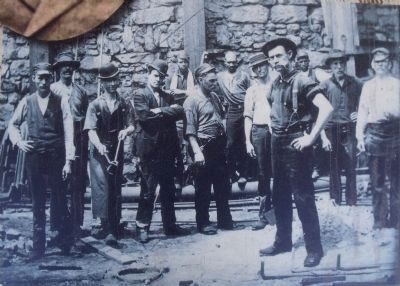
3. Tredegar Mill workers
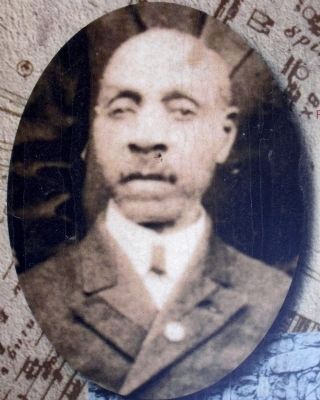
More about this marker. On the left are two photographs of Tredegar mill workers. The caption reads, "Rolling mill workers in the nineteenth century were considered highly skilled. Often they were paid as a group, and the team, or supervisor, decided how much to pay each worker. Even during slavery, black workers were part of the skilled teams that rolled iron at Tredegar, prompting a strike by white workers in 1847, who objected to training slaves. Morton Deane was a skilled worker on the rolling mill who also served on the Richmond city council in the late 19th century."
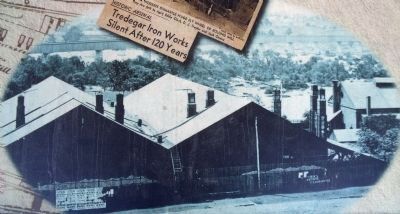
On the lower right is a photograph of the rolling mills with the caption, "The photograph (right), from the 1800s, shows the Tredegar rolling mills, which were large shed-like buildings with open sides. Despite the the mill’s lack of walls, the workers still found the heat from the furnaces intense in the summer."
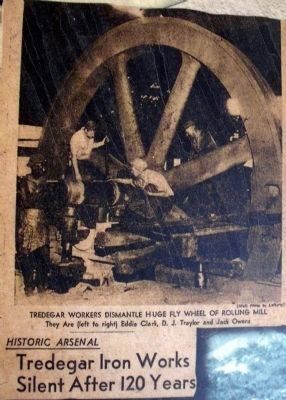
On the center right is a photo of a flywheel from a newspaper
November 8, 2009
4. Morton Deane, a Richmond city councilman, worked at the rolling mill
The first flywheel was cast in 1846 by the Armory Iron Company, one of Tredegar’s various incorporated bodies, and powered the mill through the Civil War. On August 25th, 1905, the first flywheel came loose from its bearings and exploded, killing one man and wounding two others. When the replacement wheel showed signs of cracks and stress in 1950, the wheel you see here took its place until Tredegar ceased operations in 1957."
November 8, 2009
5. Tredegar Rolling Mills c.1800s
November 8, 2009
6. Workers dismantle the rolling mill flywheel
Photographed by Bernard Fisher, November 3, 2009
7. Tredegar Rolling Mills Marker
Photographed by Bernard Fisher, November 3, 2009
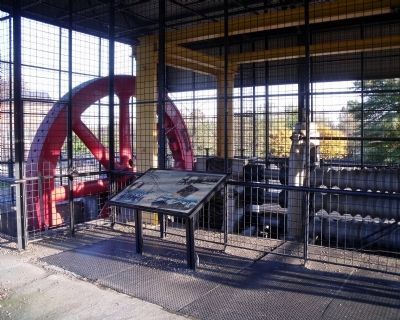
8. Duplicate marker on the other side of the display
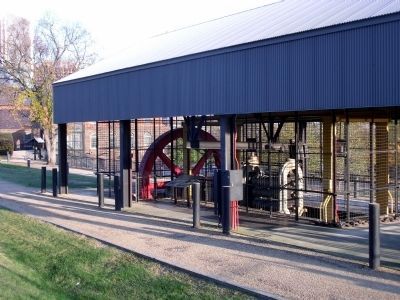
Photographed by Bernard Fisher, November 3, 2009
9. Tredegar Rolling Mills exhibit
Credits. This page was last revised on January 20, 2026. It was originally submitted on November 11, 2009, by Bernard Fisher of Richmond, Virginia. This page has been viewed 1,690 times since then and 33 times this year. Last updated on January 19, 2026, by Evan Dwyer of Richmond, Virginia. Photos: 1, 2, 3, 4, 5, 6, 7, 8, 9. submitted on November 11, 2009, by Bernard Fisher of Richmond, Virginia. • Devry Becker Jones was the editor who published this page.
