Olympia-Granby in Columbia in Richland County, South Carolina — The American South (South Atlantic)
Cotton Mill District
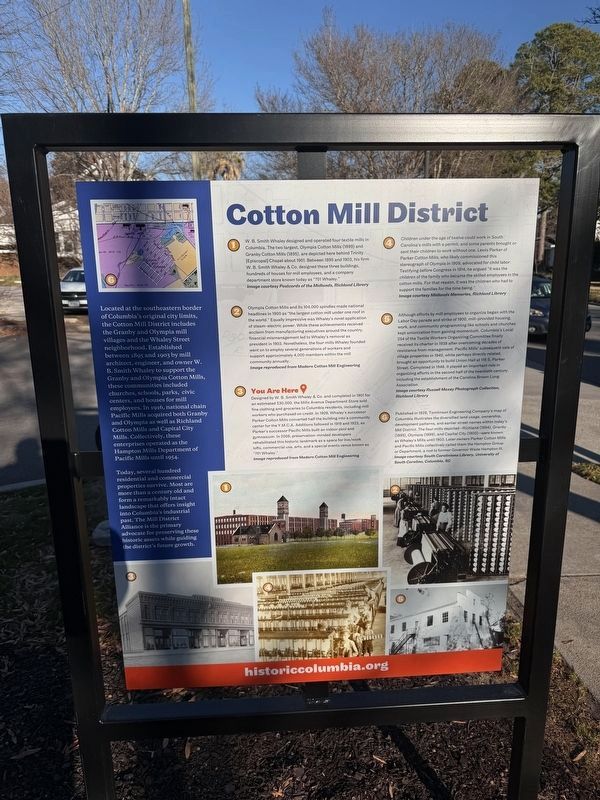
Located at the southeastern border of Columbia's original city limits, the Cotton Mill District includes the Granby and Olympia mill villages and the Whaley Street neighborhood. Established between 1895 and 1903 by mill architect, engineer, and owner W. B. Smith Whaley to support the Granby and Olympia Cotton Mills, these communities included churches, schools, parks, civic centers, and houses for mill employees. In 1916, national chain Pacific Mills acquired both Granby and Olympia as well as Richland Cotton Mills and Capital City Mills. Collectively, these enterprises operated as the Hampton Mills Department of Pacific Mills until 1954.
Today, several hundred residential and commercial properties survive. Most are more than a century old and form a remarkably intact landscape that offers insight into Columbia's industrial past. The Mill District Alliance is the primary advocate for preserving these historic assets while guiding the district's future growth.
❶ W. B. Smith Whaley designed and operated four textile mills in Columbia. The two largest, Olympia Cotton Mills (1899) and Granby Cotton Mills (1895),
this page online
Image courtesy Postcards of the Midlands, Richland Library
❷ Olympia Cotton Mills and its 104,000 spindles made national headlines in 1900 as "the largest cotton mill under one roof in the world." Equally impressive was Whaley's novel application of steam-electric power. While these achievements received acclaim from manufacturing executives around the country, financial mismanagement led to Whaley's removal as president in 1903. Nonetheless, the four mills Whaley founded went on to employ several generations of workers and support approximately 4,000 members within the mill community annually.
Image reproduced from Modern Cotton Mill Engineering
❸ You Are Here 📍
Designed by W. B. Smith Whaley & Co. and completed in 1901 for an estimated $30,000, the Mills Avenue Department Store sold fine clothing and groceries to Columbia residents, including mill workers who
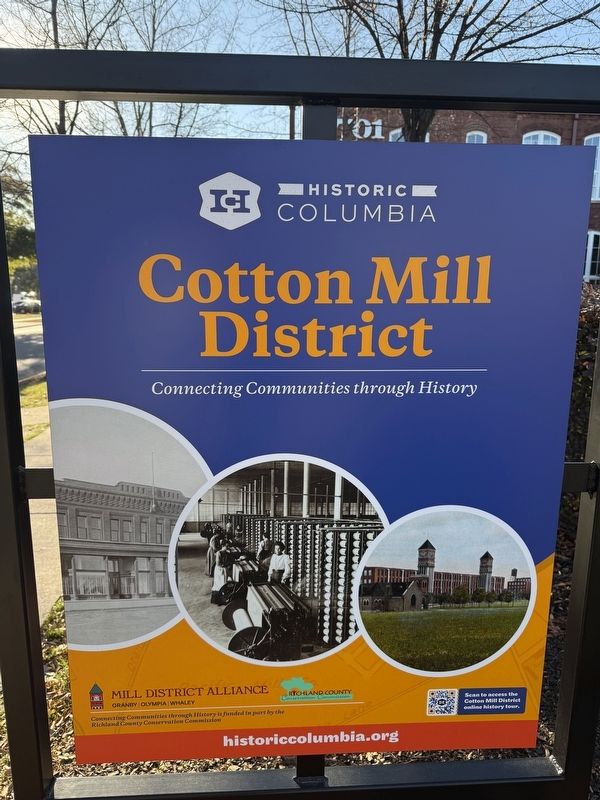
Image reproduced from Modern Cotton Mill Engineering
❹ Children under the age of twelve could work in South Carolina's mills with a permit, and some parents brought or sent their children to work without one. Lewis Parker of Parker Cotton Mills, who likely commissioned this stereograph of Olympia in 1909, advocated for child labor. Testifying before Congress in 1914, he argued "it was the children of the family who became the skilled employees in the cotton mills. For that reason, it was the children who had to support the families for the time being."
Image courtesy Midlands Memories, Richland Library
❺ Although efforts by mill employees to organize began with the Labor Day parade and strike
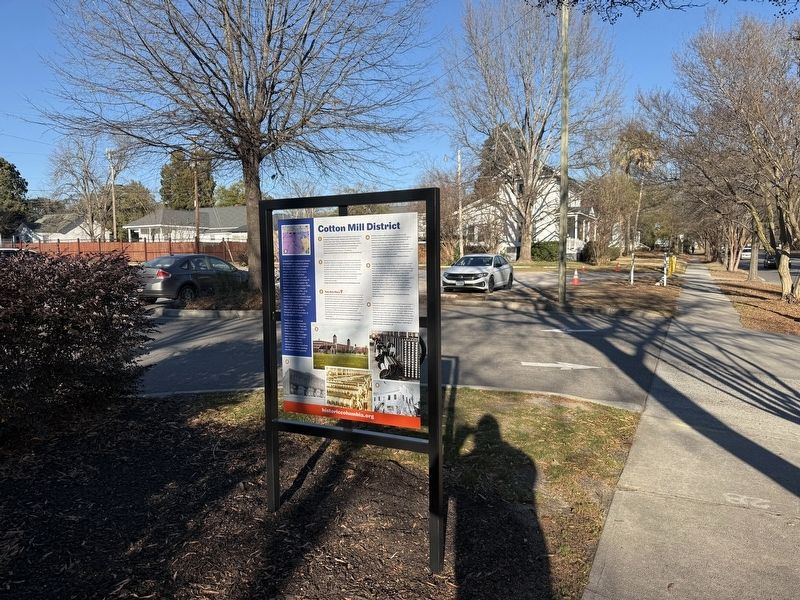
Image courtesy Russell Maxey Photograph Collection, Richland Library
❻ Published in 1928, Tomlinson Engineering Company's map of Columbia illustrates the diversified land usage, ownership, development patterns, and earlier street names within today's Mill District. The four mills depicted—Richland (1894), Granby (1895), Olympia (1899), and Capital City (1900)—were known as Whaley's Mills until 1903. Later owners Parker Cotton Mills and Pacific Mills collectively called them the Hampton Group or Department,
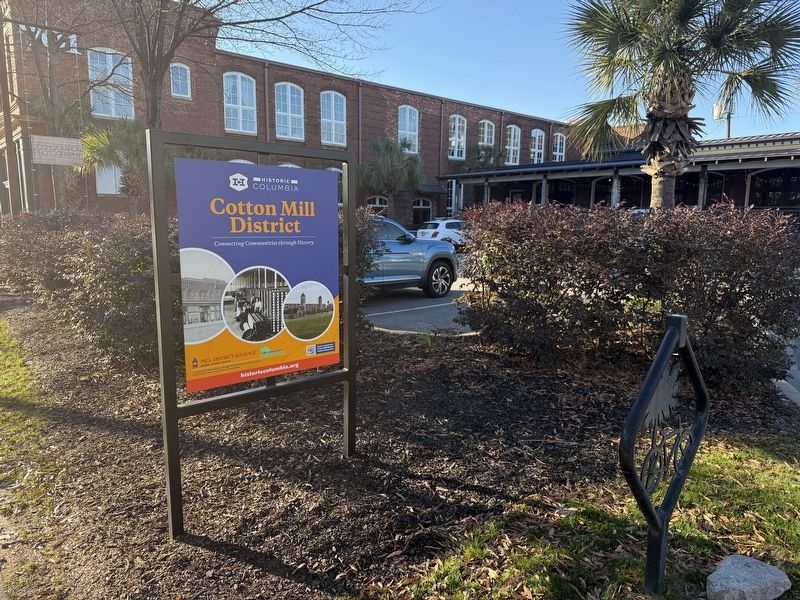
Image courtesy South Caroliniana Library, University of South Carolina, Columbia, SC
Erected by Mill District Alliance; Richland County Conservation Commission; Historic Columbia.
Topics. This historical marker is listed in these topic lists: Civil Rights • Industry & Commerce • Labor Unions • Settlements & Settlers. A significant historical year for this entry is 1895.
Location. 33° 59.136′ N, 81° 2.1′ W. Marker is in Columbia, South Carolina, in Richland County. It is in Olympia-Granby. It is on Whaley Street west of Parker Street, on the right when traveling west. Touch for map. Marker is at or near this postal address: 721 Whaley St, Columbia SC 29201, United States of America. Touch for directions.

Regionally, this marker is in the Midlands. It is also in the American South and specifically in the Deep South. Globally, it is in North America, the Western Hemisphere, the Western World, and the Anglosphere. Historically, it finds itself in what was once the territory of the Mississippian Culture, one of the original Thirteen Colonies, one of the Confederate States of America, and the Antebellum South.
Other nearby markers. At least 8 other markers are within walking distance of this marker: Supervisor's House (within shouting distance of this marker); "The Spirit of the American Doughboy" (within shouting distance of this marker); Votes for Women (approx. 0.2 miles away); Olympia Cotton Mills 2022 (approx. 0.2 miles away); Olympia Cotton Mills (approx. 0.2 miles away); Linthead 2022 (approx. 0.3 miles away); Granby Cotton Mills (approx. 0.3 miles away); Blossom Street School / Celia Dial Saxon School (approx. half a mile away). Touch for a list and map of all markers in Columbia.
Credits. This page was last revised on January 23, 2026. It was originally submitted on January 23, 2026, by Devry Becker Jones of Washington, District of Columbia. This page has been viewed 67 times since then. Photos: 1, 2, 3, 4. submitted on January 23, 2026, by Devry Becker Jones of Washington, District of Columbia.
