Lake City in Hinsdale County, Colorado — The American Mountains (Southwest)
Jail Cells for Women & the Insane
Hinsdale County Jail - 1893
Photographed by Cosmos Mariner, July 21, 2025
1. Jail Cells for Women & the Insane Marker
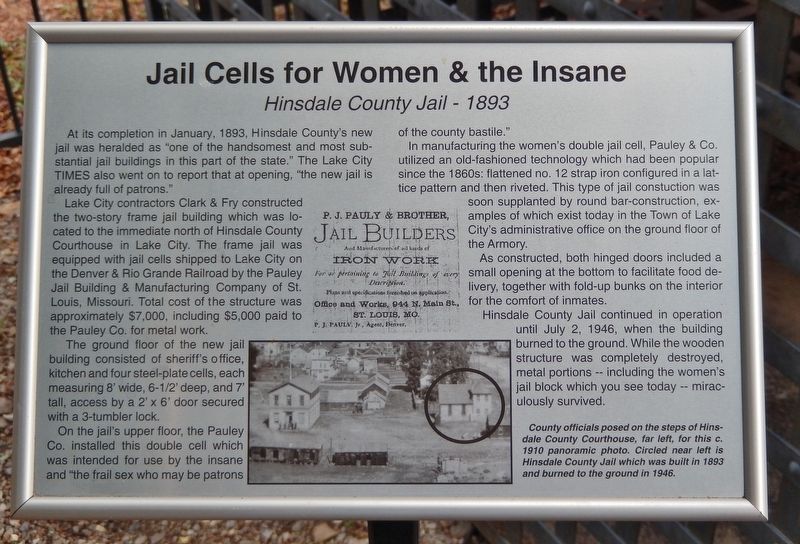
At its completion in January, 1893, Hinsdale County's new jail was heralded as “one of the handsomest and most substantial jail buildings in this part of the state.” The Lake City TIMES also went on to report that at opening, “the new jail is already full of patrons.”
Lake City contractors Clark & Fry constructed the two-story frame jail building which was located to the immediate north of Hinsdale County Courthouse in Lake City. The frame jail was equipped with jail cells shipped to Lake City on the Denver & Rio Grande Railroad by the Pauley Jail Building & Manufacturing Company of St. Louis, Missouri. Total cost of the structure was approximately $7,000, including $5,000 paid to the Pauley Co. for metal work.
The ground floor of the new jail building consisted of sheriff's office, kitchen and four steel-plate cells, each measuring 8' wide, 6-1/2' deep, and 7' tall, access by a 2' x 6' door secured with a 3-tumbler lock.
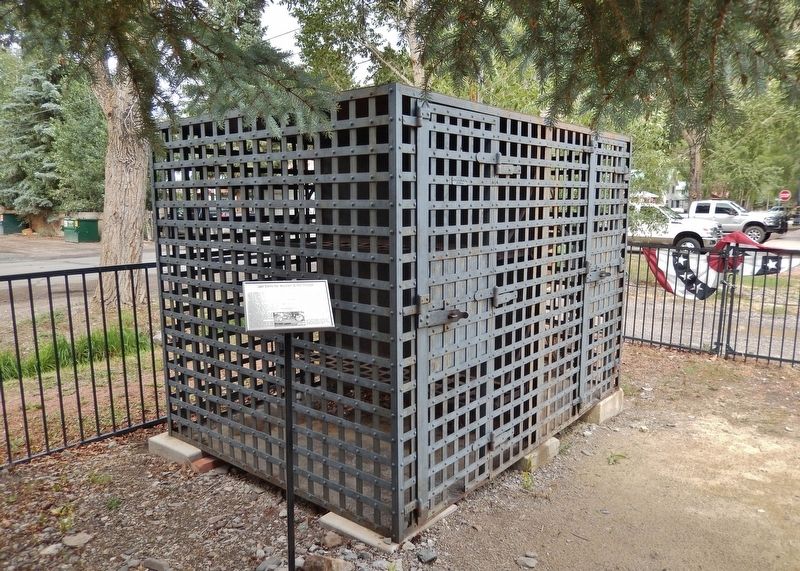
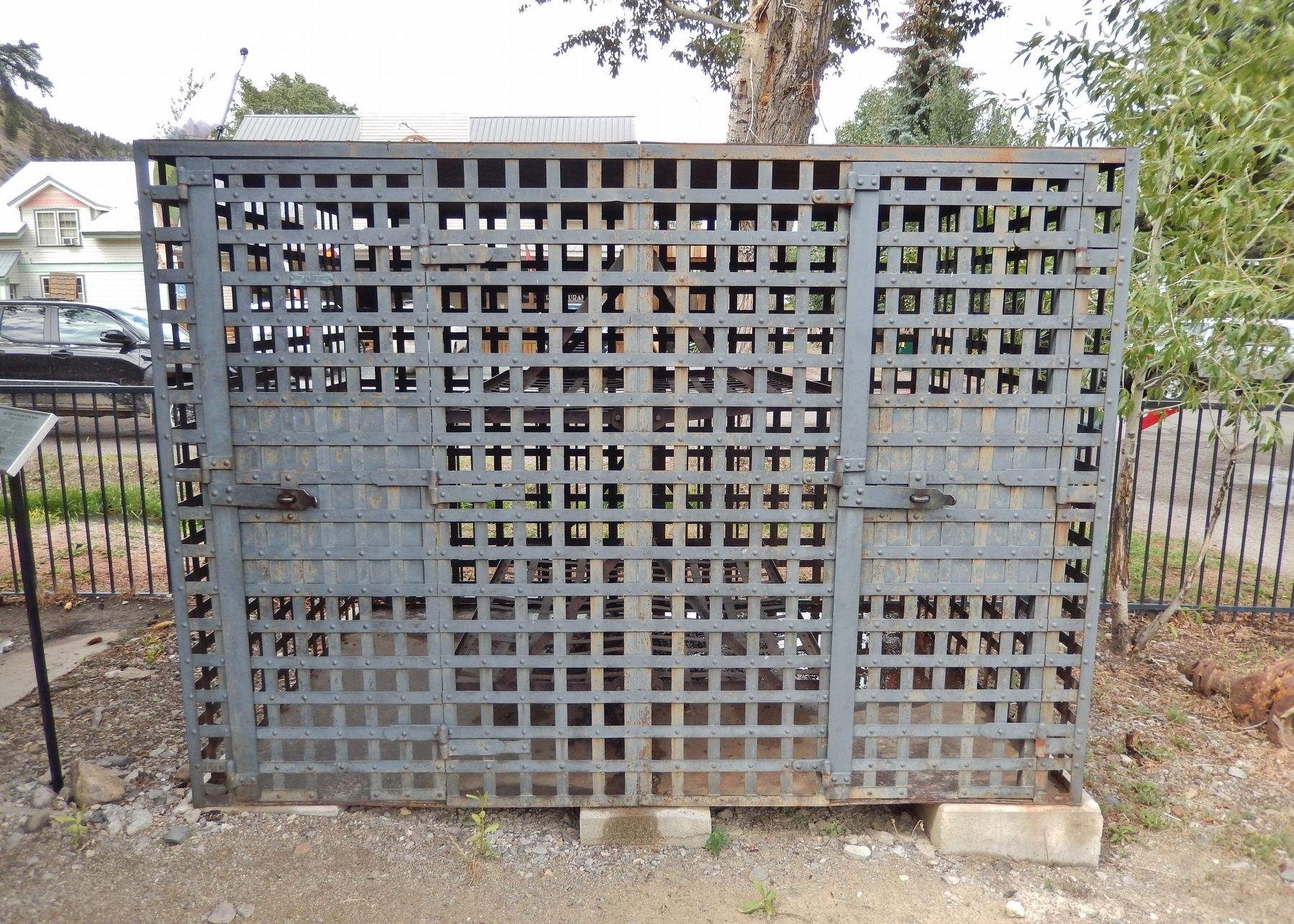
On the jail's upper floor, the Pauley Co. installed this double cell which was intended for use by the insane and “the frail sex who may be patrons of the county bastille.”
In manufacturing the women's
this page online
As constructed, both hinged doors included a small opening at the bottom to facilitate food de-livery, together with fold-up bunks on the interior for the comfort of inmates.
Hinsdale County Jail continued in operation until July 2, 1946, when the building burned to the ground. While the wooden structure was completely destroyed, metal portions — including the women's jail block which you see today — miraculously survived.
Topics. This historical marker is listed in these topic lists: Architecture • Law Enforcement • Women. A significant historical year for this entry is 1893.
Location. 38° 1.649′ N, 107° 19.039′ W. Marker is in Lake City, Colorado, in Hinsdale County. It can be reached from the intersection of Silver Street and 2nd Street (County Road 20),
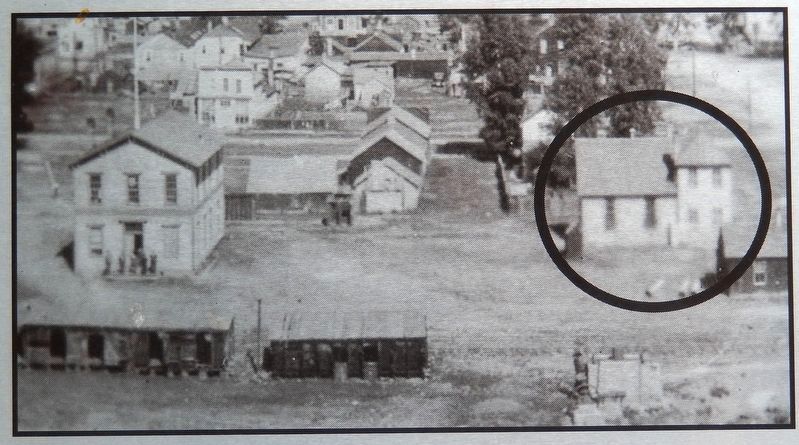
2. Marker detail: 1893 Hinsdale County Jail
County officials posed on the steps of Hinsdale County Courthouse, far left, for this c. 1910 panoramic photo. Circled near right is Hinsdale County Jail which was built in 1893 and burned to the ground in 1946.

Regionally, this marker is in the Colorado High Rockies. It is also in the American Mountain West. Globally, it is in North America, the Rocky Mountains, the Western Hemisphere, the Western World, and the Anglosphere.
Other nearby markers. At least 8 other markers are within walking distance of this marker: Curtis Planer (a few steps from this marker); Bachelor Cabins, Carson (within shouting distance of this marker); The Colorado-Yule Marble Company (within shouting distance of this marker); Colonel Channing Franklin Meek (within shouting distance of this marker); Slag Cart (within shouting distance of this marker); Finley Block — Built 1877 (within shouting distance of this marker); Lake City Played a Significant Role in the Development of Western Colorado (within shouting distance of this marker); Gaskill Hydrant (within shouting distance of this marker).
Photographed by Cosmos Mariner, July 21, 2025
3. Jail Cells for Women & the Insane Marker
Also see . . . A Fifth Generation Prepares its Family Business for a New Century (Correctional News).
Excerpt: Joseph Pauly Pohrer and his brother Robert James Pohrer own and operate Pauly Jail Building Company, a detention equipment contractor based in St. Louis. Pauly Jail has been in business for over 150 years and the brothers Pohrer are the fifth generation to oversee this enduring family enterprise. In the mid 19th century, when the company was founded, all that was needed to construct a safe and secure correctional environment were the skills of a good blacksmith and a knowledge of basic mechanics. A lot has changed since those days. New and efficient methods of construction must serve the needs of those who manage prisons, the public who depend on jails to maintain community safety, and the inmates who, in greater and greater numbers, live in the facilities.(Submitted on January 31, 2026, by Cosmos Mariner of Cape Canaveral, Florida.)
Photographed by Cosmos Mariner, July 21, 2025
4. Jail Cell
Credits. This page was last revised on January 31, 2026. It was originally submitted on January 27, 2026, by Cosmos Mariner of Cape Canaveral, Florida. This page has been viewed 39 times since then. Photos: 1, 2, 3, 4. submitted on January 31, 2026, by Cosmos Mariner of Cape Canaveral, Florida.
