Wailuku in Maui County, Hawaii — Hawaiian Island Archipelago (Pacific Ocean)
Sun of Maui
Photographed by Darren Jefferson Clay, December 7, 2025
1. Sun of Maui Marker
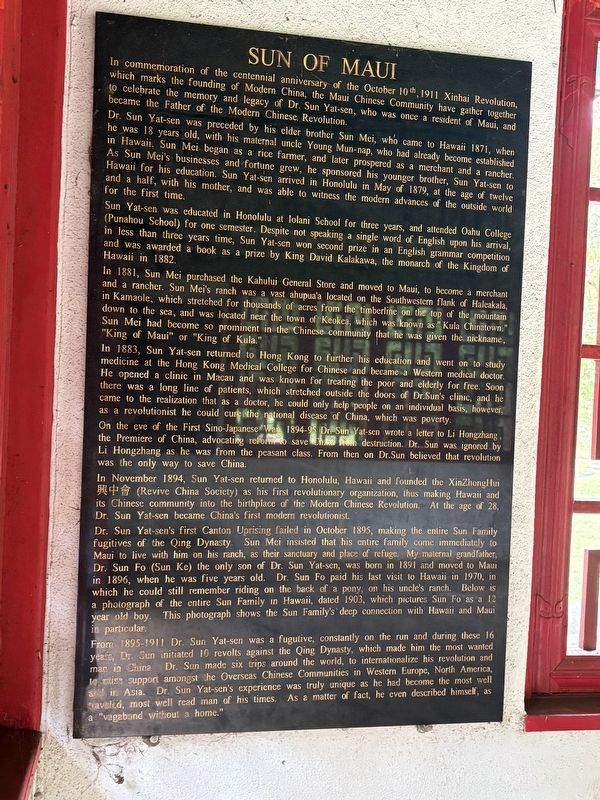
In commemoration of the centennial anniversary of the October 10th, 1911 Xinhai Revolution, which marks the founding of Modern China, the Maui Chinese Community have gather together to celebrate the memory and legacy of Dr. Sun Yat-sen, who was once a resident of Maui, and became the Father of the Modern Chinese Revolution.
Dr. Sun Yat-sen was preceded by his elder brother Sun Mei, who came to Hawaii 1871, when he was 18 years old, with his maternal uncle Young Mun-nap, who had already become established in Hawaii. Sun Mei began as a rice farmer, and later prospered as a merchant and a rancher. As Sun Mei's businesses and fortune grew, he sponsored his younger brother, Sun Yat-sen to Hawaii for his education. Sun Yat-sen arrived in Honolulu in May of 1879, at the age of twelve and a half, with his mother, and was able to witness the modern advances of the outside world for the first time.
Sun Yat-sen was educated in Honolulu at Iolani School for three years, and attended Oahu College (Punahou School) for one semester. Despite not speaking a single word of English upon his arrival, in less than three years
this page online
In 1881, Sun Mei purchased the Kahului General Store and moved to Maui, to become a merchant and a rancher. Sun Mei's ranch was a vast ahupua'a located on the Southwestern flank of Haleakala, in Kamaole, which stretched for thousands of acres from the timberline on the top of the mountain down to the sea, and was located near the town of Keokea, which was known as "Kula Chinatown." Sun Mei had become so prominent in the Chinese community that he was given the nickname, "King of Maui" or "King of Kula."
In 1883, Sun Yat-sen returned to Hong Kong to further his education and went on to study medicine at the Hong Kong Medical College for Chinese and became a Western medical doctor. He opened a clinic in Macau and was known for treating the poor and elderly for free. Soon there was a long line of patients, which stretched outside the doors of Dr. Sun's clinic, and he came to the realization that as a doctor, he could only help people on an individual basis,
Photographed by Darren Jefferson Clay, December 7, 2025
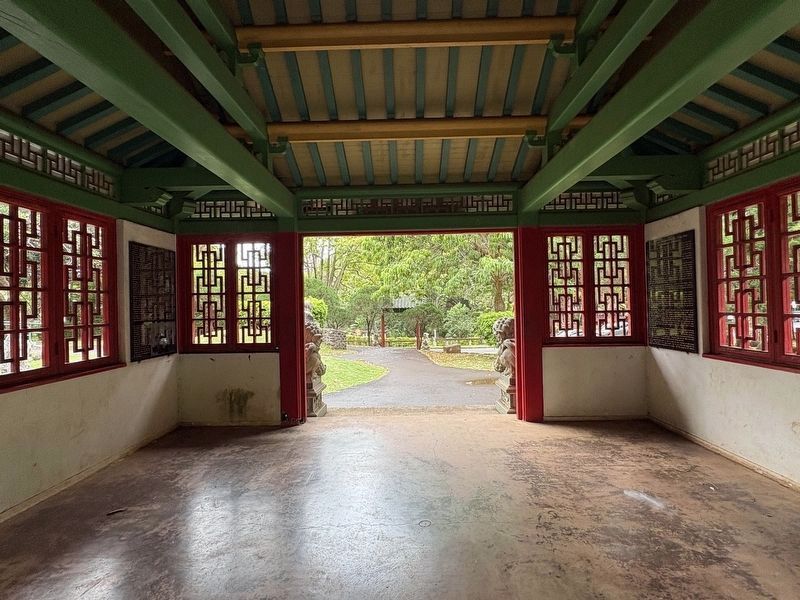
2. Sun of Maui Marker (Marker is on the left in the corner of the open air pagoda).
On the eve of the First Sino-Japanese War 1894-95 Dr Sun Yat-sen wrote a letter to Li Hongzhang, the Premiere of China, advocating reform to save China from destruction. Dr. Sun was ignored by Li Hongzhang as he was from the peasant class. From then on Dr. Sun believed that revolution was the only way to save China.
In November 1894, Sun Yat-sen returned to Honolulu, Hawaii and founded the XinzhongHui (Revive China Society) as his first revolutionary organization, thus making Hawaii and its Chinese community into the birthplace of the Modem Chinese Revolution. At the age of 28, Dr. Sun Yat-sen became China's first modern revolutionist.
Dr. Sun Yat-sen's first Canton Uprising failed in October 1895, making the entire Sun Family fugitives of the Qing Dynasty. Sun Mei insisted that his entire family come immediately to Maui to live with him on his ranch, as their sanctuary and place of refuge. My maternal grandfather, Dr. Sun Fo (Sun Ke) the only son of Dr. Sun Yat-sen, was born in 1891 and moved to Maui in 1896, when he was five years
Photographed by Darren Jefferson Clay, December 7, 2025
3. Sun of Maui Marker
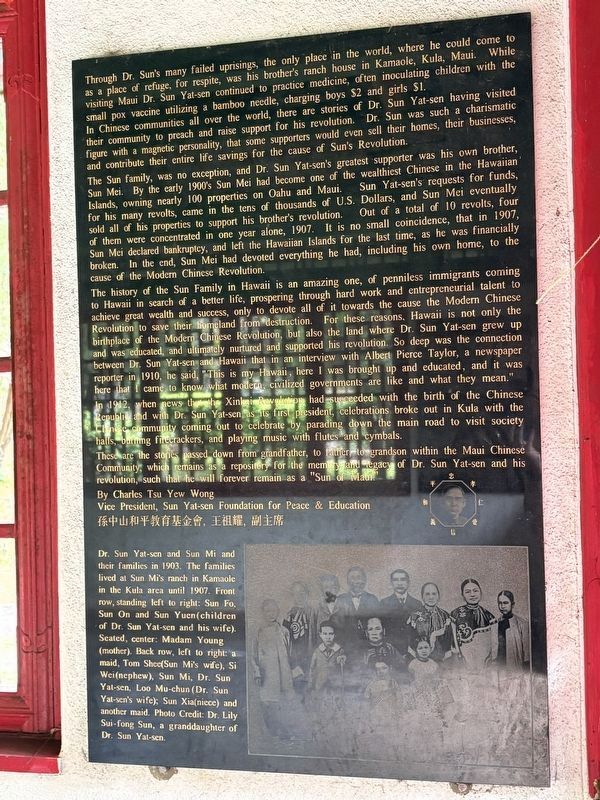
From 1895-1911 Dr. Sun Yat-sen was a fugitive, constantly on the run and during these 16 years, Dr. Sun initiated 10 revolts against the Qing Dynasty, which made him the most wanted man in China. Dr. Sun made six trips around the world, to internationalize his revolution and to raise support amongst the Overseas Chinese Communities in Western Europe, North America, and in Asia. Dr. Sun Yat-sen's experience was truly unique as he had become the most well traveled, most well read man of his times. As a matter of fact, he even described himself, as a vagabond without a home."
Through Dr. Dun's many failed uprisings, the only place in the world, where he could come to as a place of refuge, for respite, was his brother's ranch house in Kamaole, Kula, Maui. While visiting Maui Dr. Sun
Photographed by Darren Jefferson Clay, December 7, 2025
4. Sun of Maui Marker
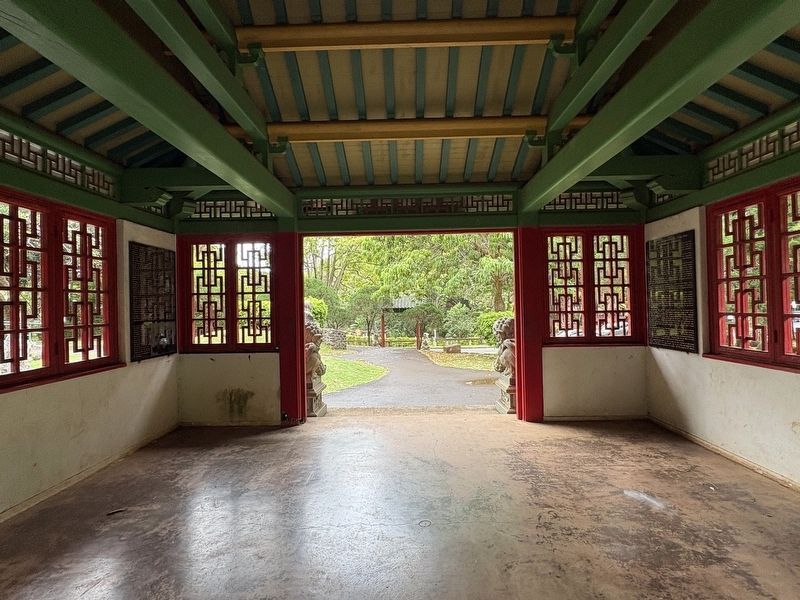
Master is on the left, mounted on the wall of the open air pagoda.
In Chinese communities all over the world, there are stories of Dr. Sun Yat-sen having visited their community to preach and raise support for his revolution. Dr. Sun was such a charismatic figure with a magnetic personality, that some supporters would even sell their homes, their businesses, and contribute their entire life savings for the cause of Sun's revolution.
The Sun family, was no exception, and Dr. Sun Yat-sen's greatest supporter was his own brother, Sun Mei. By the early 1900's Sun Mei had become one of the wealthiest Chinese in the Hawaiian Islands, owning nearly 100 properties on Oahu and Maui. Sun Yat-sen's requests for funds, for his many revolts, came in the tens of thousands of U.S. Dollars, and Sun Mei eventually sold all of his properties to support his brother's revolution. Out of a total of 10 revolts, four of them were concentrated in one year alone, 1907. It is no small coincidence, that in 1907, Sun Mei declared bankruptcy, and left the Hawaiian Islands for the last time, as he was financially broken. In the end, Sun Mei had devoted everything he had, including his own home, to the cause of the Modern Chinese Revolution.
The history of the Sun family in Hawaii is an amazing one, of penniless immigrants coming to Hawaii in search of a better life, prospering through hard work and entrepreneurial talent to achieve great wealth and success, only to devote all of it towards the cause of the Modern Chinese Revolution to save their homeland from destruction. For these reasons, Hawaii is not only the birthplace of the Modern Chinese Revolution, but also the land where Dr. Sun Yat-sen grew up and was educated, and ultimately nurtured and supported his revolution. So deep was the connection between Dr. Sun Yat-sen and Hawaii that in an interview with Albert Pierce Taylor, a newspaper reporter in 1910, he said, "This is my Hawaii, here I was brought up and educated, and it was here that I came to know what modern, civilized governments are like and what they mean."
In 1912, when news that the Xinhai Revolution had succeeded with the birth of the Chinese Republic and with Dr. Sun Yat-sen as its first president, celebrations broke out in Kula with the Chinese community coming out to celebrate by parading down the main road to visit society halls, burning firecrackers, and playing music with flutes and cymbals.
These are the stories passed down from grandfather, to father, to grandson within the Maui Chinese Community, which remains as a repository for the memory and legacy of Dr. Sun Yat-sen and his revolution, such that he will forever remain as a "Sun of Maui."
By Charles Tsu Yew Wong
Vice President, Sun Yat-sen Foundation for Peace and Education
[Caption:]
Dr. Sun Yat-sen and Sun Mi and their families in 1903. The families lived at Sun Mi's ranch in Kamaole in the Kula area until 1907. Front row, standing left to right: Sun Fo, Sun On and Sun Yeun (children of Sr. Sun Yat-sen and his wife). Seated, center: Madam Young (mother). Back row, left to right: a maid, Tom Shee (Sun Mi's wife), Si Wei (nephew), Sun Mi, Dr. Sun Yat-sen, Loo Mu-chun (Dr. Sun Yat-sen's wife); Sun Xia (niece) and another maid. Photo credit: Dr. Lily Sui-fong Sun, a granddaughter of Dr. Sun Yat-sen.
Topics. This historical marker is listed in these topic lists: Immigration • Settlements & Settlers • Wars, Non-US. A significant historical month for this entry is May 1879.
Location. 20° 53.001′ N, 156° 32.15′ W. Marker is in Wailuku, Hawaii, in Maui County. It can be reached from Iao Valley Road west of Aulii Drive, on the left when traveling west. The marker hangs in the Kepaniwai Park, mounted on the wall of an open air pagoda. Touch for map. Marker is at or near this postal address: 870 Iao Valley Rd, Wailuku HI 96793, United States of America. Touch for directions.

Regionally, this marker is in Lahaina and West Maui. Globally, it is in North America, Polynesia, the Pacific Ocean, North Pacific, the Pacific Rim, the Western Hemisphere, the Western World, and the Anglosphere.
Other nearby markers. At least 8 other markers are within walking distance of this marker: Early Chinese Immigration to Tan Heong Shan: The Sandalwood Mountains (here, next to this marker); In Commemmoration of the 200 Years Since the First Arrival of the Chinese in Hawaii (a few steps from this marker); Kapaniwai Chinese Heritage Garden / Sun Yat Sen Bronze Statue (a few steps from this marker); Chinese Exhibit (a few steps from this marker); Japanese Immigrants (a few steps from this marker); In Commeration of the Arrival of the First Japanese Immigrants to Hawai'i (a few steps from this marker); Japanese Centennial Monument (a few steps from this marker); Arrival of Puerto Ricans in Hawaii (within shouting distance of this marker). Touch for a list and map of all markers in Wailuku.
Credits. This page was last revised on February 6, 2026. It was originally submitted on February 1, 2026, by Darren Jefferson Clay of Duluth, Georgia. This page has been viewed 115 times since then. Photos: 1, 2, 3, 4. submitted on February 1, 2026, by Darren Jefferson Clay of Duluth, Georgia. • Devry Becker Jones was the editor who published this page.
