Hattiesburg in Forrest County, Mississippi — The American South (East South Central)
Vernon Ferdinand Dahmer, Sr.
March 10, 1908 — January 10, 1966
Photographed by Cosmos Mariner, June 20, 2025
1. Vernon Ferdinand Dahmer, Sr. Marker
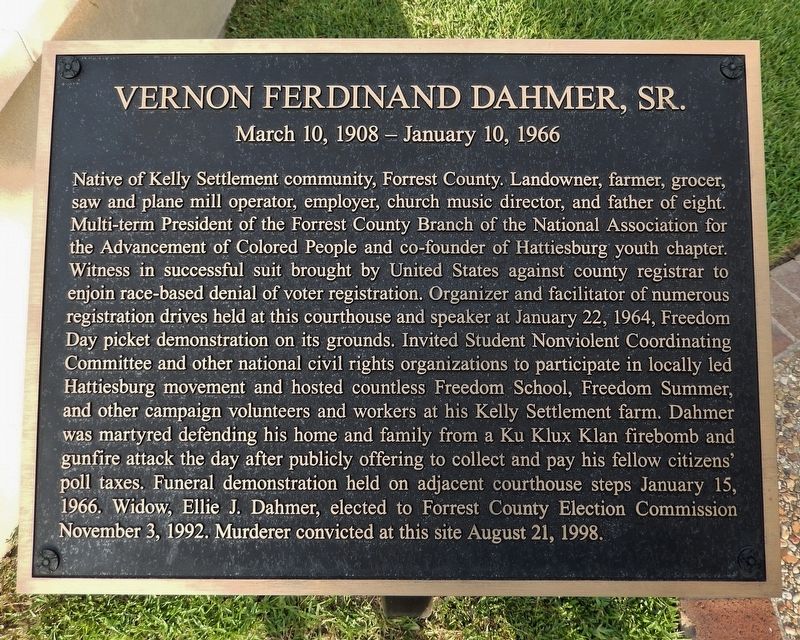
Native of Kelly Settlement community, Forrest County. Landowner, farmer, grocer, saw and plane mill operator, employer, church music director, and father of eight. Multi-term President of the Forrest County Branch of the National Association for the Advancement of Colored People and co-founder of Hattiesburg youth chapter. Witness in successful suit brought by United States against county registrar to enjoin race-based denial of voter registration. Organizer and facilitator of numerous registration drives held at this courthouse and speaker at January 22, 1964, Freedom Day picket demonstration on its grounds. Invited Student Nonviolent Coordinating Committee and other national civil rights organizations to participate in locally led Hattiesburg movement and hosted countless Freedom School, Freedom Summer, and other campaign volunteers and workers at his Kelly Settlement farm. Dahmer was martyred defending his home and family from a Ku Klux Klan firebomb and gunfire attack the day after publicly offering to collect and pay his fellow citizens' poll taxes. Funeral demonstration held on adjacent courthouse steps January 15,
this page online
Topics. This historical marker is listed in these topic lists: African Americans • Charity & Public Work • Civil Rights • Law Enforcement. A significant historical date for this entry is March 10, 1908.
Location. 31° 19.65′ N, 89° 17.469′ W. Marker is in Hattiesburg, Mississippi, in Forrest County. It is at the intersection of Main Street and Batson Street, on the left when traveling north on Main Street. The marker and sculpture are in front of the Forrest County Circuit Clerk's Office building. Touch for map. Marker is at or near this postal address: 630 Main Street, Hattiesburg MS 39401, United States of America. Touch for directions.

Regionally, this marker is in Mississippi’s Pine Belt. It is also in the American South, specifically in the Deep South, and in the Piney Woods. Globally, it is in North America, a Gulf of Mexico state, the Western Hemisphere, the Western World, and the Anglosphere. Historically, it finds itself in what was once New Spain, the territory

Photographed by Cosmos Mariner, June 20, 2025
2. Vernon Ferdinand Dahmer, Sr. Memorial
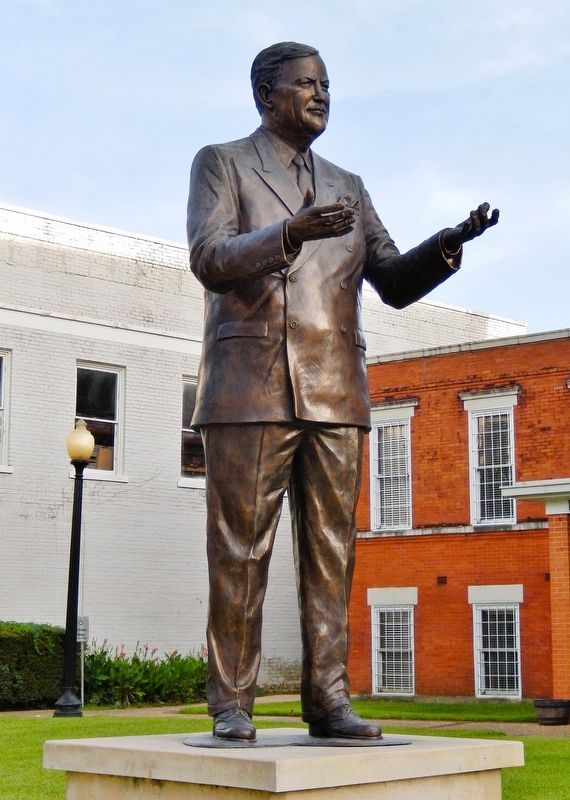
The statue is on the left and the historical marker is on the right.
Other nearby markers. At least 8 other markers are within walking distance of this marker: Forrest County Confederate Monument (within shouting distance of this marker); William Harris Hardy (about 500 feet away, measured in a direct line); Old Federal Building (about 600 feet away); Saenger Theatre (about 600 feet away); McLeod House (about 600 feet away); Pittman Park (approx. 0.2 miles away); a different marker also named William Harris Hardy (approx. 0.2 miles away); Hattiesburg (approx. 0.2 miles away). Touch for a list and map of all markers in Hattiesburg.
Related markers. Click here for a list of markers that are related to this marker. Vernon Ferdinand Dahmer, Sr.
Also see . . . Vernon Ferdinand Dahmer Sr. (Wikipedia).
Excerpt: Vernon Dahmer was born on March 10, 1908, in the Kelly Settlement, Forrest County, Mississippi. Dahmer was light-skinned enough to pass as a white man, but he chose to forgo the privileges of living as a white man and as a result, he faced the daily challenges of being black(Submitted on February 8, 2026, by Cosmos Mariner of Cape Canaveral, Florida.)in Mississippi during that time. In 1949, Dahmer was in the process of making out his new registration card when Luther Cox denied his attempts to re-register. Luther Cox was the authority figure in charge of registered voters in Forrest County and was a white segregationist. In 1950, fifteen leaders of Forrest County's black community, including Dahmer, filed a lawsuit against Cox for his administration of the voting laws. Twelve years later, in March 1962, the preliminary injunction was still in motion of being viewed by the court of law. Dahmer had testified in court against Luther Cox and his testimony helped demonstrate the pattern of discrimination in the county.Photographed by Cosmos Mariner, June 20, 20253. Vernon Ferdinand Dahmer, Sr. Statue
In the 1950s, Dahmer and Medgar Evers founded a youth NAACP chapter in Hattiesburg. The student chapter did not last longer than a year. Dahmer continued to be supportive of SNCC for the rest of his life. His farm became a home away from home for SNCC volunteers. The farm was used for voter registration projects and helped employ the committee volunteers. Dahmer was also working closely with the Coalition for Free and Open Elections (COFO) and the Delta Ministry.
On January10, 1966, the Dahmer house was attacked by the White Knights of the Ku Klux Klan. The family woke to the sounds of a shotgun being discharged and gas jugs being thrown through the windows. As Ellie grabbed the children, the house erupted into flames. Dahmer returned fire from inside the house to try to distract the Klansmen. He was eventually able to flee the burning house, but he was badly burned from the waist up. The Dahmers' home, grocery store, and car were all destroyed in the fire. Dahmer was taken to the hospital, where he died of smoke inhalation and damage to his lungs. Before he died, Dahmer told a local newspaper reporter: "I've been active in trying to get people to register to vote. People who don't vote are deadbeats on the state. I figure a man needs to do his own thinking. What happened to us last night can happen to anyone, white or black. At one time I didn't think so, but I have changed my mind."Photographed by Cosmos Mariner, June 20, 20254. Vernon Ferdinand Dahmer, Sr. Memorial
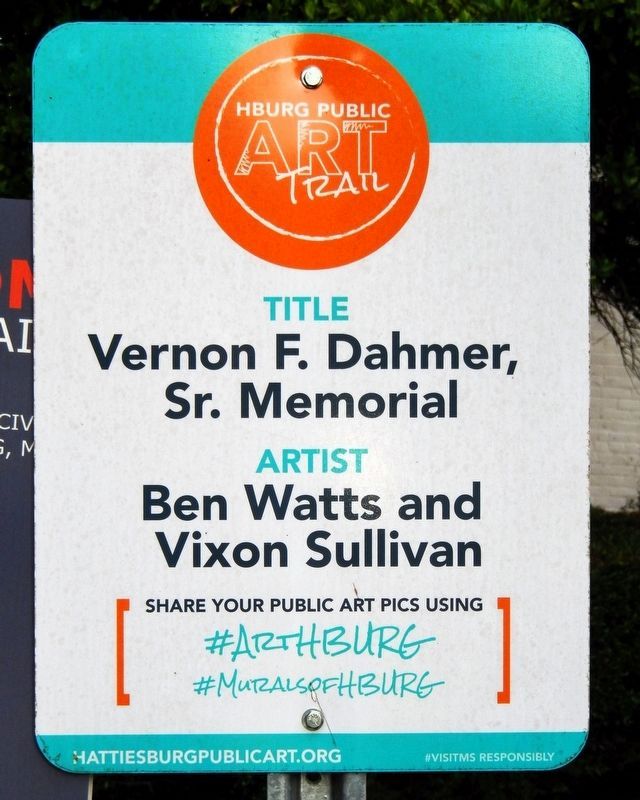
Hattiesburg Art TrailLocated adjacent to the Vernon Ferdinand Dahmer, Sr. sculpture.
In January 2020, a bronze statue of Dahmer was erected in front of the Forrest County Courthouse.

Photographed by Cosmos Mariner, June 20, 2025
5. Vernon Ferdinand Dahmer, Sr. Memorial
(Looking southwest from Main Street. The Forrest County Circuit Clerk's Office building is in the background, formerly the Forrest County Courthouse.)
“If you don’t vote, you don’t count.” Vernon F. Dahmer, Sr.
Credits. This page was last revised on February 8, 2026. It was originally submitted on February 4, 2026, by Cosmos Mariner of Cape Canaveral, Florida. This page has been viewed 64 times since then. Photos: 1, 2, 3, 4, 5. submitted on February 8, 2026, by Cosmos Mariner of Cape Canaveral, Florida.
