
Poipu in Koloa in Kauai County, Hawaii — Hawaiian Island Archipelago (Pacific Ocean)
Kilo Lani
⎯⎯⎯
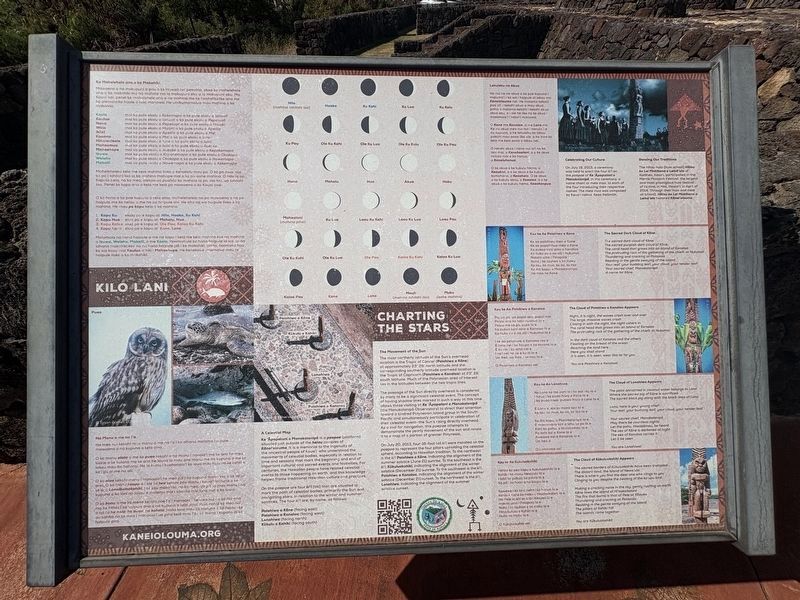
Charting The Stars
Photographed by Darren Jefferson Clay, December 5, 2025
1. Charting the Stars - Marker

Mawaena o na mokupuni a pau o ko Hawaii nei paeaina, okoa ka mahelehele ana o ka makahiki ma na mahina ma ia mokupuni aku a la mokupuni aku. Ma Kauai nei, penel ka mahelehele ana a na mahina me ka hoohalikelike ana me ka alemanaka haole a keia manawa. He umikumamalua mau mahina a ka makahiki:
Kaelo - mai ka pule ekolu o Kekemapa a ka pule ekolu o lanuali
Kaulua - mai ka pule ekolu o lanuali a ka pule ekolu o Pepeluali
Nana - mai ka pule ekolu o Pepeluali a ka pule ekolu o Malaki
Welo - mai ka pule ekolu o Malaki a ka pule ekolu o Apeliia
Ikiiki - mai ka pule ekolu o Apelila a ka pule ekolu o Mei
Kaaona - mai ka pule ekolu o Mel a ko pule ekolu o lune
Hinalaeleele - mai ka pule ekolu o lune a ka pule ekolu o lulai
Mahoemua - mai ka pule ekolu o lulal a ka pule ekolu o Aukoke Mahoehope - mai ka pule ekolu o Aukake a ka pule ekalu o Kepakemapa
Ikuwa - mai ka puke ekolu o Kepakemapa a ka pule ekolu o Okakopa
Welehu - mai ka pule ekolu o Okakopa a ka pule ekolu o Nowemapa
Makalli -mai ka pule ekolu
this page online
Mahelehelela kela me keia mahina iloko o kanakolu mau po. O ka po mua, oia ka po i lahilahi loa ai ka mahina mahope mai o ka po aohe mahina. O Hilo ia po. Kapoia pela, no ka mea, oleloia ua puahilo ka mahina ia po, oia hoi, ua lahilahi loa. Penei ke kapa ana o keia me keia po mawaena o ko Kaual poe.
O ka hana a ka poe kupuna a keia aina, maheleheleia na po mawaena a na po haipule ma ka heiau a me na po haipule ole. He eha no wa haipule iloko o ka mahina. He mau po kapu keia a ka mahina:
1. Kapu Ku - ekolu po e kapu ai: Hilo, Hoaka, Ku Kahi
2. Kapu Hua - elua po e kapu ai: Mohalu, Hua
3. Kapu Kaloa - elua po e kapu ai: Ole Pau, Kaloa Ku Kahi
4. Kapu Kane - elua po e kapu ai: Kane, Lono
Malamaia na hana haipule a me na kapu i kela me keia mahina koe na mahina o Ikuwa, Welehu, Makalii, a me Kaelo. Hoomahaia ka hana haipule la wa no na oihana makahiki koe no na hana haipule pili i ka makahiki, alaila, hoomaka hou ka wa kapu mai Kaulua a hiki i Mahoehope. He kanakolukumamalua mau la haipule iloko o ka makahiki.
[Bottom Left] Na Manu a me na l'a
He mea nui kekahi mau manu
Photographed by Darren Jefferson Clay, December 5, 2025
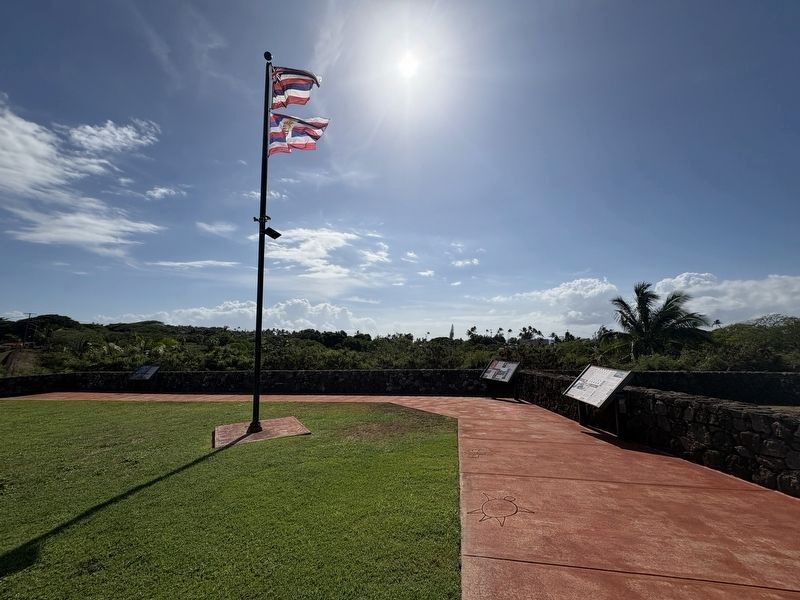
2. Charting the Stars - Marker in context
THIS marker is on the far right.
O ka manu alala a me ka pueo kekahi o na manu i nanaia'i ma ke and he mea kiekie o ke kulana ma ke ano he launa ia mau ano manu me na kupuna a me ko lakou mau ike hohonu. No ia kumu i hoohanaia'i ko laua mau hulu no ke kahili e kai pu ai me na alii.
O ka alae kekahi manu i manaoia'i he mea pili i na kupuna mana loa o ka lahul oiwi. O ka manu kaupu a i ole ka Iwa kekahi poe manu i kauia'i maluna a ke ke'a, o Lonolkamakahiki, i ke kau makahiki, no ka mea, ua piliaa mau manu i na kupuna a ka lani na lakau e malama mai i kanaka mai luna mai o ka lewa.
O ka honu a me ka mano kekahi poe l'a i manacia'i he mea nul no ka hai ana ma ka helau i ka haipule ana a na kupuna o kaia alna. Peia nohol ka mea nui o na ia he naia, he nuao, he kohola. Haiia keia mau l'a maluna a ka heiau i ke au kahiko no ka mea i manaoia'i ua piha keia mau l'a i ka mana i kupono ai ka halpule ana.
The Division of the Year
Between all the islands of Hawaii, the distribution of the year in months differs from island to island. In Kauai, the distribution of the months is different compared to the current foreign calendar. A year has twelve months:
Kaelo - from the third week of December to the third week of January
Kaulua - from the third week of January to the third week of February
Nana - from the third week of February to the third week of March
Welo - from the third week of March to the third week of April
Ikiiki - from the third week of April to the third week of May
Kaaona - from the third week of May to the third week of June
Hinalaeleele - from the third week of June to the third week of July
Mahoemua - from the third week of July to the third week of August
Mahoehope - from the third week of August to the second week of September
Ikuwa - from the third book of September to the third week of October
Weluhu - from the third week of October to the third week of November
Makalli - from the third week of November to the third week of December
Each month is divided into thirty nights. The first night is the night when the moon is the thinnest after the moonless night. Hila that night. It is called so, because it is said that the moon shone that night, that is, it was very thin. This is how this night is called among the people of Kaual.
The work of the ancestors of this country, the nights are divided between religious nights in the temple and non-religious nights. It is four times of worship during the month. These are sacred nights of the month:
1. Kapu Ku - three nights held sacred: Hilo, Hoaka, Ku Kahi
2. Kapu Hua - two nights held sacred: Mohalu, Hua
3. Kapu Kaloa - two nights held sacred: Ole Pau, Kaloa Ku Kahi
4. Kapu Kane - two nights held sacred: Kane, Lono
Religious activities and taboos are observed every month except the months of Ikuwa, Welehu, Makalii, and Kaelo. The religious work is suspended for the annual services except for the religious activities related to the year, then the sacred time starts again from Kaulua to Mahoehope. There are thirty-two religious days in a year.
[Bottom Left] Birds and Fish
Some birds and fish are important in the religious service among the ancestors of that country.
The sparrow and the owl are some of the birds that are observed here and have a high status as these species of birds are associated with the ancestors and their deep knowledge. For that reason their feathers were used to sweep the sea with the kings.
The alae is a bird that is believed to be related to the most powerful ancestors of the Lahul tribe. The kaupu bird (the black-footed albatross) or the nineth bird are some of the birds that are hung on the cross, Lonolkamakahiki, in the season, because the birds are connected to the ancestors of the sky that protect people from the sky.
The turtle and the shark are some of the people who believe that it is a good thing to tell in the story the devotion of the ancestors of this family. Thus, the most important of the fishes are naia (spinner dolphin), nuao (black cod?), and whale. These days are recited above the shrine in the old days because it is believed that these days are full of power that makes it appropriate to pray.
[Bottom Middle] English: Charting The Stars
A Celestial Map
Ke 'Āpapalani o Manokalanipō is a paepae (platform) situated just outside of the heiau complex of Kānei'olouma. It is a memorial to the ingenuity of the ancestral people of Kaua'i who understood the movements of celestial bodies, especially in relation to time and seasons that mark the beginning and end of important cultural and sacred events and festivities. For centuries, the Hawaiian people have related celestial events to those happening on earth, and this knowledge helped frame traditional Hawaiian culture and practices.
On the paepae are four ki'i (tiki) that are situated to mark the path of celestial bodies, primarily the Sun and navigating stars, in relation to the winter and summer solstices. The four ki'i are, by name, as follows:
Polohiwa a Kāne (facing east)
Polohiwa a Kanaloa (facing west)
Lonohiwa (facing north)
Kūkulu a Kahiki (facing south)
The Movement of the Sun
The most northerly latitude of the Sun's overhead location is the Tropic of Cancer (Polohiwa a Kāne) at approximately 23° 26' north latitude and the corresponding southerly latitude overhead location is the Tropic of Capricorn (Polohiwa a Kanaloa) at 23° 26' south latitude. Much of the Polynesian area of interest lies in the latitudes between the two tropic lines.
The passage of the Sun directly overhead is considered by many to be a significant celestial event. The concept of having shadow lines marked in such a way at this time allows those visiting at Ke 'Āpapalani o Manokalanipō (the Manokalanipō Observatory) to direct their attention toward a kindred Polynesian island group in the South Pacific and simultaneously participate in celebration of their celestial event - the Sun's rising directly overhead. As a tool for navigation, this paepae attempts to demonstrate the yearly movement of the sun and relate it to a map of a portion of greater Polynesia.
On July 20, 2013, four 16-foot tall ki'i were installed on the paepae to represent the four pillars upholding the celestial sphere, according to Hawaiian tradition. To the northeast is the ki'i Polohiwa a Kāne, indicating the alignment of the summer solstice (June 21) sunrise. To the southeast is the ki'i, Kūkuluokahiki, indicating the alignment of the winter solstice (December 21) sunrise. To the southwest is the ki'i, Polohiwa a Kanaloa, indicating the alignment of the winter solstice (December 21) sunset. To the northwest is the ki'i, Lonohiwa, indicating the alignment of the summer solstice sunset.
[Right - Hawaiian]
He nui no na akua a ka poe kupuna i malama'i i ka wa i haipule al lakou ma Kaneiolouma nei. He malama kekahi poe alii i kekahi akua a mau akua paha a malama kekahi i kekahi akua okoa aku, a i ole he like no ke akual malamaia'i i kekahi manawa.
O Kane me Kanaloa, a me Lono me Ku na akua mea nui loa i nanaia'i e na kupuna, a he lehulehu ko lakou pakahi mau aoao like ole, a he inoa ko kela me keia aoao o lakou nei.
O kekahi akua i nana nui ia'i no ka lani mai, o Kanehoalani, a o ke akua nolako mal a ka honua, o Kaneluhonua.
O ke akua a ke kukulu hikina, o Keaokiai, a o ke akua o ke kukulu komohana, o Keaohalo. O ke akua o ke kukulu akau, o Keaoloa, a o ke akua a ke kukulu hema, Keaohoopua.
Kau ke Ao Polohiwa a Kane
Ke ao polohiwa mea a Kane
Ke ao popolohua mea a Kane
Ka pukoa kani aina a Kanaloa
Ka huku ou o na alii i Nukumoi
Nakolo uina i Polapola
Noho i ka lauhaa a ka moku
Ko lau, ko muo, ko ao, ko liko
Ko Alii kapu, o Manokalanipo
He inoa no Kane
Kau ke Ao Polohiwa a Kanaloa
Po, ua po, ua popoi aku, popol mal
Poipu ana ka nalu nuanua la e
Poipu me ka po, puka la e
Ka pukoa kani aina a Kanaloa la e
Ka huku cu o na alii i Nukumoi la e
I ke ao polohiwa a Kanaloa ma e
E lana nei i ka houpo o ka moana la e
E ku nei i ka aina nei e
I ne'i nei no oe e ku ai la e
Ua ikea, ua ikea, i lei nou la e
O Polohiwa a Kanaloa oe!
Kau ke Ao Lonohiwa
No Lono ka lae poni ia i ka wai niu la e
I haua i ka puaa hiwa a Kane la e
I ka puaa hiwa, puawa hiwa a Lono la e
E Lono e, ela ko maka lani la e
Ko lau, ko muo, ko ao, ko liko la e
Ko Alli kapu, o Manokalanipo la e
E manomano kini a lehu ka po la e
Kani ka pahu, o Hiwakamau la e
Po kahi kai a Kane la e
Aweawe kal a Kanaloa la e
Ua Ikea e
O Lonohiwa oe!
Kau ke Ao Kukuluokahiki
Hehila ka pea kapu o Kukuluokahiki la e
Kahiki i ka moku Newaula ta e
I laila ka pilikua, ka pillalo la e
Ko pill i ka haoa e na kaupu la e
Kawewe i ka lani, nehe i ka honua la e
Kohla e Kane ka moku Hioakaikalani la e
Na Pele ia ahi ke a la i Kilauea la e
Nakolo uina i Polapola la e
Noho i ka lauhaa o ka moku la e
Hina kukulu o Kahiki la e
Hulla na moku la e
O Kukuluakahiki oe!
Celebrating Our Culture
On July 19, 2013, a ceremony was held to erect the four ki'i on the paepae of Ke 'Āpapalani o Manokalanipō. In the ceremony, a name chant or mele inoa, to each of the four introducing their respective names. The mele inoa was composed by Kaua'i native, Keao NeSmith.
Dancing Our Traditions
The hālau hula (hula school) Hālau ka Lei Mokihana a Leinā'ala of Kalāheo, Kaua'i participated in the Merrie Monarch Festival, the largest and most prestigious hula festival of its kind, in Hilo, Hawai'i in April of 2014. Through their hula and mele ali (chant), Hālau ka Lei Mokihana o Leinā'ala honored Kānei'olouma.
The Sacred Dark Cloud of Kāne
The sacred dark cloud of Kāne
The sacred purplish dark cloud of Kāne
The coral head that grows into an island of Kanaloa
The protruding rock of the gathering of the chiefs at Nukamai
Thundering and cracking at Polapola
Residing in the gentle swaying of the island
Your leaf, your budding leaf, your cloud, your tender leaf
Your sacred chief, Manokalanipō
A name for Kane.
The Cloud of Polohiwa a Kanaloa Appears
Night, it is night, the waves crash over and over
The large, massive waves crash
Closing in with the night, the night ushers in
The coral head that grows into an island of Kanaloa
The protruding rock of the gathering of the chiefs at Nukumoi
In the dark cloud of Kanaloa and the others
Floating on the breast of the ocean
Reaching the land here
Here you shall stand
It is seen, it is seen, wear this lei for you
You are Polohiwa a Kanaloa!
The Cloud of Lonohiwa Appears
The point annointed in coconut water belongs to Lono
Where the sacred pig of Kāne is sacrificed
The sacred black pig along with the black 'awa of Lono
Lono, here is your young chief
Your leaf, your budding leaf, your cloud, your tender leaf
Your sacred chief, Manokalanipō
May there be countless nights
Let the pahu, Hiwakāmau, be heard
The sea of Kāne is darkened at night
The sea of Kanaloa carries it
Let it be seen
You are Lonohiwa!
The Cloud of Kūkuluokahiki Appears
The sacred borders of Kūkuluokahiki have been trampled
The distant land, the island of Newa'ula
There is where you find the dear one who clings to you
Clinging to you despite the beating of the ka'upu bird
Making a cracking noise in the sky, gently rustling on earth
Kāne tows the island of Hi'oakaikalani
The fire that burns is that of Pele at Kilauea
Thundering and cracking at Polapola
Residing in the gentle swaying of the island
The pillars of Kahiki fall
The islands come together
You are Kūkuluokahiki!
Topics. This historical marker is listed in these topic lists: Air & Space • Anthropology & Archaeology • Indigenous Peoples and Communities.
Location. 21° 52.582′ N, 159° 27.204′ W. Marker is in Koloa, Hawaii, in Kauai County. It is in Poipu. It is on Poipu Road east of Hoowili Road, on the right when traveling east. Touch for map. Marker is at or near this postal address: 2199 Poipu Rd, Koloa HI 96756, United States of America. Touch for directions.

Regionally, it is in North America, Polynesia, the Pacific Ocean, North Pacific, the Pacific Rim, the Western Hemisphere, the Western World, and the Anglosphere.
Other nearby markers. At least 8 other markers are within walking distance of this marker: Ka Moolelo O Kauai / The Heritage of Kaua'i (here, next to this marker); Ka Moolelo O Kaneiolouma / The Story of Kanei'olouma (a few steps from this marker); Po‘ipū Beach Park (approx. 0.2 miles away); Kihāhouna Heiau (approx. 0.3 miles away); Hapa Road (approx. 0.3 miles away); Pā‘ū a Laka (Moir Gardens) (approx. 0.4 miles away); Pu‘uwanawana Volcanic Cone (approx. half a mile away); Keoneloa Bay (approx. 0.8 miles away). Touch for a list and map of all markers in Koloa.
Regarding Kilo Lani / Charting The Stars. Photo captions:
- Left:
- 2nd from left, top:
- 2nd from left, bottom:
- 3rd from left: Photos © Kānei'olouma Archives
- Right top: © Karen Wellman
- Right upper: © Kai M[?r??]
- Right mid: © Kai M[???]
- Right lower: © Joseph Apad 2013
- Right bottom: © Joseph Apad [?0??]
Credits. This page was last revised on August 15, 2026. It was originally submitted on February 9, 2026, by Darren Jefferson Clay of Duluth, Georgia. This page has been viewed 61 times since then. Photos: 1, 2. submitted on February 15, 2026, by Darren Jefferson Clay of Duluth, Georgia. • Devry Becker Jones was the editor who published this page.
