Water Use and Water Rights
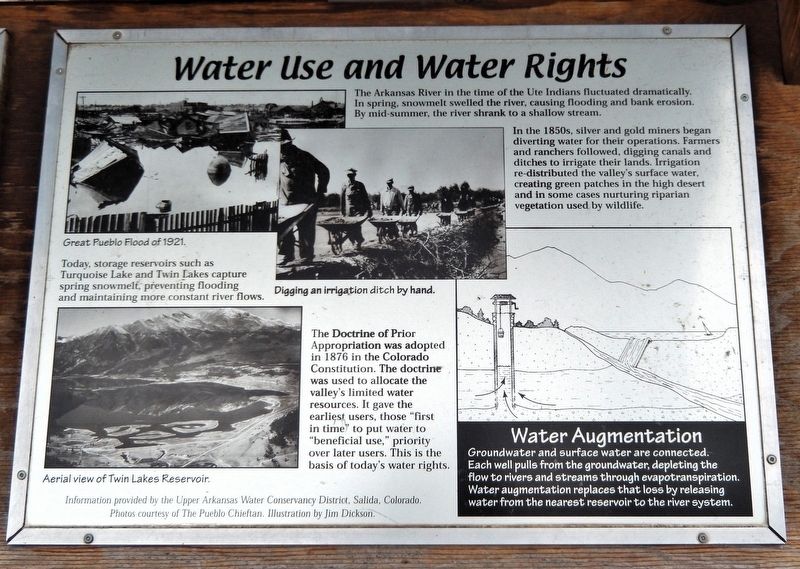
The Arkansas River in the time of the Ute Indians fluctuated dramatically. In spring, snowmelt swelled the river, causing flooding and bank erosion. By mid-summer, the river shrank to a shallow stream.
In the 1850s, silver and gold miners began diverting water for their operations. Farmers and ranchers followed, digging canals and ditches to irrigate their lands. Irrigation re-distributed the valley's surface water, creating green patches in the high desert and in some cases nurturing riparian vegetation used by wildlife.
Today, storage reservoirs such as Turquoise Lake and Twin Lakes capture spring snowmelt, preventing flooding and maintaining more constant river flows.
The Doctrine of Prior Appropriation was adopted in 1876 in the Colorado Constitution. The doctrine was used to allocate the valley's limited water resources. It gave the earliest users, those “first in time” to put water to “beneficial use,” priority over later users. This is the basis of today's water rights.
Water Augmentation
Groundwater and surface water are connected. Each well pulls from the groundwater, depleting the flow to rivers and streams through
this page online
[photo captions]
• Great Pueblo Flood of 1921.
• Digging an irrigation ditch by hand.
• Aerial view of Twin Lakes Reservoir.
Information provided by the Upper Arkansas Water Conservancy District, Salida, Colorado. Photos courtesy of The Pueblo Chieftan. Illustration by Jim Dickson.
Topics. This historical marker is listed in these topic lists: Agriculture • Industry & Commerce • Waterways & Vessels. A significant historical year for this entry is 1876.
Location. 38° 32.282′ N, 105° 59.487′ W. Marker is in Salida, Colorado, in Chaffee County. It can be reached from the intersection of West Sackett Avenue and G Street, on the right when traveling north. The marker is in the Arkansas River Overlook plaza near the southeast corner of the historic Salida Steam Plant. Touch for map. Marker is at or near this postal address: 220 West Sackett Avenue, Salida CO 81201, United States of America. Touch for directions.

Regionally, this marker is in the Arkansas River Valley, in the Colorado High Rockies and on the
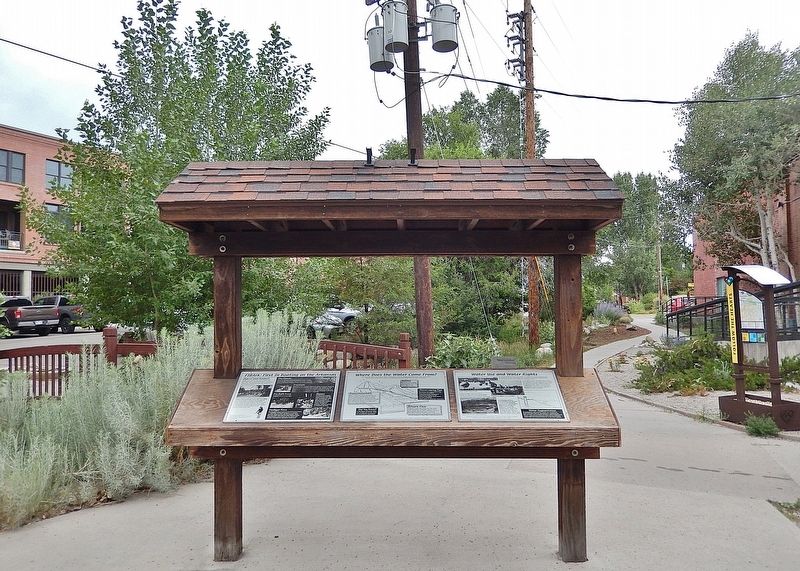
Other nearby markers. At least 8 other markers are within walking distance of this marker: FIBArk: First in Boating on the Arkansas (here, next to this marker); The Salida Steam Plant (within shouting distance of this marker); A Railroad Town (about 600 feet away, measured in a direct line); Heart of the Rockies (about 600 feet away); Old Rails New Trails (about 600 feet away); Chaffee County Honor Roll Board (approx. 0.2 miles away); Chaffee County Courthouse (approx. 0.3 miles away); Votes for Women (approx. 0.4 miles away). Touch for a list and map of all markers in Salida.
Also see . . . Prior-appropriation Water Rights (Wikipedia).
Excerpt: In the American legal system, prior appropriation water rights is the doctrine that the first person to take a quantity of water from a water source for "beneficial use" (agricultural, industrial or household) has the right to continue to use that quantity of water for that purpose. Subsequent users can take the remaining water for their own use if they do not impinge on the rights of previous users. The doctrine is sometimes summarized, "first in time, first in right". The prior appropriation doctrine developed in the Western United States from Spanish (and later Mexican) civil law and differs from the riparian water rights that apply in the rest of the United States. The appropriation doctrine originated in Gold-Rush–era California, when miners sought to acquire water for mining operations.(Submitted on February 13, 2026, by Cosmos Mariner of Cape Canaveral, Florida.)The appropriation doctrine was adopted in Colorado in 1872 when the territorial court ruled in Yunker v. Nichols, that a non-riparian user who had previously applied part of the water from a stream to beneficial use had superior rights to the water with respect to a riparian owner who claimed a right to use of all the water at a later time. The question was not squarely presented again to the Colorado Court until 1882 when in the landmark case, Coffin v. Left Hand Ditch Co., the court explicitly adopted the appropriation doctrine and rejected the riparian doctrine, citing Colorado irrigation and mining practices and the nature of the climate. The decision in Coffin ruled that prior to adoption of the appropriation doctrine in the Colorado Constitution of 1876 that the riparian doctrine had never been the law in Colorado. Within 20 years the appropriation doctrine, the so-called Colorado Doctrine, had been adopted, in whole or part, by most of the states in the Western United States that had an arid climate.
Credits. This page was last revised on February 13, 2026. It was originally submitted on February 11, 2026, by Cosmos Mariner of Cape Canaveral, Florida. This page has been viewed 76 times since then. Photos: 1, 2. submitted on February 13, 2026, by Cosmos Mariner of Cape Canaveral, Florida.
