Grinnell in Poweshiek County, Iowa — The American Midwest (Upper Plains)
Grinnell College

Photographed by Cosmos Mariner, September 19, 2025
1. Grinnell College Marker
What we know as Grinnell College was founded in 1846 in Davenport, Iowa, and called Iowa College. The school was the dream of 11 young Congregational ministers from Andover Theological Seminary in Massachusetts. Each of them pledged to establish a church somewhere in Iowa and then to collaborate on a college. The 11 were known as the “Iowa Band.”
Iowa College officially opened its doors in Davenport in 1848 and accepted its first students in 1850. Conflicts with the city of Davenport soon arose, however, and J.B. Grinnell managed (with the help of financial incentives) to lure the college to Grinnell to merge with his Grinnell University. The first classes were held in Grinnell in 1861.
When the Civil War broke out that same year, almost all male students and many male faculty members volunteered to serve. Most of them would give their lives for the cause. To increase enrollment during the war, the trustees initiated a three-year women's program. Joanna Harris Haines was the first graduate of the Ladies' Course, as well as the first female to graduate from a college west of the Mississippi River.
A cyclone in 1882 destroyed
this page online
The curriculum was soon expanded to include such subjects as political science and modern languages. The political science department was one of the first in the country. In the late 1800s, the college became the center of the Social Gospel reform movement. The first intercollegiate football and baseball games west of the Mississippi River were played in Grinnell.
In 1906, the college began the transformation to the residential campus we know today. Up until that time, out-of-town students were lodged in spare bedrooms in the community. Mears Cottage and the South Campus dorms for women were built between 1914 and 1916. The North Campus dorms for men were built between 1916 and 1919.
[photo captions]
• Porch of Blair Hall
• Blair Hall
• Goodnow Hall
Topics. This historical marker is listed in these topic lists: Education • Sports • War, US Civil • Women. A significant historical year for this entry is 1846.
Location. 41° 44.529′ N,
Photographed by Cosmos Mariner, September 19, 2025
2. Grinnell College Marker
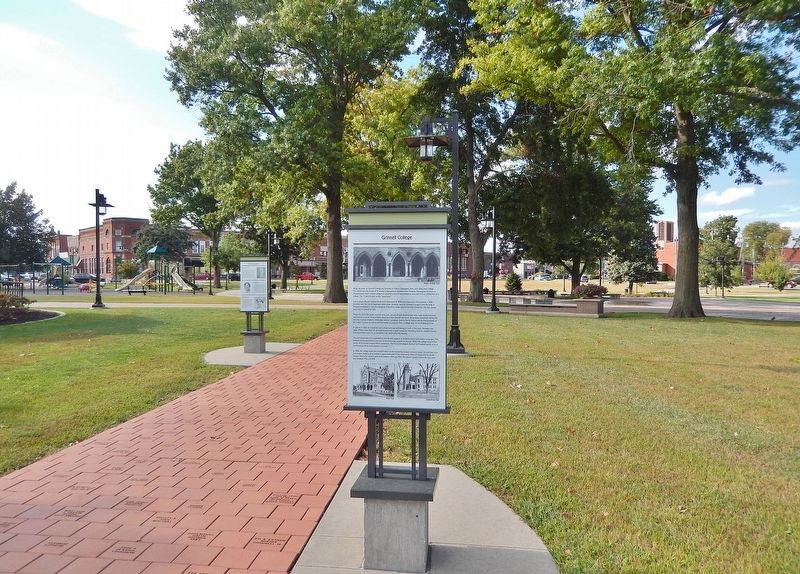
Looking northwest through Central Park.

Regionally, this marker is in Eastern Iowa. It is also in the American Midwest and in the Corn Belt. Globally, it is in North America, the Western Hemisphere, the Western World, and the Anglosphere. Historically, it finds itself in what was once the territory of the Mississippian Culture and also the Louisiana Purchase.
Other nearby markers. At least 8 other markers are within walking distance of this marker: First Businesses (here, next to this marker); Notable Grinnellians (here, next to this marker); a different marker also named Notable Grinnellians (a few steps from this marker); a different marker also named Notable Grinnellians (a few steps from this marker); Historic Buildings (a few steps from this marker); J. B. Grinnell (a few steps from this marker); Founding of Grinnell (a few steps from this marker); a different marker also named Notable Grinnellians (a few steps from this marker). Touch for a list and map of all markers in Grinnell.
Also see . . . Grinnell College (Wikipedia).
Excerpt: The first 25 years of Grinnell's history saw a change in name and location. In Davenport, the college had advocated against slavery and saloons, leading to conflict with the Davenport city council, which retaliated by constructing roads that transected the campus. Iowa College moved farther west from Davenport to the town of Grinnell and unofficially adopted the name of its new home, which itself had been named for the abolitionist minister Josiah Bushnell Grinnell. The name of the corporation, "The Trustees of Iowa College", remained, but in 1909 the name "Grinnell" was adopted by the trustees for the institution.(Submitted on February 20, 2026, by Cosmos Mariner of Cape Canaveral, Florida.)
In its early years, the college experienced setbacks. Although two students received Bachelor of Arts degrees in 1854 (the first to be granted by a college west of the Mississippi River), within 10 years the Civil War had claimed most of Grinnell's students and professors. In the decade following the war, growth resumed: women were officially admitted as candidates for degrees, and the curriculum was enlarged to include then-new areas of academic studies, such as natural sciences with laboratory work.
Credits. This page was last revised on February 20, 2026. It was originally submitted on February 17, 2026, by Cosmos Mariner of Cape Canaveral, Florida. This page has been viewed 97 times since then. Photos: 1. submitted on February 19, 2026, by Cosmos Mariner of Cape Canaveral, Florida. 2. submitted on February 20, 2026, by Cosmos Mariner of Cape Canaveral, Florida.
