Grinnell in Poweshiek County, Iowa — The American Midwest (Upper Plains)
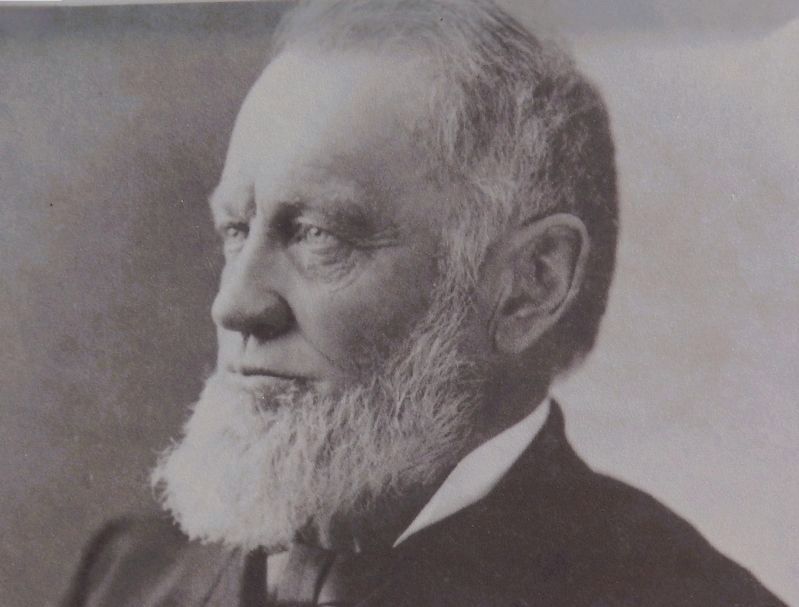
J. B. Grinnell

Photographed by Cosmos Mariner, September 19, 2025
1. J. B. Grinnell Marker
During his lifetime, J.B. Grinnell was a minister, lawyer, sheep farmer, banker, railroad builder, state senator and member of the U.S. Congress. From the beginning, he was driven by opposition to slavery, a passion for education, and a yearning for a moral life.
J.B. had not only the vision but also the ability and energy to persuade others to follow him. He prevailed in most early decision-making (including naming the town and the college after himself). The prohibition of slavery was written into the church constitution and the sale of land stipulated that if liquor were sold on the site, the land would revert back to J.B.
Beyond his contributions to the town and college, J.B. was a tireless promoter of Iowa's needs in his role as a representative in the U.S. Congress from 1863 to 1865 and 1865 to 1867. He championed the rights of the Native Americans of the Meskwaki tribe to purchase land and remain in Iowa. In 1865, J.B. was among those who signed the 13th Amendment to the U.S. Constitution, abolishing slavery in the United States.
Abolitionist Roots
J.B. Grinnell and the other town founders were passionately opposed
this page online
One winter night in 1859, notorious abolitionist John Brown knocked on J.B.'s door. Brown had with him 12 runaway slaves who were seeking shelter on their way to freedom in Canada. J.B. housed Brown and made arrangements for the slaves to sleep in nearby homes. One evening Brown addressed townspeople at a church service, speaking with fervor against slavery. When the travelers left, they took with them donations of clothing, food and the offering of $26.50. The J.B. Grinnell gravesite in Hazelwood Cemetery is a part of the National Park Service Underground Railroad Network to Freedom.
Topics. This historical marker is listed in these topic lists: Abolition & Underground RR • Charity & Public Work • Education • Indigenous Peoples and Communities. A significant historical year for this entry is 1859.
Location. 41° 44.523′ N, 92° 43.367′ W. Marker is in Grinnell, Iowa, in Poweshiek County. It is at the intersection of 3rd Avenue and Park

Photographed by Cosmos Mariner, September 19, 2025
2. J. B. Grinnell Marker
Looking southeast through Central Park.

Regionally, this marker is in Eastern Iowa. It is also in the American Midwest and in the Corn Belt. Globally, it is in North America, the Western Hemisphere, the Western World, and the Anglosphere. Historically, it finds itself in what was once the territory of the Mississippian Culture and also the Louisiana Purchase.
Other nearby markers. At least 8 other markers are within walking distance of this marker: Founding of Grinnell (here, next to this marker); Notable Grinnellians (a few steps from this marker); a different marker also named Notable Grinnellians (a few steps from this marker); a different marker also named Notable Grinnellians (a few steps from this marker); a different marker also named Notable Grinnellians (a few steps from this marker); Grinnell College (a few steps from this marker); First Businesses (a few steps from this marker);
3. Marker detail: J. B. Grinnell
Also see . . .
1. Josiah Bushnell Grinnell (Grinnell College).
Excerpt: Grinnell enlisted the help of Homer Hamlin, a minister; Henry Hamilton, a surveyor; and Dr. Thomas Holyoke to find a location for a new settlement. They looked at different locations in the Midwest, including Minnesota and Missouri, but decided on the divide between the Iowa and Skunk rivers, where the east/west and north/south Rock Island railways were set to cross. On this site, the city of Grinnell was founded. J.B. Grinnell and his three companions commenced building the settlement in 1854 with three temporary log cabins. They began to sell land for $1.62 an acre, and the town quickly grew.(Submitted on February 20, 2026, by Cosmos Mariner of Cape Canaveral, Florida.)
With the founding of the town, Grinnell also founded "Grinnell University," although it was a university only in name. He created a board of trustees and listed all the members of town as professors. No buildings were ever built, nor classes held, but after J.B. Grinnell persuaded Iowa College to move to Grinnell from Davenport,Iowa, all of Grinnell University was signed over to the Trustees of Iowa College. 4. Marker detail: J. B. Grinnell Home
Grinnell went on to serve in Congress, where his abolitionist stance often put his life in danger. After winning re-election twice, he lost a third bid and moved back to Grinnell. He remained there until his death in 1891 from bronchitis and asthma after a trip through Texas into Mexico.
2. Josiah Bushnell Grinnell (Wikipedia).
Excerpt: U.S. Congressman from Iowa's 4th congressional district, an ordained Congregational minister, radical abolitionist, one of the founders of Grinnell, Iowa and benefactor of Grinnell College. After his service in Congress, Grinnell resumed the practice of law. He was also interested in the building of railroads, becoming a director of the Rock Island Railroad, and receiver of the Iowa Central Railroad (later the St. Louis & St. Paul Railroad). He also served as president of the Iowa State Horticultural Society and of the First National Bank in Grinnell.(Submitted on February 20, 2026, by Cosmos Mariner of Cape Canaveral, Florida.)
Credits. This page was last revised on February 20, 2026. It was originally submitted on February 17, 2026, by Cosmos Mariner of Cape Canaveral, Florida. This page has been viewed 91 times since then. Photos: 1, 2, 3, 4. submitted on February 20, 2026, by Cosmos Mariner of Cape Canaveral, Florida.
