Spokane in Spokane County, Washington — The American West (Northwest)
Walter Lawson
Buffalo Soldier, Police Officer
| — | 1862-1917 | — |
Photographed by Rae Anna Victor, December 10, 2024
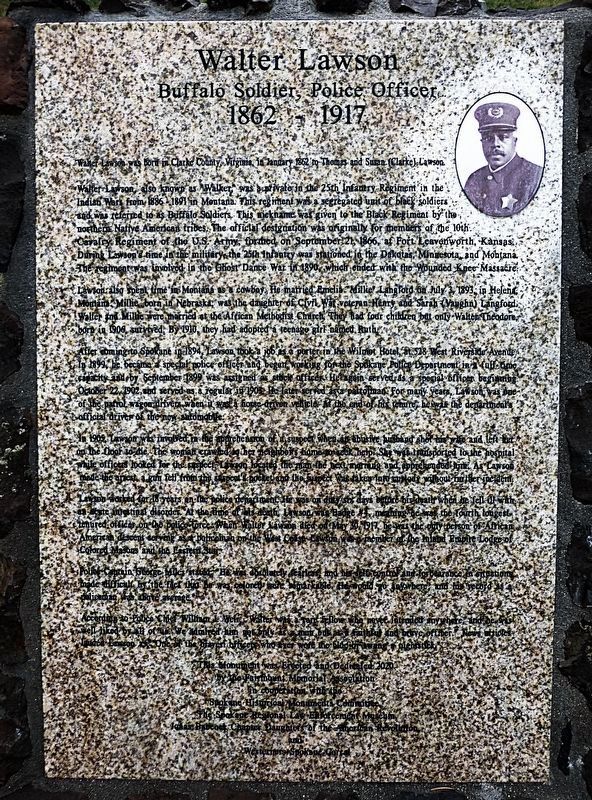
1. Walter Lawson Marker
Walter Lawson, also known as “Walker,” was a private in the 25th Infantry Regiment in the Indian Wars from 1886 – 1891 in Montana. This regiment was a segregated unit of black soldiers and was referred to as Buffalo Soldiers. This nickname was given to the Black Regiment by the northern Native American tribes. The official designation was originally for members of the 10th Cavalry Regiment of the U.S. Army, formed on September 21, 1866, at Fort Leavenworth, Kansas. During Lawson’s time in the military, the 25th Infantry was stationed in the Dakotas, Minnesota, and Montana. The regiment was involved in the Ghost Dance War in 1890, which ended with the Wounded Knee Massacre.
Lawson also spent time in Montana as a cowboy. He married Emelia “Millie” Langford on July 3, 1893, in Helena, Montana. Millie, born in Nebraska, was the daughter of Civil War veteran Henry and Sarah (Vaughn) Langford. Walter and Millie were married at the African Methodist Church. They had four children but only Walter Theodore, born in 1906, survived.
this page online
After coming to Spokane in 1894, Lawson took a job as a porter in the Wilmot Hotel, at 528 West Riverside Avenue. In 1899, he became a special police officer and began working for the Spokane Police Department in a full-time capacity and by September 1899 was assigned as stock officer. He again served as a special officer beginning October 22, 1902 and served as a regular in 1903. He later served as a patrolman. For many years, Lawson was one of the patrol wagon drivers when it was a horse-driven vehicle. At the end of his tenure, he was the department’s official driver of the new automobile.
In 1905, Lawson was involved in the apprehension of a suspect when an abusive husband shot his wife and left her on the floor to die. The woman crawled to her neighbor’s home to seek help. She was transported to the hospital while officers looked for the suspect. Lawson located the man the next morning and apprehended him. As Lawson made the arrest, a gun fell from the suspect’s pocket and the suspect was taken into custody without further incident.
Lawson worked for 18 years on the police
Photographed by Rae Anna Victor, May 20, 2021
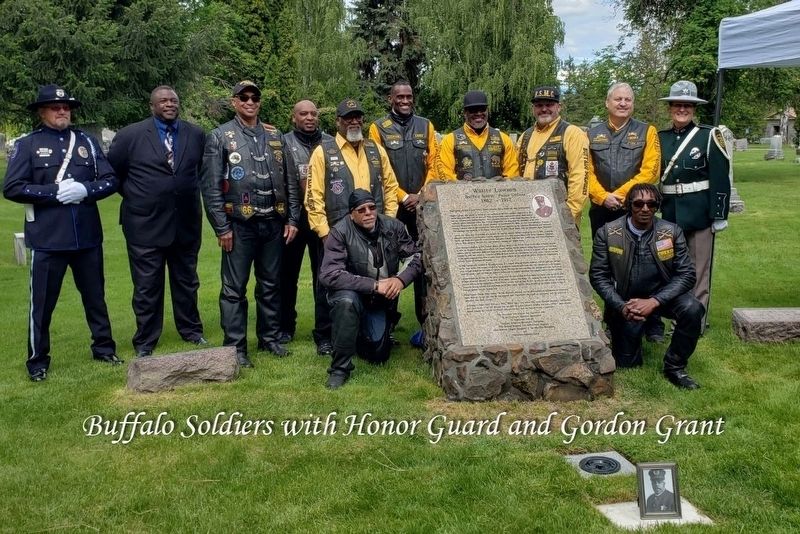
2. Buffalo soldiers with honor guard and Gordon Grant
Police Captain George Miles stated: “He was absolutely fearless, and his self-control and forbearance in situations made difficult by the fact that he was colored were remarkable. He would go anywhere, and his record as a policeman was above average.”
According to Police Chief William J. Weir, “Walter was a rare fellow who never intruded anywhere, and he was well liked by all of us. We admired him not only as a man but as a faithful and brave officer.” News articles lauded Lawson as, “One of the bravest officers who ever wore the blue or swung a nightstick.”
Erected 2020 by the Fairmount Memorial Association in cooperation with the Spokane Historical Monuments Committee, The Spokane Law Enforcement
Photographed by Rae Anna Victor
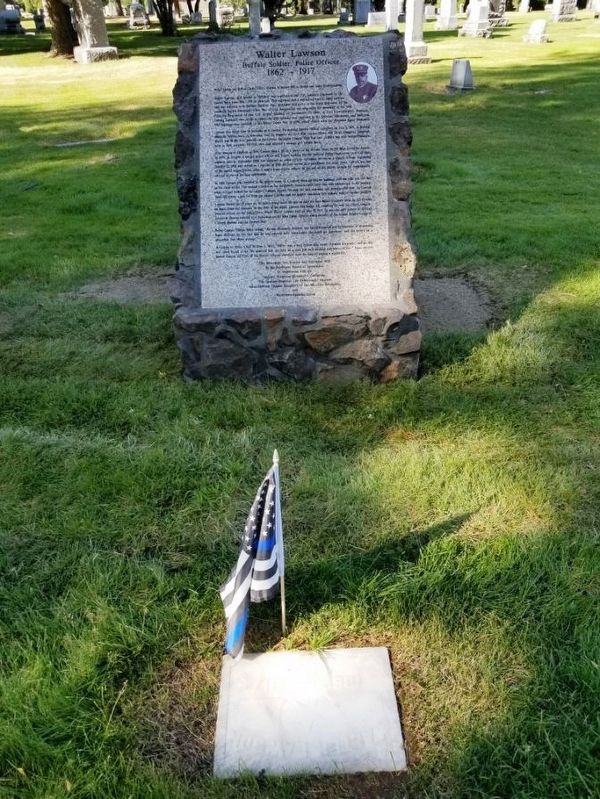
3. Walter Lawson Marker
Topics. This historical marker is listed in these topic lists: African Americans • Law Enforcement • Wars, US Indian. A significant historical year for this entry is 1862.
Location. 47° 39.657′ N, 117° 28.2′ W. Marker is in Spokane, Washington, in Spokane County. It can be reached from Government Way north of West Greenwood Road. Touch for map. Marker is at or near this postal address: 211 N Government Way, Spokane WA 99224, United States of America. Touch for directions.

Regionally, this marker is in the American Mountain West and in the Lewis & Clark Corridor. Globally, it is in North America, on the Pacific Rim, in the Western Hemisphere, in the Western World, and in the Anglosphere.
Other nearby markers. At least 8 other markers are within walking distance of this marker: William Horatio Lewis (within shouting distance of this marker); Seth Thomas Woodard (within shouting distance of this marker); Amos Bradley (about 400 feet away, measured in a direct line); Rebecca Jane “Reba” Hurn (about 500 feet away);
Courtesy of Jonas Babcock Chapter NSDAR, May 20, 2021
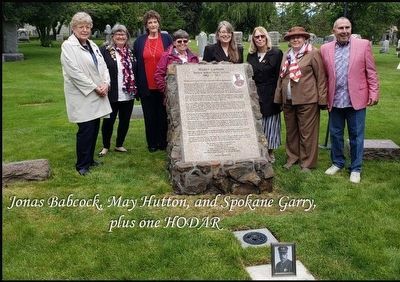
4. Jonas Babcock, May Hutton, Spokane Garry DAR Chapters, & one HODAR (Husband of DAR)
More about this marker. The marker was erected and dedicated in 2020 at Greenwood Memorial Terrace, Lawn 14, Lot 56, Space 43. FindAGrave ID: 142543069.
Credits. This page was last revised on February 25, 2026. It was originally submitted on February 18, 2026, by Shirley A Stirling of Lacey, Washington. This page has been viewed 43 times since then. Photos: 1, 2, 3, 4. submitted on February 18, 2026, by Shirley A Stirling of Lacey, Washington. • James Hulse was the editor who published this page.
