Yonge-Bay Corridor in Toronto, Ontario — Central Canada (North America)
A Community Church
⎯⎯⎯
Une église communautaire
Photographed by Tim Boyd, February 15, 2026
1. A Community Church/Une église communautaire Marker

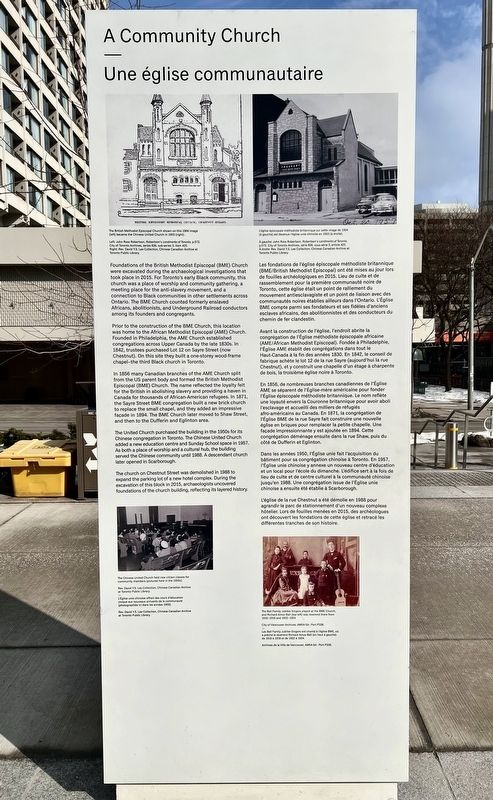
Foundations of the British Methodist Episcopal (BME) Church were excavated during the archaeological investigations that took place in 2015. For Toronto's early Black community, this church was a place of worship and community gathering, a meeting place for the anti-slavery movement, and a connection to Black communities in other settlements across Ontario. The BME Church counted formerly enslaved Africans, abolitionists, and Underground Railroad conductors among its founders and congregants.
Prior to the construction of the BME Church, this location was home to the African Methodist Episcopal (AME) Church. Founded in Philadelphia, the AME Church established congregations across Upper Canada by the late 1830s. In 1842, trustees purchased Lot 12 on Sayre Street (now Chestnut). On this site they built a one-storey wood-frame chapel-the third Black church in Toronto.
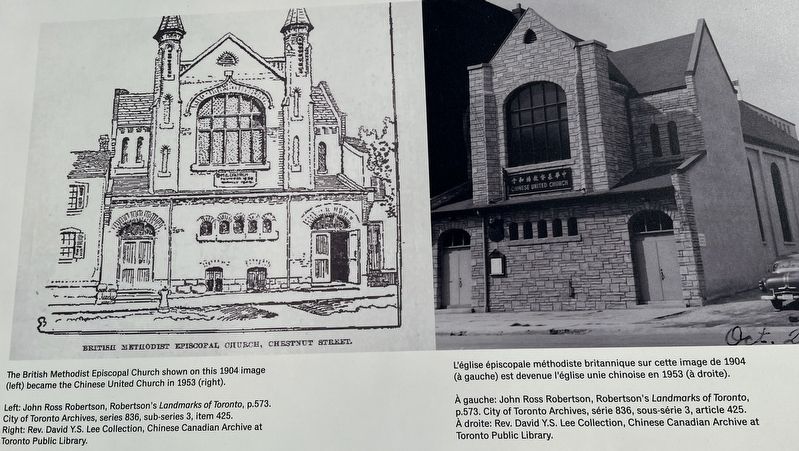
In 1856 many Canadian branches of the AME Church split from the US parent body and formed the British Methodist Episcopal (BME) Church. The name reflected the loyalty felt for the British in abolishing slavery and providing a haven in Canada for thousands of African-American refugees. In 1871, the Sayre Street BME congregation built a new brick church to replace the small chapel, and they added an impressive façade in 1894. The BME Church later moved to Shaw Street, and then to the Dufferin and Eglinton area.
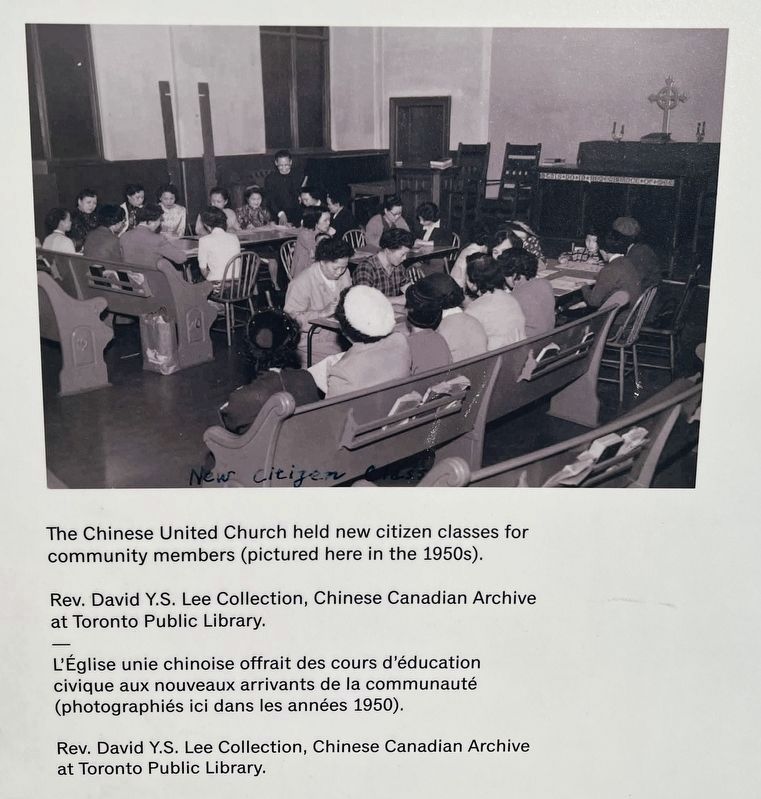
The United Church purchased the building in the 1950s for its Chinese congregation in Toronto. The Chinese United Church added a new education centre and Sunday School space in 1957. As both a place of worship and a cultural hub, the building served the Chinese community until 1988. A descendant church later opened in Scarborough.
The church on Chestnut Street was demolished in 1988 to expand the parking
this page online
Les fondations de l'église épiscopale méthodiste britannique (BME/British Methodist Episcopal) ont été mises au jour lors de fouilles archéologiques en 2015. Lieu de culte et de rassemblement pour la première communauté noire de Toronto, cette église était un point de ralliement du mouvement antiesclavagiste et un point de liaison avec des communautés noires établies ailleurs dans l'Ontario. L'Église BME compte parmi ses fondateurs et ses fidèles d'anciens esclaves africains, des abolitionnistes et des conducteurs du chemin de fer clandestin.
Avant la construction de l'église, l'endroit abrite la congrégation de l'Eglise méthodiste épiscopale africaine (AME/African Methodist Episcopal). Fondée à Philadelphie, l'Église AME établit des congrégations dans tout le Haut-Canada à la fin des années 1830. En 1842, le conseil de fabrique achète le lot 12 de la rue Sayre (aujourd'hui la rue Chestnut), et y construit une chapelle d'un étage à charpente
Photographed by Tim Boyd, February 15, 2026
2. A Community Church/Une église communautaire Marker
Facing northeast
En 1856, de nombreuses branches canadiennes de l'Église AME se séparent de l'Église-mère américaine pour fonder l'Église épiscopale méthodiste britannique. Le nom reflète une loyauté envers la Couronne britannique pour avoir aboli l'esclavage et accueilli des milliers de réfugiés afro-américains au Canada. En 1871, la congrégation de l'Église BME de la rue Sayre fait construire une nouvelle église en briques pour remplacer la petite chapelle. Une façade impressionnante y est ajoutée en 1894. Cette congrégation déménage ensuite dans la rue Shaw, puis du côté de Dufferin et Eglinton.
Dans les années 1950, l'Église unie fait l'acquisition du bâtiment pour sa congrégation chinoise à Toronto. En 1957, l'Église unie chinoise y annexe un nouveau centre d'éducation et un local pour l'école du dimanche. L'édifice sert à la fois de lieu de culte et de centre culturel à la communauté chinoise jusqu'en 1988. Une congrégation issue de l'Église unie chinoise a ensuite été établie à Scarborough.
L'église de la rue Chestnut a été démolie en 1988 pour agrandir le parc de stationnement d'un nouveau
Photographed by Tim Boyd, February 15, 2026
3. A Community Church/Une église communautaire marker photos and captions detail (top)
Topics and series. This historical marker is listed in these topic lists: Abolition & Underground RR • African Americans • Anthropology & Archaeology • Asian Americans • Religion & Religious Structures. In addition, it is included in the African Methodist Episcopal (AME) Church series list. A significant historical year for this entry is 1842.
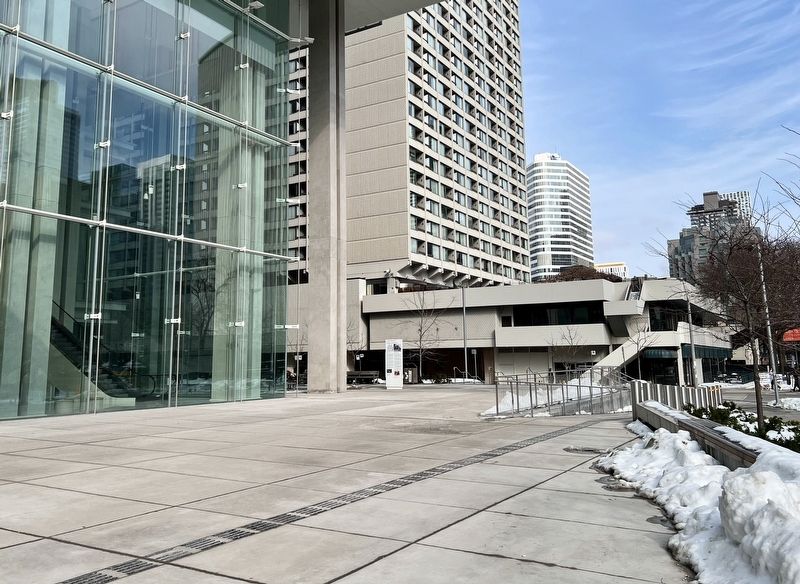
Location. 43° 39.233′ N, 79° 23.137′ W. Marker is in Toronto, Ontario. It is in Yonge-Bay Corridor. It is at the intersection of Armoury Street and Chestnut Street, on the left when traveling east on Armoury Street. Touch for map. Marker is at or near this postal address: 80 Chestnut Street, Toronto ON M5G 1R1, Canada. Touch for directions.

Regionally, this marker is in Greater Toronto and on the Golden Horseshoe. It is also in Central Canada. Globally, it is in North America, on the Great Lakes, in the Western Hemisphere, in the Western World, and in the Anglosphere. Historically, it finds itself
circa 1950s
4. A Community Church/Une église communautaire marker photo and caption detail (bottom left)
Other nearby markers. At least 8 other markers are within walking distance of this marker: Black Life in St. John's Ward / La vie des Noirs dans le St. John's Ward (a few steps from this marker); Toronto’s First Chinatown (within shouting distance of this marker); Winston Churchill (within shouting distance of this marker); a different marker also named Winston Churchill (within shouting distance of this marker); a different marker also named Winston Churchill (within shouting distance of this marker); a different marker also named Winston Churchill (within shouting distance of this marker); a different marker also named Winston Churchill (within shouting distance of this marker); Immigration, Migration, and Life in The Ward (within shouting distance of this marker). Touch for a list and map of all markers in Toronto.
Also see . . . British Methodist Episcopal Church (Wikipedia).
In 1850, the Fugitive Slave Act was passed in the United States causing some ex-slave AMEC preachers in the United(Submitted on February 19, 2026, by Tim Boyd of Hamilton, Ontario.)Canadas to be fearful of attending conferences in the U.S. Reverend Benjamin Stewart of Chatham, Ontario proposed that the AME churches in the United Canadas separate from the U.S. association and form their own church. At an AME conference the new church was named the British Methodist Episcopal Church in appreciation of finding a safe haven from slavery in British North America. In Philadelphia in 1856, Stewart's proposal was adopted and the new church association was founded.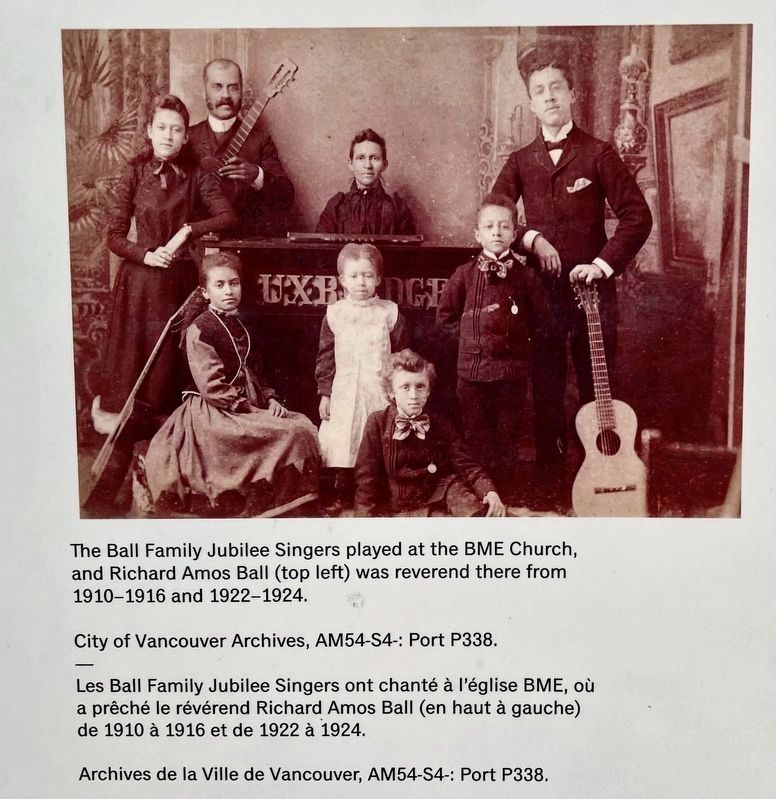 5. A Community Church/Une église communautaire marker photo and caption detail (bottom right)
Credits. This page was last revised on February 24, 2026. It was originally submitted on February 19, 2026, by Tim Boyd of Hamilton, Ontario. This page has been viewed 69 times since then. Photos: 1, 2, 3, 4, 5. submitted on February 19, 2026, by Tim Boyd of Hamilton, Ontario. • Andrew Ruppenstein was the editor who published this page.
