Lyon Park in Arlington in Arlington County, Virginia — The American South (Mid-Atlantic)
Lyon Park History
The Anacostan People
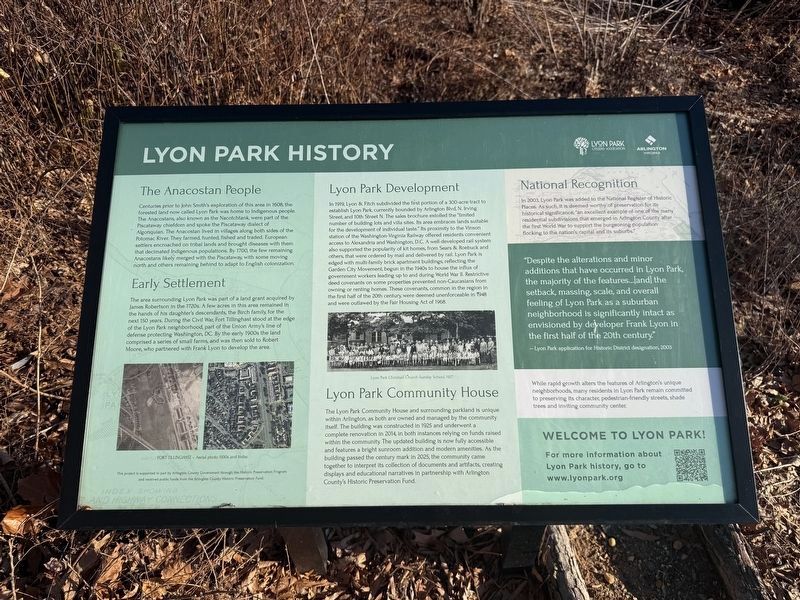
Centuries prior to John Smith's exploration of this area in 1608, the forested land now called Lyon Park was home to Indigenous people. The Anacostans, also known as the Nacotchtank, were part of the Piscataway chiefdom and spoke the Piscataway dialect of Algonquian. The Anacostan lived in villages along both sides of the Potomac River. They farmed, hunted, fished and traded. European settlers encroached on tribal lands and brought diseases with them that decimated Indigenous populations. By 1700, the few remaining Anacostans likely merged with the Piscataway, with some moving north and others remaining behind to adapt to English colonization.
Early Settlement
The area surrounding Lyon Park was a part of a land grant acquired by James Robertson in the 1720s. A few acres in this area ramined in the hands of his daughter's descendants, the Birch family, for the next 150 years. During the Civil War, Fort Tillinghast stood at the edge of the Lyon Park neighborhood, part of the Union Army's line of defense protecting Washington, DC. By the early 1900s the land comprised a series of small farms, and
this page online
Lyon Park Development
In 1919, Lyon & Fitch subdivided the first portion of a 300-acre tract to establish Lyon Park, currently bounded by Arlington Blvd., N. Irving Street, and 10th Street N. The sales brochure extolled the "limited number of building lots and villa sites. Its area embraces lands suitable for the development of individual taste." Its proximity to the Vinson station of the Washington-Virginia Railway offered residents convenient access to Alexandria and Washington, D.C. A well-developed rail system also supported the popularity of kit homes, from Sears & Roebuck and others, that were ordered by mail and delivered by rail. Lyon Park is edged with multi-family brick apartment buildings, reflecting the Garden City Movement, begun in the 1940s to house the influx of government workers leading up to and during World War II. Restrictive deed covenants on some properties prevented non-Caucasians from owning or renting homes. These covenants, common in the region in the first half of the 20th century, were deemed unenforceable in 1948 and were
Lyon Park Community House
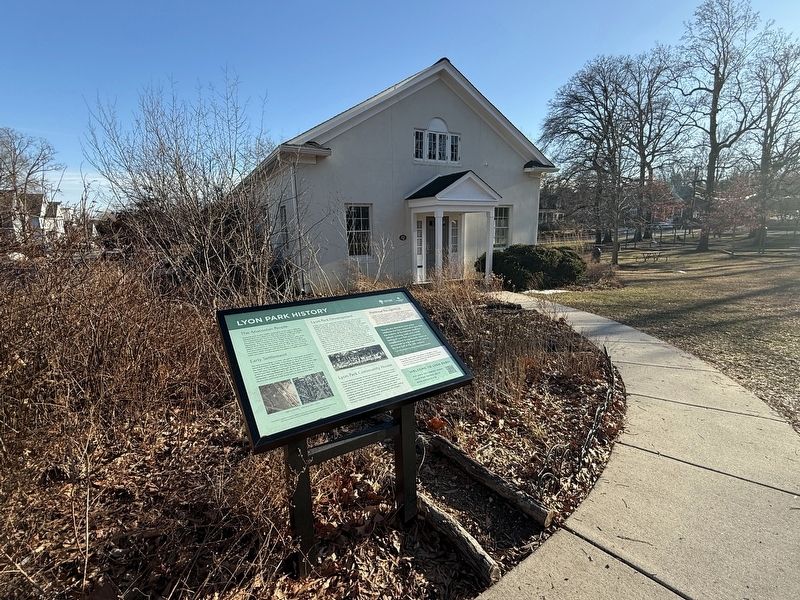
The Lyon Park Community House and surrounding parkland is unique within Arlington, as both are owned and managed by the community itself. The building was constructed in 1925 and underwent a complete renovation in 2014, in both instances relying on funds raised within the community. The updated building is now fully accessible and features a bright sunroom addition and modern amenities. As the building passed the century mark in 2025, the community came together to interpret its collection of documents and artifacts, creating displays and educational narratives in partnership with Arlington County's Historic Preservation Fund.
National Recognition
In 2003, Lyon Park was added to the National Register of Historic Places. As such, it is deemed worthy of preservation for its historical significance, "an excellent example of one of the many residential subdivisions that emerged in Arlington County after the first World War to support the burgeoning population flocking to the nation's capital and its suburbs."
"Despite the alterations and minor additions that have occurred in Lyon Park, the majority of the features…[and] the setback, massing, scale, and overall feeling of Lyon Park as a suburban neighborhood is significantly intact as envisioned by developer Frank Lyon in the first half of the 20th century."
- Lyon Park application for Historic District designation, 2003
While rapid growth alters the features of Arlington's unique neighborhoods, many residents in Lyon Park remain committed to preserving its character, pedestrian-friendly streets, shade trees and inviting community center.
Welcome to Lyon Park!
For more information about Lyon Park history, go to www.lyonpark.org
Erected 2025 by Lyon Park Citizens Association; Arlington County, Virginia.
Topics and series. This historical marker is listed in these topic lists: Indigenous Peoples and Communities • Industry & Commerce • Settlements & Settlers • War, US Civil. In addition, it is included in the Defenses of Washington series list. A significant historical year for this entry is 1608.
Location. 38° 52.762′ N, 77° 5.532′ W. Marker is in Arlington, Virginia, in Arlington County. It is in Lyon Park. It is on North Fillmore Street south of North Pershing Drive, on the right when traveling south. Touch for map. Marker is at or near this postal address: 414 N Fillmore St, Arlington VA 22201, United States of America. Touch for directions.

Regionally, this marker is in the Washington Metropolitan Area and in Northern Virginia. It is also in the American South, specifically in the Upper South, in the Mid-Atlantic, and on the Eastern Seaboard. Globally, it is in the North Atlantic Region, North America, the Western Hemisphere, the Western World, and the Anglosphere. Historically, it finds itself in what was once the territory of the Mississippian Culture, one of the original Thirteen Colonies, one of the Confederate States of America, and the Antebellum South.
Other nearby markers. At least 8 other markers are within walking distance of this marker: Lyon Park Community Center (a few steps from this marker); At the Heart of Lyon Park (within shouting distance of this marker); Rockwell Field (approx. 0.2 miles away); Fort Tillinghast (approx. half a mile away); Orville Wright’s First Virginia Flight (approx. half a mile away); World’s First Public Passenger Flight (approx. half a mile away); Fort Whipple (approx. half a mile away); Arlington Post Office (approx. half a mile away). Touch for a list and map of all markers in Arlington.
Credits. This page was last revised on February 20, 2026. It was originally submitted on February 20, 2026, by Devry Becker Jones of Washington, District of Columbia. This page has been viewed 41 times since then. Photos: 1, 2. submitted on February 20, 2026, by Devry Becker Jones of Washington, District of Columbia.
