Downtown Seattle in King County, Washington — The American West (Northwest)
Memory Wall
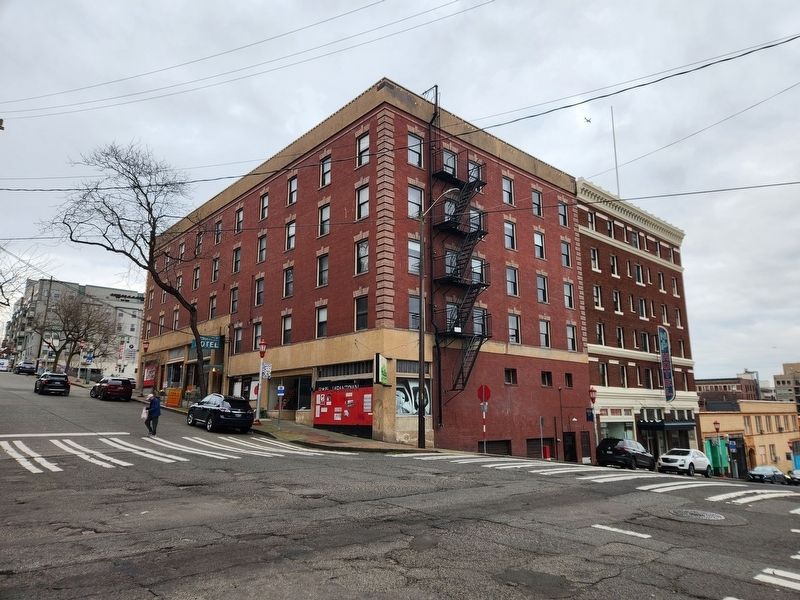
Panama Hotel
| — | National Historic Landmark | — |
Photographed by Douglass Halvorsen, February 19, 2026
1. Panama Hotel Memory Wall Marker
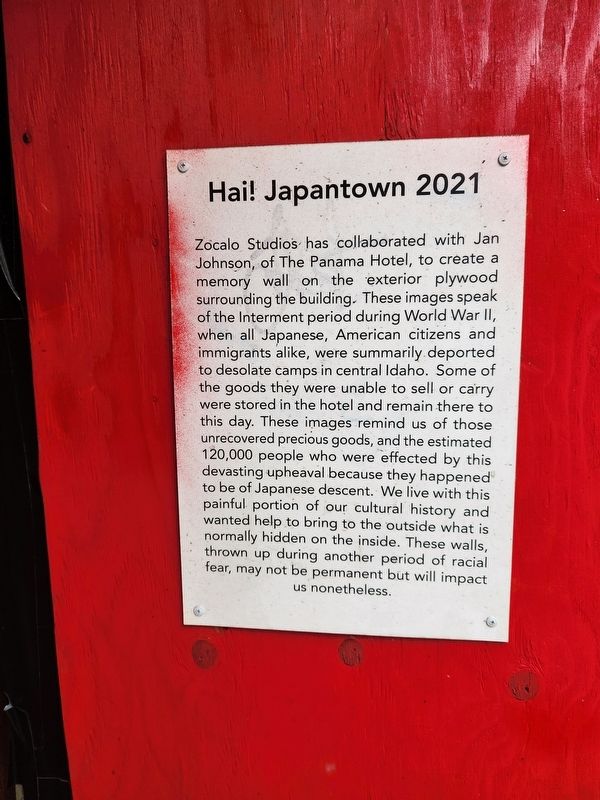
Hai! Japantown 2021
Zocalo Studios has collaborated with Jan Johnson, of the Panama Hotel, to create a memory wall on the exterior plywood surrounding the building. These images speak of the Internment period during World War II, when all Japanese, American citizens and immigrants alike, were summarily deported to desolate camps in central Idaho. Some of the goods they were unable to sell or carry were stored in the hotel and remain there to this day. These images remind us of those unrecovered precious goods, and the estimated 120,000 people who were effected by this devasating upheaval because they happened to be of Japanese descent. We live with this painful portion of our cultural history and wanted help to bring to the outside what is normally hidden on the inside. These walls, thrown up during another period of racial fear, may not be permanent but will impact us nonetheless.
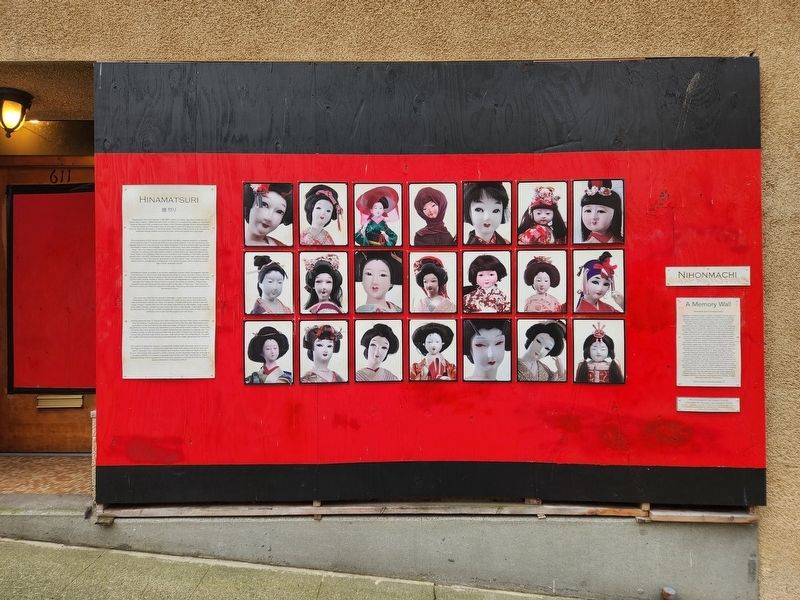
Hinamatsuri
Hinamatsuri, the Doll’s Festival or [Japanese symbols], Momo no Sekku, the Peach Festival, is a special day in Japan. Celebrated each year on March 3, it is one of five Sekku, or important seasonal festivals, held on auspicious
this page online
The centerpiece of this festival is a multi-tiered and fabric-covered platform or hinadan, which exhibits a set of ornamental dolls and decorative objects. They are shrines, bu displays that evoke royal pavilions and called hinakazari. The dolls traditionally represented the seated Emperor and Empress, the ladies of the court, and other attendants in ornate dress. This is no longer a strict requirement and you will see a great variety in modern displays. Furnishings and instruments suited to a royal wedding in the Heian dynastic period (784-1185 AD). The festival itself began to be celebrated this way in the much later Edo period of the 17th Centrury, spreading across the nation. They can vary from simple affairs of only a couple steps to elaborate, multi-tiered displays, which recall the golden age of high Japanese culture.
Photographed by Douglass Halvorsen, February 19, 2026
2. Panama Hotel Memory Wall Marker
Hinamatsuri traces its origins to an ancient Japanese custom called hinanagashi (literally, “doll-floating”) in which straw hina dolls are set afloat in a boat and sent down a river to the sea, supposedly taking troubles or bad spirits with them. The Shimogamo Shrine (part of the Damo Shrine complex in Kyoto) celebrates the Nagashibina by floating these dolls between the Takano and Kamo rivers to pray for the safety of children. People have stopped doing this because they were caught in the nets of fishermen. They now send them out to sea, and when the spectators are gone, they bring the boats and dolls back to the temple to burn.
The customary drink for the festival is shirozake, a sake made from fermented rice. Hina-arare, small colored crackers flavored with sugar or soy sauce, and hishi-mochi, diamond-shaped colored rice cakes, are served. Chirashizushi (sushi rice flavored with sugar, vinegar, topped with raw fish and other ingredients) is often eaten. A salt-based soup call ushiojiru containing clams still in the shell is also served. Clam shells in food are deemed the symbol of a united and peaceful couple, because a pair
Photographed by Douglass Halvorsen, February 20, 2026
3. Panama Hotel Memory Wall Marker
Families generally start to display the dolls in February and take them down immediately after the festival. Traditionally, the dolls were put away the day after Hinamatsuri and superstition holds that leaving the dolls any longer will result in a late marriage for the daughter, but some families may leave them up for the entire month of March. Historically, the dolls were used as toys, but in modern times they are intended for display only. The display of dolls usually discontinues when the girls reach 10 years old. Families normally ensure that girls have a set of the two main dolls before their first Hinamatsuri. The dolls are usually fairly expensive and may be handed down from older generations as heirlooms.
The custom of elaborate displays of masterfully crafted dolls ultimately came to focus on marriage and families. It represented Japanese hopes and values, and as the dolls were said to represent the Imperial Emporer and Empress, it also fostered respect for the throne. The holiday then spread to other countries via the Japanese craftwork and
Photographed by Douglass Halvorsen, February 20, 2026
4. Panama Hotel
Nihonmachi
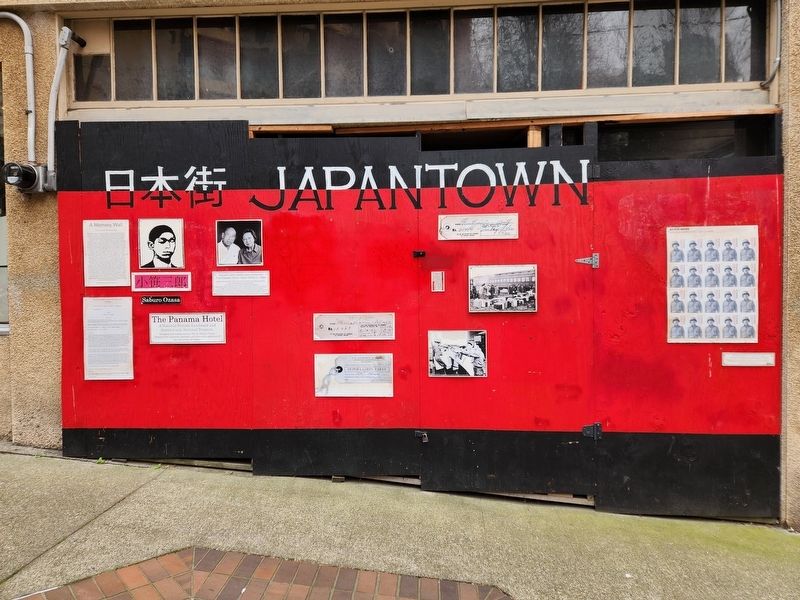
A Memory Wall
Nihonmachi and the Panama Hotel:
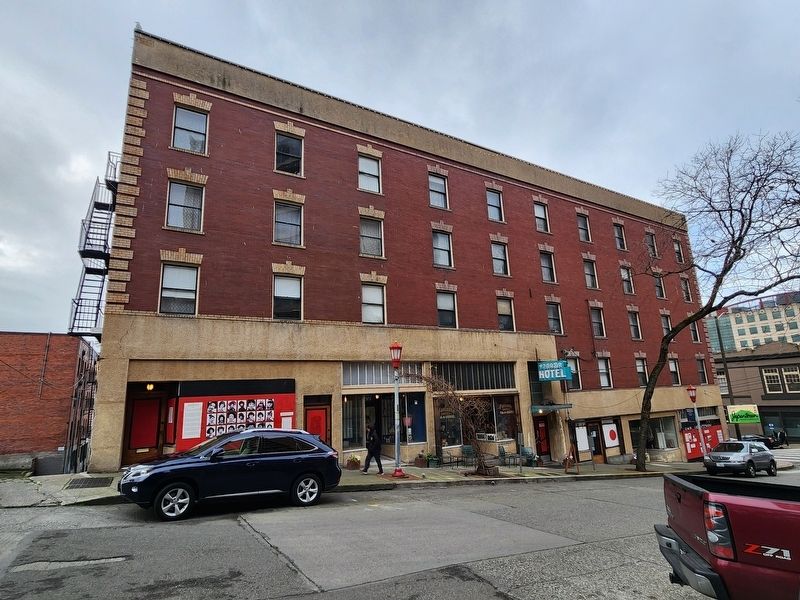
Japanese immigrants began to settle in Seattle in the last part of the 19th century, working in often brutal conditions in lumber, railroads, coal mines, canneries and on farms. Demand for their hard labor grew, as did their numbers, as wives and families followed. The Panama Hotel was built in 1910 by the first Japanese architect in Seattle, Saburo Ozasa. The hotel, designed to house single working men, became an essential focal point of Nihonmachi, the small but thriving zone of Japanese immigrants. These residential zones, which became de facto ghettos when lenders and officialdom restricted access to real estate according to race, had the long term effect of nurturing a large melded community of people carrying forward memories from diverse regional traditions in Japan. There were many services and businesses run by and for the community members. For several generations, Japantown thrived as a cultural focal point, unifying and nurturing its citizens’ strong traditions. The hotel, with its hashidate yu sento
Photographed by Douglass Halvorsen, February 19, 2026
5. Panama Hotel - National Historic Landmark
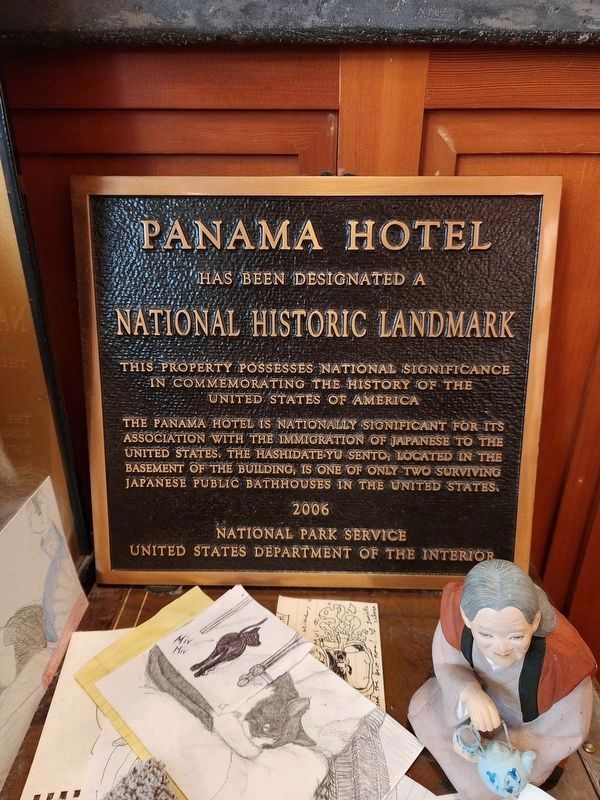
A bronze plaque resides inside the Panama Hotel in front of a cafe counter and reads:
Panama Hotel
Has Been Designated a
National Historic Landmark
This property possesses national significance in commemorating the history of the United States of America
The Panama Hotel is nationally significant for its association with the immigration of Japanese to the United States. The Hashidate-Yu Sento, located in the basement of the building, is one of only two surviving Japanese public bathouses in the United States.
2006
National Park Service
United States Department of the Interior
Has Been Designated a
National Historic Landmark
This property possesses national significance in commemorating the history of the United States of America
The Panama Hotel is nationally significant for its association with the immigration of Japanese to the United States. The Hashidate-Yu Sento, located in the basement of the building, is one of only two surviving Japanese public bathouses in the United States.
2006
National Park Service
United States Department of the Interior
Takashi Hori owned and operated the Panama Hotel from 1936 to 1986. After the war, Mr. Hori continued to run the Panama Hotel and later married Lily Morinaga. They had two children, Susan and Robert. The Hori Family worked and lived in the hotel, until they sold
Photographed by Douglass Halvorsen, February 19, 2026
6. Panama Hotel
The Panama Hotel
A National Historic Landmark and Seattle’s only National Treasure.
Designed and constructed in 1911 by Saburo Ozasa, Seattle’s first Japanese American architect and a graduate of the University of Oregon
Erected 2021 by Zocalo Studios and Jan Johnson of the Panama Hotel.
Topics and series. This memorial is listed in these topic lists: Asian Americans • Immigration • War, World II • Women. In addition, it is included in the National Historic Landmarks series list. A significant historical date for this entry is March 3, 2021.
Location. 47° 35.999′ N, 122° 19.561′ W. Memorial is in Seattle, Washington, in King County. It is in Downtown Seattle. It is on South Main Street east of 6th Avenue South, on the right when traveling east. Touch for map. Memorial is at or near this postal address: 611 South Main St, Seattle WA 98104, United States of America. Touch for directions.

Regionally, this memorial is in Washington’s Puget Sound Region. It is also on the American Pacific Coast, in the Pacific Northwest, and in the Lewis & Clark Corridor. Globally, it is in North America, in the Cascade Range, in the Inside Passage, on the Ring of Fire, on the Pacific Rim, in the Western Hemisphere, in the Western World, and in the Anglosphere.
Other nearby markers. At least 8 other markers are within walking distance of this marker: Japantown (about 300 feet away, measured in a direct line); Chinese American Soldiers Memorial (about 500 feet away); Grand Pavilion (about 500 feet away); Gordon Hirabayashi (about 600 feet away); Seattle Chinatown Gate (about 600 feet away); Vindication, Healing, and the Legacy of Justice (about 700 feet away); Reclaiming our Roots (about 700 feet away); A Community Takes Root (about 700 feet away). Touch for a list and map of all markers in Seattle.
More about this memorial. Two painted wooden panels make up a 'Memory Wall' memorializing Japanese Americans who were sent to internment camps, as well as highlighting Japanese culture. They reside in front of the historic Panama Hotel, a National Historic Landmark and a Seattle National Treasure.
Regarding Memory Wall. There is a cafe inside the Panama Hotel with two rooms where visitors may sit and read a book, catch up on work on a laptop, or browse around and view historic pictures of Japantown and Chinatown hanging on the walls. There is also a glass section in the floor behind the cafe where visitors can see below into the basement. This is where the personal possessions of Japanese Americans sent to internment camps were kept and never reclaimed after World War II.
Also see . . .
1. Panama Hotel & Japanese American Museum of Seattle. <blockquote>The Panama Hotel was built in 1910 by the first Japanese American Architect as a single room occupancy for single Japanese men seeking to work in America.
Today, the Panama Hotel is a historic landmark for Japanese American heritage in the Pacific Northwest where guests can experience the original hotel in Seattle. (Submitted on February 21, 2026, by Douglass Halvorsen of Klamath Falls, Oregon.)
2. Panama Hotel. (Submitted on February 21, 2026, by Douglass Halvorsen of Klamath Falls, Oregon.)
3. The Panama Hotel opens in Seattle's Japantown in the summer of 1910.
In August 1910, the Panama Hotel opens at 605 1/2 S Main Street, in the heart of Seattle's Nihonmachi (Japantown). The builder and designer is Sabro Ozasa, a Japanese American architect and graduate of the University of Oregon. The Panama is a five-story workingman's hotel, with businesses located on the first floor. The businesses include a laundry, a dentist, a tailor, a pool hall, a book store, a florist, and a sushi shop. The upper floors contain single occupant residences. In the basement, there is (and remains to this day) a "sento," a Japanese-style public bathhouse. The Panama Hotel's sento, named the Hashidate-Yu, is the only such bathhouse remaining intact in the United States today (2010).(Submitted on February 21, 2026, by Douglass Halvorsen of Klamath Falls, Oregon.)
Credits. This page was last revised on February 27, 2026. It was originally submitted on February 21, 2026, by Douglass Halvorsen of Klamath Falls, Oregon. This page has been viewed 77 times since then. Photos: 1, 2, 3, 4, 5, 6. submitted on February 21, 2026, by Douglass Halvorsen of Klamath Falls, Oregon. • Devry Becker Jones was the editor who published this page.
