Smithsonian National Zoo in Northwest Washington in Washington, District of Columbia — The American Northeast (Mid-Atlantic)
Flamingo Breeding
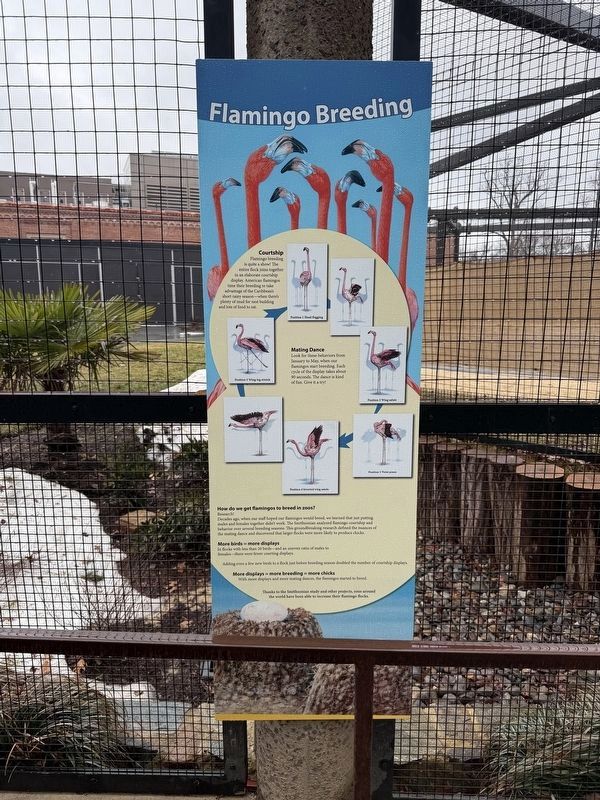
Courtship
Flamingo breeding is quite a show! The entire flock joins together in an elaborate courtship display. American flamingos time their breeding to take advantage of the Caribbean's short rainy season—when there's plenty of mud for nest building and lots of food to eat.
Mating Dance
Look for these behaviors from January to May, when our flamingos start breeding. Each cycle of the display takes about 90 seconds. The dance is kind of fun. Give it a try!
How do we get flamingos to breed in zoos?
Research!
Decades ago, when our staff hoped our flamingos would breed, we learned that just putting males and females together didn't work. The Smithsonian analyzed flamingo courtship and behavior over several breeding seasons. This groundbreaking research defined the nuances of the mating dance and discovered that larger flocks were more likely to produce chicks.
More birds = more displays
In flocks with less than 20 birds—and an uneven ratio of males to females—there were fewer courting displays.
Adding even a few new birds to a flock just before breeding season doubled the number of courtship displays.
More diplays = more breeding = more chicks
With
this page online
Erected by Smithsonian National Zoo.
Topics. This historical marker is listed in these topic lists: Animals • Environment • Science & Medicine.
Location. 38° 55.743′ N, 77° 3.096′ W. Marker is in Northwest Washington in Washington, District of Columbia. It is in Smithsonian National Zoo. It can be reached from Asia Trail Northwest south of Olmsted Walk Northwest, on the right when traveling north. Touch for map. Marker is at or near this postal address: 3001 Connecticut Ave NW, Washington DC 20008, United States of America. Touch for directions.

Regionally, this marker is in the Washington Metropolitan Area. It is also in the American Northeast, in the Upper South, in the Mid-Atlantic, in the Tidewater, and in the Chesapeake Bay Region. Globally, it is in North America, the Western Hemisphere, the Western World, and the Anglosphere.
Other nearby markers. At least
Credits. This page was last revised on February 22, 2026. It was originally submitted on February 22, 2026, by Devry Becker Jones of Washington, District of Columbia. This page has been viewed 32 times since then. Photos: 1, 2. submitted on February 22, 2026, by Devry Becker Jones of Washington, District of Columbia.
