Dupont Circle in Northwest Washington in Washington, District of Columbia — The American Northeast (Mid-Atlantic)
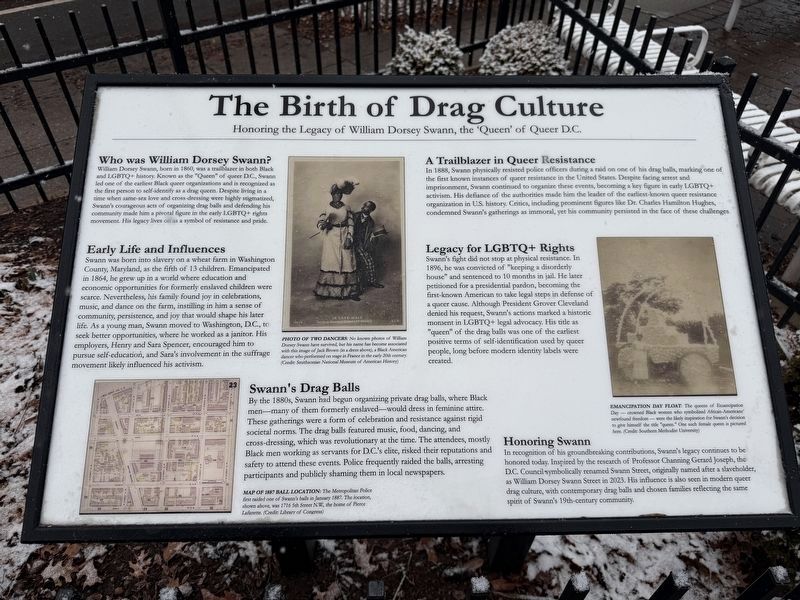
The Birth of Drag Culture
Honoring the Legacy of William Dorsey Swann, the 'Queen' of Queer D.C.
Who was William Dorsey Swann?
William Dorsey Swann, born in 1860, was a trailblazer in Black and LGBTQ+ history. Known as the "Queen" of queer D.C., Swann led one of the earliest Black queer organizations and is recognized as the first person to self-identify as a drag queen. Despite living in a time when same-sex love and cross-dressing were highly stigmatized, Swann's courageous acts of organizing drag balls and defending his community made him a pivotal figure in the early LGBTQ+ rights movement. His legacy lives on as a symbol of resistance and pride.
Early Life and Influences
Swann was born into slavery on a wheat farm in Washington County, Maryland, as the fifth of 13 children. Emancipated in 1864, he grew up in a world where education and economic opportunities for formerly enslaved children were scarce. Nevertheless, his family found joy in celebrations, music, and dance on the farm, instilling in him a sense of community, persistence, and joy that would shape his later life. As a young man, Swann moved to Washington, D.C., to seek better opportunities, where he worked as a janitor. His employers, Henry and
this page online
Swann's Drag Balls
By the 1880s, Swann had begun organizing private drag balls, where Black men—many of them formerly enslaved—would dress in feminine attire. These gatherings were a form of celebration and resistance against rigid societal norms. The drag balls featured music, food, dancing, and cross-dressing, which was revolutionary at the time. The attendees, mostly Black men working as servants for D.C.'s elite, risked their reputations and safety to attend these events. Police frequently raided the balls, arresting participants and publicly shaming them in local papers.
A Trailblazer in Queer Resistance
In 1888, Swann physically resisted police officers during a raid on one of his drag balls, marking one of the first known instances of queer resistance in the United States. Despite facing arrest and imprisonment, Swann continued to organize these events, becoming a key figure in early LGBTQ+ activism. His defiance of the authorities made him the leader of the earliest-known queer resistance
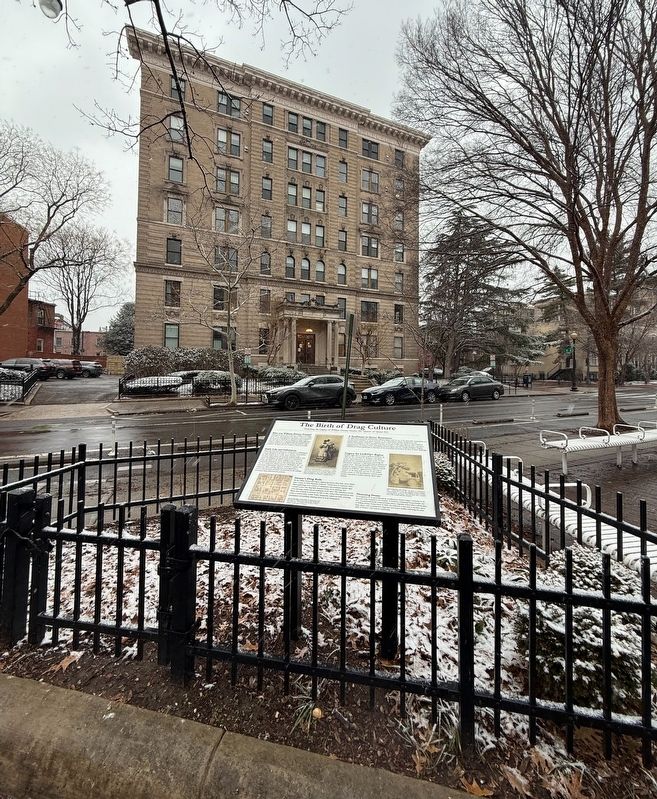
Photographed by Devry Becker Jones (CC0), March 2, 2026
2. The Birth of Drag Culture Marker in T Street Park
Legacy for LGBTQ+ Rights
Swann's fight did not stop at physical resistance. In 1896, he was convicted of "keeping a disorderly house" and sentenced to 10 months in jail. He later petitioned for a presidential pardon, becoming the first-known American to take legal steps in defense of a queer cause. Although President Grover Cleveland denied his request, Swann's actions marked a historic moment in LGBTQ+ legal advocacy. His title as "queen" of the drag balls was one of the earliest positive terms of self-identification used by queer people, long before modern identity labels were created.
Honoring Swann
In recognition of his groundbreaking contributions, Swann's legacy continues to be honored today. Inspired by the research of Professor Channing Gerard Joseph, the D.C. Council symbolically renamed Swann Street, originally named after a slaveholder, as William Dorsey Swann Street in 2023. His influence is also seen in modern queer

courtesy of Library of Congress, January 1, 1896
3. Excerpt from January 1, 1896 issue of the Evening Star
[Captions:]
Photo of two dancers: No known photos of William Dorsey Swann have survived, but his name has become associated with this image of Jack Brown (in a dress above), a Black American dancer who performed on stage in France in the early 20th century. (Credit: Smithsonian National Museum of American History)
Map of 1887 ball location: The Metropolitan Police first raided one of Swann's balls in January 1887. The location, shown above, was 1716 5th Street N.W., the home of Pierce Lafayette. (Credit: Library of Congress)
Emancipation Day Float: The queens of Emancipation Day — crowned Black women who symbolized African-Americans' newfound freedom — were likely the inspiration for Swann's decision to give himself the title "queen." One such female queen is pictured here. (Credit: Southern Methodist University)
Erected 2025 by DC Department of Parks and Recreation (DPR).
Topics and series. This historical marker is listed in these topic lists: African Americans • Civil Rights • Entertainment • Law Enforcement. In addition, it is included in the Former U.S. Presidents: #22 and #24 Grover Cleveland series list. A significant historical month for this entry is January 1887.
Location. 38° 54.913′ N, 77° 2.304′ W. Marker is in Northwest Washington in Washington, District of Columbia. It is in Dupont Circle. It is at the intersection of New Hampshire Avenue Northwest and 17th Street Northwest, on the right when traveling south on New Hampshire Avenue Northwest. The marker stands on the grounds of T Street Park. Touch for map. Marker is in this post office area: Washington DC 20009, United States of America. Touch for directions.

Regionally, this marker is in the Washington Metropolitan Area. It is also in the American Northeast, in the Upper South, in the Mid-Atlantic, in the Tidewater, and in the Chesapeake Bay Region. Globally, it is in North America, the Western Hemisphere, the Western World, and the Anglosphere.
Other nearby markers. At least 8 other markers are within walking distance of this marker: 1700 Swann Street (about 300 feet away, measured in a direct line); At 1740 New Hampshire Ave. (about 400 feet away); Todd Duncan Residence (about 400 feet away); Historic Kappa House (about 500 feet away); Owen D Young Peace Tower (about 600 feet away); Universalist National Memorial Church Stormwater Features (about 600 feet away); The Whyland (about 700 feet away); Strivers' Section (about 700 feet away). Touch for a list and map of all markers in Northwest Washington.
Also see . . . Marker honoring gay former slave installed near Dupont Circle. This September 10, 2025 Washington Blade article written by Lou Chibbaro, Jr. notes that the DC Department of Parks and Recreation (DPR) erected the marker with text produced by Princeton University Professor Channing Joseph. Note that the marker does not include the DPR logo. (Submitted on March 2, 2026, by Devry Becker Jones of Washington, District of Columbia.)
Additional keywords. 🏳️🌈
Credits. This page was last revised on March 2, 2026. It was originally submitted on March 2, 2026, by Devry Becker Jones of Washington, District of Columbia. This page has been viewed 79 times since then. Photos: 1, 2. submitted on March 2, 2026, by Devry Becker Jones of Washington, District of Columbia. 3. submitted on March 2, 2026.
