Sumter in Sumter County, South Carolina — The American South (South Atlantic)
Henry J. Maxwell Farm
Photographed by Mike Stroud, 2010
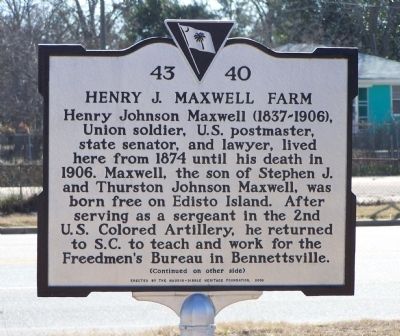
1. Henry J. Maxwell Farm Marker
Henry Johnson Maxwell (1837-1906), Union soldier, U.S. postmaster, state senator, and lawyer, lived here from 1874 until his death in 1906. Maxwell, the son of Stephen J. and Thurston Johnson Maxwell, was born free on Edisto Island. After serving as a sergeant in the 2nd U.S. Colored Artillery, he returned to S.C. to teach and work for the Freedmen’s Bureau in Bennettsville.
(Reverse text)
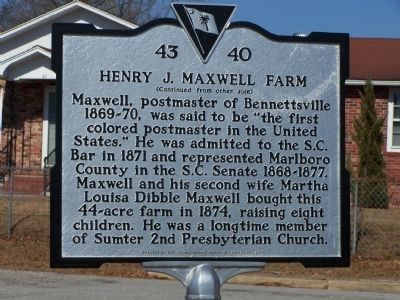
Maxwell, postmaster of Bennettsville 1869-70, was said to be “the first colored postmaster in the United States.” He was admitted to the S.C. Bar in 1871 and represented Marlboro County in the S.C. Senate 1868-1877. Maxwell and his second wife Martha Louisa Dibble Maxwell bought this 44-acre farm in 1874, raising eight children. He was a longtime member of Sumter 2nd Presbyterian Church.
Erected 2008 by The Naudin-Dibble Heritage Foundation. (Marker Number 43-40.)
Topics. This historical marker is listed in these topic lists: African Americans • Agriculture • Communications • War, US Civil. A significant historical year for this entry is 1874.
Location. 33° 53.612′ N, 80° 20.482′ W. Marker is
this page online

Regionally, this marker is in the Pee Dee. It is also in the American South and specifically in the Deep South. Globally, it is in North America, the Western Hemisphere, the Western World, and the Anglosphere. Historically, it finds itself in what was once the territory of the Mississippian Culture, one of the original Thirteen Colonies, one of the Confederate States of America, and the Antebellum South.
Other nearby markers. At least 8 other markers are within 2 miles of this marker, measured as the crow flies: Jehovah Baptist Church (approx. 0.9 miles away); Battle of Dingle's Mill (approx. 1.2 miles away); Potter's Raid (approx. 1.2 miles away); a different marker also named Battle of Dingle's Mill (approx. 1.3 miles away); a different marker also named Battle of Dingles Mill (approx. 1.3 miles away); Site of The Battle of Dingle's Mill
Photographed by Mike Stroud, February 10, 2010
2. Henry J. Maxwell Farm Marker, reverse side
Regarding Henry J. Maxwell Farm. On March 3, 1865, Congress established the Bureau of Refugees, Freedmen, and Abandoned Lands, which was more commonly known as the Freedmen's Bureau. It was to be in service for only one year but, on July 16, 1866, Congress extended the life of the bureau despite the veto by President Andrew Johnson. The bureau's main focus was to provide food and medical care, to help the freedmen to resettle, to ensure justice for the freedmen, to manage abandoned or confiscated property, to regulate labor, and to establish schools. In many cases, it also provided aid for destitute whites.
Also see . . .
1. Henry J. Maxwell. Wikipedia entry (Submitted on April 9, 2025, by Larry Gertner of New York, New York.)
2. Henry Johnson Maxwell. Find A Grave website entry (Submitted on April 9, 2025, by Larry Gertner of New York, New York.)
Additional keywords. USCT
via Find a Grave, unknown
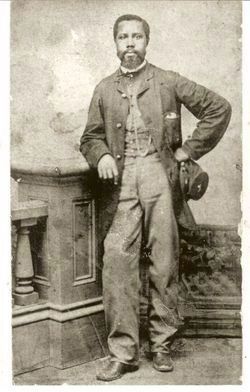
3. Henry J. Maxwell
Photographed by Mike Stroud, February 10, 2010
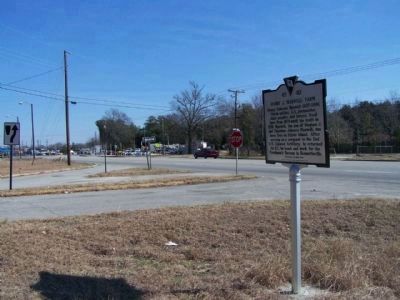
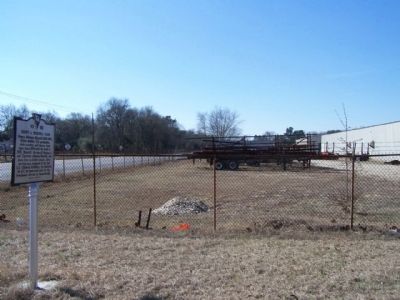
4. Henry J. Maxwell Farm Marker seen at Maxwell Avenue and Pocalla Road (US15) looking north
Photographed by Mike Stroud, February 10, 2010
5. Henry J. Maxwell Farm Marker, looking south along Pocalla Road (US15)
Credits. This page was last revised on April 9, 2025. It was originally submitted on April 4, 2010, by Mike Stroud of Bluffton, South Carolina. This page has been viewed 1,874 times since then and 42 times this year. Photos: 1, 2. submitted on April 4, 2010, by Mike Stroud of Bluffton, South Carolina. 3. submitted on April 9, 2025, by Larry Gertner of New York, New York. 4, 5. submitted on April 4, 2010, by Mike Stroud of Bluffton, South Carolina. • Kevin W. was the editor who published this page.
